OpenAI has introduced GPT-6 Astra, positioning the new ai language model as its most capable system for complex reasoning, coding, computer use, research, and professional workflows. The openai gpt-6 astra rollout is beginning with limited organizations and is set to expand to ChatGPT Plus, Pro, Business, and Enterprise users, as well as developers through the OpenAI API and major cloud platforms. For teams watching openai updates, the release signals a sharper push toward AI systems that can not only answer questions, but also carry out multi-step work across browsers, codebases, documents, and business software.
What changed with the GPT-6 release?
The central change in the gpt-6 release is OpenAI’s claim that Astra combines stronger reasoning with more capable computer use, making it better suited for end-to-end work rather than isolated prompts. OpenAI says GPT-6 Astra is state of the art across computer use, browsing, software engineering, cybersecurity, science, and professional work, while also emphasizing improvements in alignment and task-boundary behavior. In practical terms, that means the model is being aimed at jobs where users need planning, execution, verification, and polished output in one workflow.
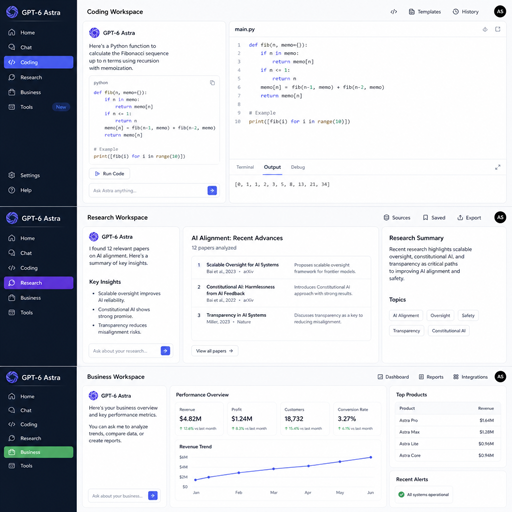
The company describes Astra as a model that can fill out online forms, update CRM records, organize calendars, conduct online research, draft summaries in email or document editors, analyze scientific data, create plots, build websites, and run frontend quality checks. Those examples place the launch squarely in the broader race toward agentic AI: systems that can work across software tools with less step-by-step instruction from the user.
For businesses, the gpt-6 features most likely to matter are not just higher benchmark scores, but workflow continuity. OpenAI says Astra is trained for professional environments, including the creation of documents, presentations, spreadsheets, and analyses that follow existing templates and match a user’s writing or visual style. The model guidance for developers also says Astra is designed to handle multi-step workflows across code, browsers, and professional software.
Availability expands across ChatGPT, API, and cloud platforms
OpenAI says GPT-6 Astra is rolling out first to a limited set of organizations before becoming available over the following days to ChatGPT Plus, Pro, Business, and Enterprise users. The model is also coming to developers through the OpenAI API, Microsoft Azure, and AWS Bedrock. For developers building with OpenAI models, the API model name is gpt-6-astra.
OpenAI’s model documentation lists GPT-6 Astra as the default flagship model for the hardest end-to-end work, with support for complex reasoning, coding, computer use, research, and document creation. The same documentation lists a 1,050,000-token context window, 128,000 maximum output tokens, reasoning-token support, and an April 30, 2026 knowledge cutoff for the model. It also lists support for tools including file search, image generation, code interpreter, hosted shell, apply patch, skills, computer use, MCP, and tool search.
OpenAI says Astra usage is included within existing subscription allowances, with additional credits available for users and businesses that need more usage. Users on Pro, Business, and Enterprise plans are also slated to receive access to GPT-6 Astra Pro, according to the launch announcement.
Key rollout details include:
- ChatGPT access: Planned availability for Plus, Pro, Business, and Enterprise users after the initial limited rollout.
- Developer access: Availability through the OpenAI API under the gpt-6-astra model name.
- Cloud access: Distribution through Microsoft Azure and AWS Bedrock.
- Business positioning: A focus on demanding professional work, including coding, documents, spreadsheets, presentations, browsing, and computer-use workflows.
- Expanded usage path: Existing subscription allowances apply, with optional credits for additional usage where available.
New gpt-6 features focus on computer use and professional output
Astra’s launch is notable because OpenAI is framing the model less as a chatbot upgrade and more as a work-execution system. The company says the model can operate across everyday software tasks, from managing forms and calendars to creating websites and checking whether frontend features work. That matters because many organizations have existing tools that do not always expose clean APIs, leaving employees to move information between apps manually.
OpenAI’s work-focused Astra page says that in ChatGPT Work and Codex, the model can write code and work in the same applications people already use, including applications without APIs. The company argues that this can let businesses apply AI inside existing workflows without first rebuilding their systems around custom integrations. That is a practical framing of the future of AI: less about a separate assistant window, and more about models that can act within the operating environment where work already happens.
The release also gives Codex a new context-handling feature. OpenAI says Astra can preserve and retrieve context when a session’s context window fills, using notes and searchable earlier context windows instead of repeatedly compressing long sessions into a single summary. For developers working through major refactors, debugging sessions, or multi-step builds, that could reduce the chance of losing requirements, failed fixes, or test results as the conversation grows.
Coding, research, and science are major targets
OpenAI describes GPT-6 Astra as its best model for software engineering to date. The company says Astra is intended for agentic coding, codebase understanding, browser testing, and verification-heavy software tasks. It is also being paired with updates to the Codex harness that OpenAI says improve computer-use speed.
The launch announcement places Astra in several technical and scientific contexts, including mathematics, science, software engineering, and cybersecurity. OpenAI says Astra reaches high scores on FrontierMath Tier 4, ARC-AGI-3, and ExploitBench, and it reports stronger results on SRE-Bench than GPT-5.6 Sol. Because those figures come from OpenAI’s own announcement, independent evaluation will still matter as researchers, developers, and enterprise users test how the model performs outside controlled launch materials.
For scientific work, OpenAI says GPT-6 Astra is a major advance in discovery, mathematics, and health, and that it sets new records across a group of math and science evaluations. The practical promise is that a model with stronger reasoning and tool use may help researchers analyze data, generate plots, review literature, and test hypotheses more efficiently. The practical caution is that scientific and medical workflows still require expert oversight, reproducibility checks, and domain-specific validation before results can be trusted.
Safety questions rise alongside capability gains
The Astra announcement also comes with unusually prominent safety language. OpenAI’s safety overview says GPT-6 Astra is the most capable model it has broadly deployed and its first model to reach the Critical level of cybersecurity capability under the company’s Preparedness Framework. OpenAI says that, with the right tools and access, the model could find previously unknown security flaws and develop new exploit paths across well-protected systems without a person guiding every step.
That capability is a major reason the launch is being watched closely. On one side, stronger cyber reasoning could help defenders complete secure code review, patching, vulnerability validation, malware analysis, and detection engineering more quickly. On the other, the same class of capability could be misused if safeguards fail or access controls are weak. OpenAI says the launch version will refuse more advanced cybersecurity tasks such as creating proof-of-concept exploits for vulnerabilities, while expanded defensive workflows are planned through OpenAI Daybreak.
OpenAI also says it strengthened protections around harmful cyber actions and internal deployment, including stricter isolation, checkpoint encryption, monitoring of full trajectories, and blocking alignment evaluations before internal use. For enterprise buyers, developers, and policymakers, those claims will likely become part of the broader discussion around ai advancements: the same technical gains that make models more useful also raise the cost of getting safety, governance, and access rules wrong.
What happens next for teams and developers
In the near term, the most practical step for users is to watch availability inside ChatGPT, Codex, the OpenAI API, Azure, and Bedrock. Developers evaluating the model should compare Astra against existing systems on real internal tasks rather than relying only on headline benchmarks. The highest-value tests will likely be workflows that require planning, tool use, context retention, verification, and final deliverables, because those are the areas OpenAI is emphasizing most strongly.
Teams considering openai gpt-6 astra should also define safety and review policies before widening access. That includes deciding which tasks the model may perform autonomously, when human approval is required, what data can be used, and how outputs will be checked. OpenAI says Astra supports Zero Data Retention for eligible API customers and notes ongoing work around Private Safety Processing, but organizations still need their own governance for sensitive workflows.
The broader significance of GPT-6 Astra is that the frontier of AI is moving from conversation toward execution. If OpenAI’s claims hold up in everyday use, the model could become a benchmark for how advanced AI systems handle complex professional work across software, documents, research, and security. The launch also makes clear that the future of ai will be judged not only by raw intelligence, but by reliability, controllability, and whether users can safely delegate real work to these systems.