Z.ai’s GLM-5.3-Flash is a native multimodal model built for users who want strong agentic, coding, document, and visual reasoning performance without paying flagship-model rates. The release matters because it combines a large 320B-parameter mixture-style footprint with only 18B active parameters, open weights, a long-context design, and official API pricing that sits far below GLM-5.3. This guide explains the GLM-5.3-Flash specs, pricing, performance claims, and practical tradeoffs so builders can decide where it fits.
What is GLM-5.3-Flash?
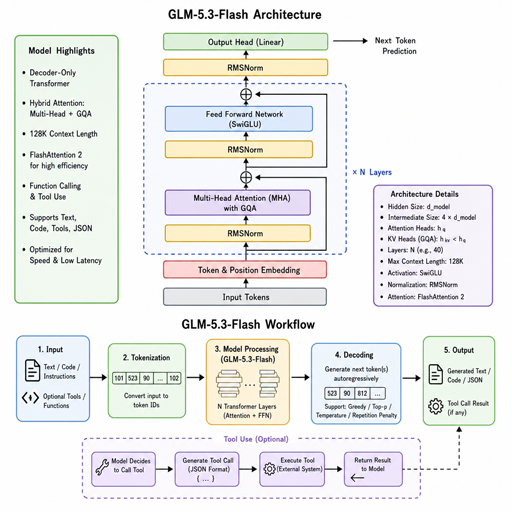
GLM-5.3-Flash is Z.ai’s first natively multimodal model in the GLM-5 family, designed to handle text, images, video, files, and professional workflows from a single model architecture. Z.ai describes it as a new base model rather than a simple speed-tuned variant, with 320B total parameters, 18B active parameters, hybrid sparse and linear attention, and training on a 30T-token multimodal corpus.
The “Flash” label signals the model’s main purpose: reduce inference cost while retaining enough intelligence for complex tasks. Instead of positioning it only as a lightweight chat model, Z.ai is aiming it at agentic workflows, coding, tool use, document processing, visual review, and business automation. That makes the GLM-5.3-Flash release more interesting than a routine low-cost tier, because it tries to compress high-end capability into a much cheaper and more deployable package.
For developers, the most important framing is simple: GLM-5.3-Flash is not only a text model with image support added later. Z.ai says native multimodal training lets the model reason across document structure, charts, layouts, interface states, and operational feedback, which is exactly the kind of mixed input modern agents often need.
The release at a glance
The GLM-5.3-Flash release is best understood as a cost-efficiency move inside the broader GLM-5 lineup. Z.ai’s official materials emphasize lower compute, smaller active-parameter count, and multimodal capability, while the Hugging Face model card confirms public availability, MIT licensing, and deployment instructions for common inference frameworks.
Key GLM-5.3-Flash specs include:
- Model size: 320B total parameters, listed as 321B on Hugging Face model metadata.
- Active parameters: 18B active parameters, which helps explain the lower serving cost.
- Modality: native image-text-to-text support, with Z.ai describing support for text, images, video, and files.
- Architecture: hybrid sparse and linear attention, plus Manifold-Constrained Hyper-Connections.
- Training: Z.ai says the model was trained on a 30T-token multimodal corpus.
- License: MIT, according to Hugging Face.
- Deployment: support is documented for frameworks including vLLM, SGLang, TokenSpeed, Transformers, KTransformers, and Unsloth.
The release also has an unusual backstory. Z.ai says GLM-5.3-Flash was evaluated anonymously before official release as “Ox Alpha” under real-world traffic, and that this traffic was served on Chinese AI accelerators. That detail matters because it suggests the model was not tested only through internal benchmark scripts, though real production results will still depend heavily on prompt design, serving stack, workload type, and latency requirements.
GLM-5.3-Flash performance signals
Z.ai’s published GLM-5.3 performance claims focus on three areas: agentic work, coding/tool use, and multimodal professional tasks. In its comparison against GLM-5.2, Z.ai reports higher results for GLM-5.3-Flash across benchmarks such as Terminal Bench 2.1, DeepSWE v1.1, NL2Repo, Toolathlon Verified, AutomationBench, Agents’ Last Exam, HLE with Tools, and GDPval-AA v2.
Those benchmark categories point to a model built for execution rather than only conversation. Terminal and software-engineering evaluations test whether a model can reason through tasks in an environment. Tool-use and automation benchmarks test whether it can select actions, use external capabilities, and recover when intermediate steps change. Professional-work benchmarks test whether it can operate on business-style materials rather than isolated puzzle prompts.
Z.ai also reports multimodal benchmark results for OfficeQA Pro, CharXiv Reasoning with Tools, Chartography with Tools, BabyVision, MVBench, and MMVU. These are especially relevant for teams considering GLM-5.3-Flash for document intelligence, presentation review, dashboard analysis, chart interpretation, or visual QA workflows.
Still, a careful GLM-5.3-Flash review should avoid treating benchmark claims as a universal verdict. Z.ai itself notes that actual performance can vary with inference settings, tools, execution frameworks, and evaluation environments. In practice, developers should test the model on representative tasks: messy PDFs, long codebases, internal spreadsheets, image-heavy prompts, function-calling chains, and the exact agent harness they plan to use.
Why does the architecture matter?
The architecture matters because inference cost, context handling, and agent reliability are often limited by attention compute and memory pressure, not only raw model intelligence. Z.ai says GLM-5.3-Flash reduces active parameters from 32B to 18B and layers from 92 to 45 compared with the GLM-4.5 series, while its hybrid attention design is meant to reduce long-context serving cost.
Sparse attention and linear attention serve different roles. In Z.ai’s description, linear attention captures local dependencies through state modeling, while sparse attention uses an indexer to retrieve relevant information from the broader context. That combination is meant to help the model stay useful in long-context tasks without paying the full cost of dense attention everywhere.
Z.ai also says GLM-5.3-Flash uses IndexPool at context lengths up to one million tokens, compressing cached key vectors to reduce latency and memory overhead. In its own comparison, the company reports roughly a 3.0× reduction in attention compute and a 4.4× reduction in KV-cache size compared with GLM-5.3. Those figures are central to the model’s value proposition: make long-context and agentic use cases cheaper to serve, not merely cheaper to buy through an API.
For teams building production agents, this can matter more than a small benchmark delta. A model that is slightly less capable but much cheaper to run may be the better default for summarizing files, routing tasks, inspecting UI states, generating first drafts, or executing repeated code-review passes.
GLM-5.3-Flash price and API economics
The official Z.ai pricing page lists GLM-5.3-Flash at $0.15 per 1M input tokens, $0.03 per 1M cached input tokens, and $0.50 per 1M output tokens, with cached input storage marked as limited-time free. On the same official rate card, GLM-5.3 is listed at $1.40 input, $0.26 cached input, and $4.40 output per 1M tokens.
That GLM-5.3-Flash price changes the model’s practical role. Instead of reserving it only for high-value requests, teams can consider it for high-volume workflows where a flagship model would be too expensive: batch document extraction, codebase exploration, support-answer drafting, meeting artifact cleanup, chart interpretation, or agent substeps. The pricing also makes cached-input design important, because repeated context can be much cheaper when cache hits apply.
A sensible cost strategy is to separate tasks by difficulty:
- Use GLM-5.3-Flash first for routine analysis, long-context reading, document inspection, coding drafts, and multimodal review.
- Escalate only hard cases to GLM-5.3 or another premium model when failures are costly or reasoning depth is more important than price.
- Cache stable prompts and source material whenever possible, especially for agents that repeatedly use the same repository, policy set, product documentation, or customer account context.
- Measure output length because output tokens cost more than input tokens, and agent loops can silently become expensive if they generate verbose traces.
This is where the phrase “glm-5 price” can be misleading unless the exact model is specified. GLM-5, GLM-5.1, GLM-5.2, GLM-5.3, and GLM-5.3-Flash have different rates on Z.ai’s official pricing page.
GLM-5.3-Flash comparison with GLM-5.3 and GLM-5.2
The most useful GLM-5.3-Flash comparison is not “best model versus worst model.” It is a workload decision. GLM-5.3-Flash is the cost-efficient, multimodal, open-weight option; GLM-5.3 is the higher-priced flagship tier; GLM-5.2 remains priced like GLM-5.3 on the current Z.ai rate card.
Choose GLM-5.3-Flash when:
- You need native multimodal inputs at a low per-token cost.
- You run many repeated agent steps and need predictable economics.
- You want open weights under an MIT license.
- Your application benefits from long context, file inspection, chart reading, or UI feedback.
- You can tolerate some quality variation and validate outputs with tools, tests, or reviewers.
Choose GLM-5.3 when:
- A marginal quality improvement is worth a much higher API cost.
- You are solving tasks where failure is expensive and every reasoning gain matters.
- You already know from internal evaluations that GLM-5.3 outperforms Flash on your workload.
- You use it as a planner, judge, or final reviewer rather than for every subtask.
Choose GLM-5.2 only when you have a specific compatibility, benchmark, or legacy reason. Z.ai’s own published GLM-5.3-Flash comparison reports Flash outperforming GLM-5.2 across several listed agentic, coding, tool-use, and professional-work benchmarks, while the official pricing page currently lists GLM-5.2 at the same price as GLM-5.3.
How should developers evaluate it?
Developers should evaluate GLM-5.3-Flash with task-specific tests, not only public leaderboards. The model’s strengths are most relevant when prompts include long context, files, images, charts, interfaces, tools, or multi-step execution; a short chat test will miss much of what the release is trying to prove.
A practical GLM-5.3-Flash review checklist should include:
- Representative prompts: Use real documents, real code, real images, and real failure cases.
- Latency measurement: Track time to first token, total completion time, and agent-loop duration.
- Cost tracking: Measure input, cached input, and output tokens separately.
- Tool reliability: Test whether the model calls tools at the right time and recovers from tool errors.
- Visual accuracy: Check charts, layouts, cropped images, UI states, and document structure.
- Long-context recall: Place important facts at different positions in the context and verify retrieval.
- Output discipline: Require concise formats where possible to control output cost.
- Human review: For business-critical use, compare model output against expert review before production rollout.
Hugging Face documents usage paths through Transformers, vLLM, SGLang, Docker Model Runner, and other local-app routes, while Z.ai’s model card notes reasoning-effort controls and chat-template behavior that can affect results. Those details are worth reviewing before benchmark reproduction or production deployment.
Deployment and open-weight implications
Open weights make GLM-5.3-Flash more flexible than API-only models. Teams can experiment with local serving, private infrastructure, quantized variants, custom routing, or provider diversity instead of depending on one hosted endpoint. Hugging Face lists the model with MIT licensing, safetensors, image-text-to-text support, and model size metadata, and the model card points to several supported inference frameworks.
That does not mean deployment is trivial. A 320B-class model is still large, even if only 18B parameters are active per token. Self-hosting requires serious hardware planning, careful quantization choices, memory budgeting, serving optimization, and monitoring. For many teams, the official API or a managed inference provider will be the faster path to evaluation, while self-hosting becomes attractive when privacy, control, throughput, or unit economics justify the engineering work.
The open-weight release also improves model governance. Developers can inspect deployment options, compare providers, test quantizations, and avoid being locked into a single product surface. That flexibility is especially useful for enterprises that want to separate experimentation, staging, and production traffic.
Best-fit use cases
GLM-5.3-Flash looks most compelling where multimodal context, agentic execution, and cost sensitivity overlap. It is less about replacing every flagship model and more about becoming the default worker model for high-volume intelligent tasks.
Strong-fit use cases include:
- Coding agents: repository exploration, patch drafting, terminal tasks, test interpretation, and code review triage.
- Document workflows: PDF review, spreadsheet interpretation, presentation cleanup, and file-to-report generation.
- Visual business analysis: chart reading, dashboard interpretation, layout checking, and interface review.
- Research assistants: organizing public information, distinguishing facts from assumptions, and turning notes into deliverables.
- Automation agents: multi-step workflows where the model must plan, use tools, inspect outputs, and continue.
- Support and operations: summarizing tickets, reviewing screenshots, drafting responses, and extracting structured details.
The caution is that multimodal and agentic workflows need guardrails. The model should be paired with validation layers, tests, deterministic tools, retrieval controls, and clear escalation rules. Flash pricing makes iteration cheaper, but it does not remove the need for quality control.
The bottom line
GLM-5.3-Flash is one of Z.ai’s most important GLM-5 releases because it brings native multimodal capability, open weights, long-context-oriented architecture, and aggressive API pricing into the same package. Its strongest promise is not that it will beat every flagship model on every task, but that it can make advanced agentic and multimodal workflows affordable enough to run at scale.
For builders comparing GLM-5 specs, GLM-5 performance, and GLM-5 price options, GLM-5.3-Flash deserves a hands-on evaluation. Start with your real workload, measure cost and failure modes, compare it against GLM-5.3 only where quality differences matter, and decide whether the savings, open-weight flexibility, and multimodal workflow support justify making it your default production worker model.