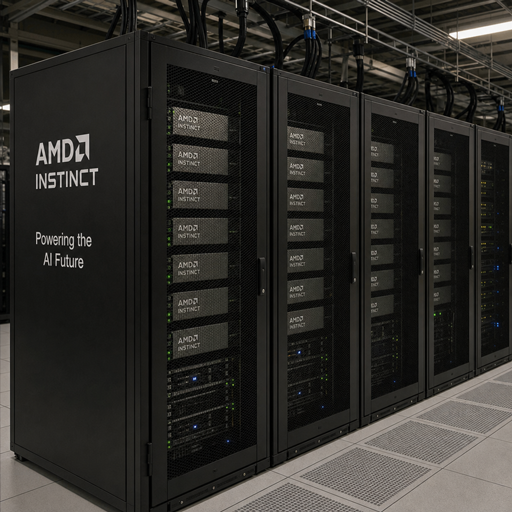
OpenAI and AMD’s multi-billion dollar compute partnership has become one of the most closely watched AI infrastructure deals because it links OpenAI’s long-term compute buildout with AMD’s bid to challenge Nvidia in accelerated computing. Announced on October 6, 2025, the agreement calls for OpenAI to deploy 6 gigawatts of AMD GPUs across multiple generations, starting with 1 gigawatt of AMD Instinct MI450 Series GPUs in the second half of 2026.
The amd openai partnership news also changed the market conversation around AMD’s valuation, analyst price targets, and the competitive map for AI chips. The deal is not simply a purchase order; it includes performance-based warrants that could let OpenAI buy up to 160 million AMD shares if deployment, purchasing, stock-price, and other conditions are met.
What happened in the OpenAI AMD partnership?
OpenAI and AMD signed a multi-year, multi-generation agreement for OpenAI to deploy 6 gigawatts of AMD Instinct GPUs for next-generation AI infrastructure. The first 1 gigawatt deployment is expected to begin in the second half of 2026 using AMD Instinct MI450 Series GPUs, with future deployments extending across later AMD GPU generations.
The agreement positions AMD as a core strategic compute partner for OpenAI, rather than a one-off supplier. OpenAI said the companies will share technical expertise to optimize product roadmaps, building on work that began with MI300X and continued with MI350X. That detail matters because large AI clusters require more than chip shipments; they depend on coordinated work across hardware, software, networking, rack-scale systems, and model workloads.
AMD also issued OpenAI a warrant to purchase up to 160 million shares of AMD common stock at an exercise price of $0.01 per share. According to AMD’s SEC filing, the first tranche vests after delivery of the initial 1 gigawatt of MI450 products, while full vesting requires purchases scaling to 6 gigawatts. Vesting is also subject to AMD stock-price targets that escalate to $600 per share for the final tranche, stock performance thresholds, and additional technical and commercial conditions.
The deal gives AMD strategic validation at AI scale
For AMD, the partnership is a major endorsement of its AI accelerator roadmap. OpenAI is one of the world’s highest-profile buyers of AI compute, so a long-term commitment to AMD GPUs gives the chipmaker a stronger reference point as it competes for hyperscale data center budgets. AMD CFO Jean Hu said the partnership is expected to deliver “tens of billions of dollars in revenue” for AMD while accelerating OpenAI’s AI infrastructure buildout.
That revenue potential is why the amd openai partnership valuation debate quickly moved beyond a normal supply agreement. Investors are not only looking at the first 1 gigawatt; they are trying to estimate what scaled deployments could mean for AMD’s data center segment over several years. S&P Global Market Intelligence reported that AMD shares surged 23.7% on October 6, 2025, closing at $203.70 after the deal was unveiled, and said analysts lifted AMD’s longer-term data center and growth forecasts for 2026 through 2028.
As of September 24, 2026, AMD’s market capitalization was about $1.02 trillion, with shares trading near $614.61 in the data available at that time. That figure helps explain why the warrant structure receives so much attention: if all milestones are met, OpenAI’s potential equity exposure could become meaningful, while AMD shareholders are weighing future revenue visibility against dilution risk.
Key terms investors and customers are watching
The openai amd partnership has several moving parts, and each one affects how the market interprets the deal. The most important terms are not just headline size, but timing, conditionality, and how much of the agreement converts into deployed, revenue-generating infrastructure.
- Scale: OpenAI plans to deploy 6 gigawatts of AMD GPUs across multiple generations, a very large AI infrastructure commitment by industry standards.
- Starting point: The initial 1 gigawatt deployment is set to use AMD Instinct MI450 Series GPUs and begin in the second half of 2026.
- Equity alignment: AMD issued OpenAI warrants for up to 160 million shares, with vesting linked to GPU purchase milestones and other conditions.
- Stock-price hurdles: AMD disclosed that warrant vesting is further subject to company stock-price targets, with the final tranche tied to a $600 per-share target and stock performance thresholds.
- Accounting status: AMD later stated in its February 2026 annual filing amendment that none of the warrant shares had met vesting or exercise conditions and that the warrant had no impact on its 2025 financial statements.
- Strategic goal: OpenAI gains another path to large-scale compute, while AMD gains a marquee AI customer and a stronger platform for future hyperscale adoption.
These terms show why the deal is powerful but still conditional. It gives AMD greater visibility, yet much of the ultimate value depends on execution, product readiness, power availability, deployment schedules, and whether OpenAI or authorized purchasers scale all the way to 6 gigawatts.
Price targets moved because analysts saw a new revenue runway
Search interest around “amd openai partnership price target” and “amd openai partnership price target increase” reflects the speed of analyst reaction. Piper Sandler raised its AMD target to $240 from $190 while keeping an Overweight rating, citing the 6-gigawatt agreement and the potential for broader adoption of AMD Instinct accelerators among OpenAI and cloud partners.
Evercore ISI also raised its AMD target to $240, from $188, and maintained an Outperform rating. Its analysis framed the OpenAI deal as a technology endorsement and said the partnership could add more than $2 to AMD’s 2027 earnings per share estimate and more than $4 to its 2028 estimate. Investing.com also reported that Jefferies raised its AMD price target to $300 after upgrading the stock from Hold to Buy, while UBS and Stifel lifted their targets as well.
Those price target increases do not mean the upside is guaranteed. They reflect analyst models that must make assumptions about shipment timing, margins, deployment scale, capital intensity, competitive pricing, and follow-on customer demand. Still, the reason the price target conversation changed so quickly is straightforward: OpenAI gave AMD a visible, high-profile path to AI GPU revenue that many investors had been waiting to see.
Nvidia implications: competition, not immediate displacement
The nvidia openai amd partnership implications are best understood as diversification rather than replacement. OpenAI and Nvidia announced a separate strategic partnership on September 22, 2025, involving a letter of intent to deploy at least 10 gigawatts of Nvidia systems for OpenAI’s next-generation AI infrastructure, with Nvidia intending to invest up to $100 billion in OpenAI progressively as each gigawatt is deployed.
That means AMD’s agreement does not automatically push Nvidia out of OpenAI’s infrastructure plans. Instead, OpenAI appears to be building a multi-supplier compute strategy at a time when frontier AI workloads require enormous capacity, power, and system-level coordination. Reuters, via Investing.com, reported that the AMD deal did not change OpenAI’s ongoing compute plans, including its Microsoft partnership.
For Nvidia, the implication is that even dominant suppliers can face pressure when customers need more capacity, negotiating leverage, and architectural diversity. For AMD, the implication is more positive: a major OpenAI deployment could reduce skepticism about AMD’s ability to compete in large AI training and inference environments. However, Nvidia remains far larger in AI accelerators, and AMD still has to prove that its hardware, software ecosystem, and rack-scale execution can perform at the scale OpenAI requires.
The valuation debate now turns on execution
The amd openai partnership valuation question is not just “How big is the deal?” It is “How much of the deal becomes shipped capacity, recognized revenue, durable margins, and repeat demand?” That distinction matters because AI infrastructure announcements often span years, depend on supply chains and power availability, and may involve complex financing or customer arrangements.
AMD’s own filings highlight that the warrant terms are milestone-based rather than immediately vested. The 2025 annual filing amendment stated that no warrant shares had met vesting or exercise conditions during the year ended December 27, 2025. That does not weaken the strategic importance of the agreement, but it does clarify that the financial impact comes later and depends on meeting the stated conditions.
Investors are also weighing dilution against demand visibility. If OpenAI ultimately earns the right to exercise a large portion of the warrants, it would likely mean AMD has delivered significant GPU capacity and met demanding stock-performance thresholds. In other words, dilution risk is tied to a scenario in which the commercial partnership has likely scaled.
What happens next
The next major milestone is the planned start of the first 1 gigawatt deployment in the second half of 2026. Investors, customers, and competitors will watch whether MI450 systems ship on schedule, whether OpenAI ramps smoothly, and whether AMD can turn this reference win into broader cloud and enterprise AI adoption.
Several signals will shape future amd openai partnership news:
- updates on MI450 availability, performance, and rack-scale deployment;
- AMD data center revenue guidance for 2026 and 2027;
- any disclosure about OpenAI-related purchase milestones;
- progress toward the warrant vesting conditions;
- follow-on AI infrastructure deals with other hyperscalers;
- commentary from Nvidia, cloud providers, and analysts on competitive share shifts.
For now, the partnership is a defining moment in AMD’s AI strategy and a sign that OpenAI wants more than one route to massive compute capacity. The deal gives AMD credibility, gives OpenAI supply optionality, and gives the market a new framework for judging AI infrastructure winners. The hard part begins with execution: turning a headline-grabbing 6-gigawatt commitment into deployed systems, recognized revenue, and sustained performance in the most competitive segment of the semiconductor market.