The Agentic AI Foundation has brought MCP certifications into the spotlight with the Model Context Protocol Associate, or MCPA, a vendor-neutral credential for people building and governing agentic AI systems. The certification gives developers, platform teams, and AI governance professionals a clearer way to demonstrate practical understanding of MCP architecture, implementation, security, and real-world use. It also arrives at a moment when “MCP” can mean two very different things: the modern Model Context Protocol in AI, and the older Microsoft Certified Professional acronym many IT learners still search for.
What does the new MCP certification actually validate?
The new MCPA validates foundational knowledge of the Model Context Protocol: how MCP components fit together, how messages and tool interactions work, and how teams should think about trust boundaries, permissions, risk, and governance when agents connect to external systems. The Linux Foundation announced the certification on September 14, 2026, describing it as the first official certification for MCP and the first certification launched by the Agentic AI Foundation.
That matters because MCP is not just another library to memorize. It is an integration layer for agentic systems, where AI applications need safe, consistent access to tools, data sources, and services. When an agent can call a tool, retrieve information, or trigger a workflow, the technical design has business and security consequences. A credential focused on those mechanics can help teams separate surface-level familiarity from working knowledge.
The MCPA marks a practical step for agentic AI skills
The Agentic AI Foundation positions the MCPA as a foundational, vendor-neutral credential aligned with emerging AI engineering, platform engineering, and AI governance roles. According to the foundation, the exam is built around MCP concepts, architecture, implementation considerations, and responsible application across agentic deployments.
For hiring managers and technical leads, that creates a shared vocabulary. Instead of asking whether a candidate has “worked with agents,” teams can look for evidence that the person understands MCP hosts, clients, servers, tools, resources, prompts, message flow, interaction lifecycles, and security controls. For practitioners, it offers a structured way to turn hands-on experimentation into a recognizable signal.
This is also where many searches for an mcp certifications list may become confusing. Historically, MCP often meant Microsoft Certified Professional. In the new agentic AI context, MCP refers to the Model Context Protocol. The MCPA is not a Microsoft certification, and it should not be confused with legacy Microsoft Certified Professional credentials or Microsoft’s current role-based certification programs.
What is on the MCPA exam?
The MCPA exam covers five domains: MCP Fundamentals, Architecture & Components, Interactions & Execution, Security & Governance, and Use Cases & Ecosystem. The Linux Foundation describes it as a 120-minute, online, proctored, multiple-choice exam, with domain weightings that place the largest emphasis on Interactions & Execution and Security & Governance.
A practical study plan should therefore go beyond reading definitions. Candidates should be able to explain how an MCP interaction moves through components, what can go wrong, and how to design the integration responsibly. The goal is not simply to name the parts of the protocol, but to reason through how the parts behave when an agent connects to real systems.
Key areas to understand include:
- Core protocol purpose: Why MCP exists, what interoperability problem it addresses, and how it supports agentic AI applications.
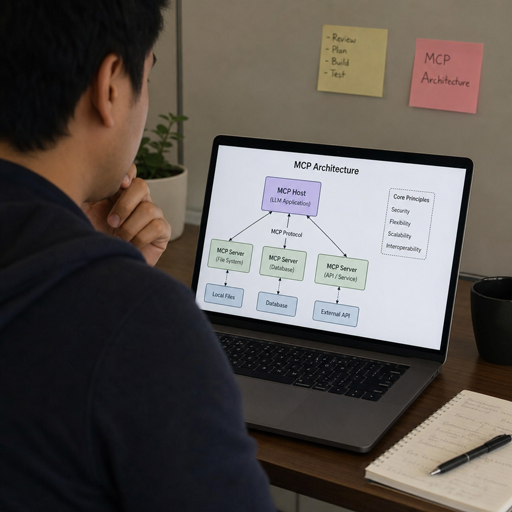
- Architecture and components: The roles of hosts, clients, servers, tools, resources, prompts, schemas, and structured data.
- Execution flow: How requests, responses, tool calls, errors, and protocol primitives move through an interaction lifecycle.
- Security and governance: How permissions, consent, trust boundaries, auditability, observability, and risk controls shape production use.
- Ecosystem use cases: How MCP can support assistants, enterprise AI platforms, developer tools, and portable integrations.
The foundation says there are no formal prerequisites, though it recommends familiarity with JSON-RPC or similar message-based protocols, LLM APIs, agentic patterns, and basic security concepts such as API keys, OAuth 2.1, and token handling.
MCP training courses should focus on implementation, not memorization
Good mcp training courses should help learners build a mental model of the protocol before drilling exam objectives. That means working through component roles, request flows, and failure scenarios in a way that mirrors real engineering decisions. A course that only lists terminology may help with recognition, but it will not prepare someone to reason about security, governance, or production tradeoffs.
When evaluating training, look for coverage that maps to the exam domains while still remaining hands-on. Learners should practice tracing an interaction, identifying where permissions matter, and explaining why an agent should or should not be allowed to call a given tool. They should also understand how MCP fits into a broader AI stack rather than treating it as a standalone buzzword.
A useful preparation path might look like this:
- Start with the specification mindset. Learn what MCP standardizes and what responsibilities remain with the application, infrastructure, and governance teams.
- Map the components. Draw the host, client, server, tool, resource, and prompt relationships until you can explain them without notes.
- Trace execution. Follow a tool invocation from request to response, including error handling and permission checks.
- Study security scenarios. Ask what happens when an agent accesses sensitive data, modifies records, or connects to external systems.
- Review ecosystem examples. Look at how MCP supports portability across tools and platforms without assuming every deployment is identical.
This approach keeps exam preparation grounded in day-to-day engineering judgment. It also helps teams decide whether a certification candidate can contribute to architecture discussions, not just pass a multiple-choice test.
How does this compare with the Microsoft certification path?
The MCPA and the Microsoft certification path serve different purposes. The MCPA is a vendor-neutral Model Context Protocol credential administered through the Linux Foundation ecosystem, while Microsoft certifications are tied to Microsoft technologies, job roles, exams, and Microsoft Learn training paths. Microsoft’s own certification process overview frames certification as a way to demonstrate real-world skills and prepare through Microsoft Learn resources, exams, and renewal requirements.
This distinction is important because many learners search for “microsoft certifications mcp” or “microsoft certified professional” when they see the letters MCP. In Microsoft’s historical context, MCP referred to Microsoft Certified Professional. In the current AI standards context, MCP refers to Model Context Protocol. The overlap is linguistic, not organizational.
Microsoft does address agentic AI and Model Context Protocol in its newer certification ecosystem. For example, Microsoft’s AI-500 beta exam for Designing and Implementing Multi-Agent AI Solutions expects candidates to be familiar with open-source frameworks and standards including Model Context Protocol, retrieval-augmented generation, LangGraph, and Microsoft Agent Framework.
That means the right choice depends on your career goal:
- Choose MCPA if you want a vendor-neutral credential focused specifically on MCP architecture, interactions, security, and ecosystem use.
- Choose a Microsoft certification path if your work centers on Azure, Microsoft Foundry, Microsoft 365, security, data, or role-based Microsoft platforms.
- Combine both if you build agentic systems in Microsoft environments and also need portable protocol knowledge.
A practical microsoft certification overview for MCP-minded learners
A modern microsoft certification overview should start with role alignment. Microsoft’s current certification ecosystem is organized around skills and job roles, with credentials and exams that map to areas such as Azure, Microsoft 365, security, data, AI, and developer work. Microsoft Learn also maintains current certification listings, exam pages, retirement notices, and preparation resources, which is important because exams and courses change over time.
For someone interested in agentic AI, the Microsoft route may be useful when the target environment is Azure or Microsoft’s AI tooling. The AI-500 beta exam, for instance, is aimed at expert-level practitioners designing and implementing production-ready multi-agent AI solutions and workflows, with assessed skills across architecture, development, evaluation, monitoring, security, governance, and deployment.
The key is to avoid treating “MCP” as a single universal certification label. A legacy Microsoft Certified Professional search will not necessarily lead to the new Model Context Protocol Associate credential. Likewise, the new MCPA does not replace Microsoft certifications for Azure or Microsoft platform roles.
The value of MCP certifications will depend on how teams use them
MCP certifications are most valuable when they support real capability building. A credential can create a common baseline, but organizations still need code reviews, threat modeling, architecture standards, and production observability. In agentic AI, the difference between a demo and a dependable system often comes down to how carefully teams handle tool access, permissions, identity, logging, and rollback paths.
For individuals, the MCPA can help organize learning around a fast-moving standard. It gives developers a reason to study not only how to connect an agent to a tool, but also what responsibility comes with that connection. For teams, it can become part of a broader readiness model for people who design or approve agent integrations.
Before pursuing any certification, ask:
- Does this credential match the systems I build or want to build?
- Will it help me explain architecture and risk more clearly?
- Do I need vendor-neutral protocol knowledge, platform-specific skills, or both?
- Are the available training resources current with the exam and specification?
- Can I apply the learning in a real project, lab, or internal proof of concept?
The takeaway for AI builders and IT professionals
The Agentic AI Foundation’s MCPA gives the AI community its first official certification dedicated to the Model Context Protocol. It is especially relevant for developers, platform engineers, and governance professionals who need to understand how agentic systems connect to tools and services responsibly.
At the same time, the acronym overlap with Microsoft Certified Professional will continue to cause search confusion. If you are building AI agents, look at the MCPA and related mcp training courses. If you are pursuing Microsoft platform roles, follow the Microsoft certification path and use Microsoft Learn for the latest exam and credential details. For many modern AI professionals, the strongest strategy may be a blend: vendor-neutral MCP fluency plus platform-specific certification where your work actually runs.