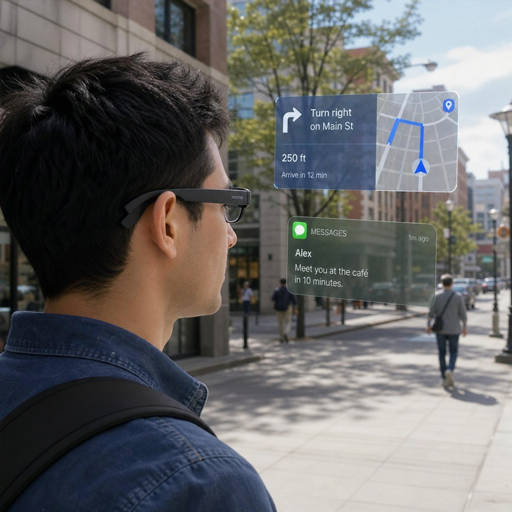
Augmented reality is moving from novelty to everyday computing, and glasses are the form factor most people are watching. The next generation of Augmented Reality AR glasses will not simply put a tiny screen near your eyes; it will blend useful digital information into the physical world through lighter hardware, smarter software, and more natural controls. For consumers, that could mean navigation, translation, entertainment, fitness, and hands-free help. For businesses, it could mean faster training, remote support, safer fieldwork, and richer collaboration.
What will AR glasses actually become?
AR glasses are likely to become context-aware computing devices that sit somewhere between today’s smartphones, smart glasses, and mixed reality headsets. Instead of asking you to stop what you are doing, pick up a device, and look down at a screen, future ar glasses will show relevant information in your line of sight when it helps and disappear when it does not. The winning products will feel less like “wearing a computer” and more like wearing normal eyewear that can assist, guide, capture, translate, and display.
That future will not arrive all at once. The market is already splitting into several categories: display glasses for large virtual screens, AI smart glasses with cameras and voice assistants, enterprise ar headset devices for specialized work, and true optical see-through augmented reality glasses that place digital objects into real space. IDC describes a broader XR market where mixed reality and display glasses are both expected to grow toward 2030, while Omdia has pointed to a major shift toward AI-enabled AR glasses and AR near-eye displays.
The practical takeaway is simple: the future of augmented reality will be layered. Some people will buy smart glasses for calls, photos, and AI assistance. Others will use lightweight display glasses for gaming or mobile work. Designers, technicians, surgeons, logistics teams, and educators may adopt more advanced mixed reality systems before mass-market consumers do. Over time, these categories will converge as batteries improve, displays get brighter, chips become more efficient, and ar technology becomes easier to build into familiar frames.
The shift from screens to spatial computing
For decades, personal computing has been organized around flat screens. Phones, laptops, tablets, televisions, and monitors all ask us to work inside rectangular windows. Augmented reality changes that relationship by making the world itself part of the interface. A kitchen counter can become a recipe guide, a warehouse aisle can become a picking path, and a meeting room can become a shared 3D workspace.
This is why mixed reality matters. In everyday conversation, people often use augmented reality and mixed reality interchangeably, but there is a useful distinction. Augmented reality typically means digital content is placed over a view of the real world. Mixed reality goes further by letting digital objects understand and interact with the physical environment, such as anchoring a 3D model to a table or letting a virtual instruction panel stay attached to a machine.
Headsets have helped push this idea forward because they can carry more sensors, larger batteries, and stronger processors. Apple positions Vision Pro around spatial computing, while Microsoft’s HoloLens line helped establish enterprise mixed reality workflows for training, remote assistance, and 3D visualization. Glasses, however, are the more socially natural endpoint. People may tolerate a headset for a task, a shift, or a simulation, but they are more likely to wear glasses throughout the day if the device is comfortable, stylish, and genuinely useful.
That shift will change how software is designed. Apps will become less like destinations and more like services that appear in context. Instead of opening a weather app, you may glance toward the sky and see a subtle forecast. Instead of searching for a tutorial, you may look at a broken appliance and see the next repair step. Instead of joining a video call on a laptop, you may see a colleague’s spatial avatar or shared diagram positioned in the room.
The hardware race is really a comfort race
The biggest challenge for AR glasses is not imagination. The challenge is making a powerful computer feel like ordinary eyewear. A phone can be heavy because it sits in a pocket. A laptop can get warm because it rests on a desk. Glasses sit on your nose and ears, so every gram, cable, lens tint, heat source, and battery compromise matters.
Meta’s Orion prototype showed why the category is exciting and difficult at the same time. Meta described Orion as true augmented reality glasses with holographic displays, a relatively wide field of view for the form factor, and access for employees and select external audiences so the company could learn before building toward consumer AR glasses. Snap has also continued developing Spectacles as standalone AR glasses for developers, supported by Lens Studio and Snap OS. These efforts show progress, but they also underline that mass-market AR glasses require more than a good demo.
Displays must be bright, sharp, and subtle
A great AR display has to work indoors, outdoors, in motion, and across different lighting conditions. It must be bright enough to see, transparent enough to preserve the real world, and efficient enough to avoid draining the battery. It also has to handle field of view, contrast, eye comfort, prescription compatibility, and the visual quality of text.
This is why display technology is such a defining battleground. Waveguides, microLEDs, laser beam scanning, birdbath optics, and other approaches each involve trade-offs. A device can offer a large virtual screen but look bulky. It can be lightweight but have a narrow field of view. It can be visually impressive but expensive to manufacture. Omdia notes that AR devices still face a trade-off between performance, weight, and battery life, which is one reason the path to mass adoption is gradual rather than instant.
Battery life will shape the user experience
Battery life is not just a specification. It decides what people use the glasses for. A device with limited battery life may be perfect for a commute, a training session, or a gaming break, but it will not replace all-day eyewear. A device with all-day battery life may need to limit display brightness, processing power, or always-on features.
Future designs will likely use a mix of strategies. Some processing may move to a phone, puck, or cloud service. Some displays may turn on only when needed. Some products may separate AI-first smart glasses from full AR display glasses, giving users a lighter option for voice, camera, and assistant features while reserving richer visuals for more demanding tasks.
Fit, prescription lenses, and style will matter as much as specs
Consumers do not choose eyewear like they choose routers or monitors. Glasses are visible, personal, and tied to identity. If ar glasses are uncomfortable, awkward, or too futuristic for daily life, many people will leave them at home no matter how advanced the technology is.
That makes partnerships with eyewear brands, prescription lens support, adjustable fit, and frame variety extremely important. The future will not be one universal device. It will likely include work-focused frames, sport frames, fashion frames, display-first glasses, audio-first glasses, and premium mixed reality glasses for power users.

The software layer will make or break adoption
Hardware gets attention, but software will decide whether people keep using AR glasses after the first week. A device that can show floating windows is interesting. A device that understands what you are doing and offers the right help at the right moment is useful.
Google’s Android XR work points toward this platform layer. Google has described Android XR as extending across headsets and glasses, with Gemini built into future experiences and partnerships intended to bring the platform to multiple device types. That matters because AR glasses need more than isolated apps. They need operating systems, developer tools, design standards, privacy controls, mapping systems, identity layers, and content ecosystems.
The most valuable AR software will do three things well:
- Understand context: The glasses need to know what the user is looking at, where they are, what task they are trying to complete, and what information is safe or appropriate to show.
- Respect attention: AR should not turn the world into a notification billboard. The best experiences will be quiet, glanceable, and easy to dismiss.
- Support natural interaction: Voice, gaze, gestures, touchpads, rings, wrist devices, and phone handoffs may all play a role. No single input method will be right for every environment.
Developers will also need to think spatially. A mobile app can assume the user is focused on a screen. An AR experience must account for movement, lighting, other people, safety, and physical surroundings. This makes design harder, but it also creates new possibilities that flat screens cannot match.
How will AI change augmented reality?
AI will turn AR glasses from passive displays into active assistants. Instead of only showing digital overlays, future glasses will be able to interpret scenes, summarize information, translate speech, recognize objects, suggest actions, and help users complete tasks in real time. In many cases, the AI layer may be the reason people buy smart glasses before they buy full-display AR glasses.
This is already visible in the market. AI smart glasses can offer hands-free capture, voice assistance, translation, search, and contextual help without needing a full holographic display. That makes them easier to design, lighter to wear, and potentially more affordable. Over time, AI-first smart glasses and display-first ar glasses are likely to merge, creating devices that can both understand the world and visually augment it.
AI will make interfaces more conversational
The smartphone era trained people to tap, swipe, and type. AR glasses will push interfaces toward conversation. If you are carrying groceries, repairing equipment, cycling, cooking, or walking through an airport, voice can be more natural than touch.
But voice alone is not enough. People will not want to speak every command out loud in public. Future systems may combine voice with eye tracking, subtle gestures, head movement, and contextual prediction. You might look at a restaurant and ask, “Is this place open?” or glance at a sign in another language and see a translation without asking at all.
AI will reduce friction for creators
AR content creation has historically required specialized 3D skills. AI could lower that barrier by helping creators generate models, animations, spatial layouts, and interactive scripts. Snap’s AR ecosystem, for example, already emphasizes Lens Studio as a creation platform for Spectacles experiences. As generative tools improve, more marketers, teachers, trainers, and independent creators will be able to build AR experiences without starting from scratch.
This will be important because hardware adoption depends on content. People need useful things to do with the device. Businesses need workflows worth paying for. Developers need a market large enough to justify investment. AI-assisted creation could help fill that gap faster.
AI will raise new trust questions
The same intelligence that makes AR glasses powerful also makes them sensitive. A camera on your face can see what you see. Microphones can hear nearby conversations. Eye tracking can reveal attention and intent. Scene understanding can identify people, places, objects, documents, and habits.
Researchers are already exploring consent-driven privacy systems for smart glasses, including approaches that blur or protect bystander data at capture and restore it only with consent. That direction is important because social acceptance may be as big a barrier as battery life. If people feel watched, recorded, analyzed, or interrupted, they will resist the technology even if the hardware is impressive.
Consumer use cases will begin with convenience
The first mainstream uses for Augmented Reality AR glasses will probably be simple, frequent, and easy to understand. Most consumers do not need a floating 3D dashboard every minute of the day. They need help with small moments: finding a gate, reading a message, following directions, translating a menu, remembering a name, capturing a moment, or watching content privately on a large virtual screen.
That is why near-term adoption may be driven by practical convenience rather than science-fiction spectacle. People adopted smartphones because they solved many small problems in one pocketable device. AR glasses will need a similar collection of everyday wins.
Navigation and travel
Navigation is one of the clearest AR use cases. Instead of looking down at a phone map, users could see directional cues placed in the real world. In a city, arrows could appear at turns. In an airport, gate information could stay visible without blocking the user’s view. In a museum or historic site, contextual information could appear near exhibits.
The key will be restraint. Good AR navigation should not clutter the world with graphics. It should provide enough guidance to reduce uncertainty while keeping the user aware of traffic, people, and surroundings.
Translation and accessibility
Real-time translation could become one of the most valuable features of smart glasses. Subtitles for conversations, translated signs, and language assistance during travel could make the world easier to navigate. For accessibility, AR glasses could support captions, object identification, visual descriptions, reminders, and environmental cues.
These features will need careful design. They must work quickly, respect privacy, and avoid overpromising accuracy in sensitive situations. Still, the potential is significant because the value is immediate and personal.
Entertainment and virtual screens
Not every pair of ar glasses needs to understand every surface in a room. Some of the most popular devices may function as wearable displays for gaming, movies, fitness apps, and productivity. XREAL, for example, markets AR glasses and spatial display products that connect to compatible devices to create a large virtual screen experience.
This category is important because it gives consumers a clear reason to buy now. Watching a movie on a plane, playing games from a handheld console, or working from a laptop with extra virtual screen space are easier to understand than fully spatial computing. These display-first products may act as a bridge toward richer augmented reality.
Social connection and memory
Smart glasses can also change how people capture and share daily life. A face-worn camera makes hands-free photos and video easier than pulling out a phone. Add AR, and social experiences could include shared annotations, live reactions, spatial messages, or co-present games.
This is also where privacy expectations become crucial. A phone camera is visible because someone raises it. Glasses are always on the face, so devices need clear recording indicators, strong controls, and social norms that people understand.
Enterprise adoption will lead many breakthroughs
Businesses often adopt AR before consumers because the value can be easier to measure. If an ar headset helps a technician finish a repair faster, reduces training time, or lets an expert support multiple sites remotely, the business case may be clearer than it is for casual consumer use. Gartner has noted that training use cases are prominent among enterprise AR head-mounted display adopters because they can connect to practical outcomes such as retention, recall, and time savings.
Enterprise environments are also more tolerant of specialized hardware. A warehouse worker, field technician, surgeon, or manufacturing trainer may wear a device for a defined task, even if it is not fashionable enough for everyday consumer life. That gives companies room to test workflows, gather feedback, and build software before consumer AR glasses are fully mature.
Training and simulation
AR can make training more hands-on without requiring every scenario to be physically recreated. A new employee can see step-by-step instructions overlaid on equipment. A medical student can study anatomy in 3D. A manufacturing trainee can practice procedures with visual guidance before working independently.
Unlike video training, AR can be situated in the actual environment where the work happens. That context helps connect instruction to action. It also allows trainers to standardize guidance while still adapting to different locations or equipment.
Remote expert support
Remote assistance is one of the most practical enterprise uses for AR glasses. A frontline worker can share their view with an expert, receive annotations, and follow instructions while keeping both hands free. This can reduce travel, speed up troubleshooting, and preserve expert knowledge across teams.
The important point is that AR does not have to replace workers. In many enterprise settings, it enhances communication between less experienced workers and specialists. The glasses become a shared viewpoint.
Design, engineering, and spatial review
For architects, product designers, engineers, and construction teams, mixed reality can make 3D ideas easier to evaluate. A digital model can be viewed at real scale. A proposed layout can be tested in a physical room. A team can spot conflicts earlier because they are not only looking at drawings on a screen.
This type of use case benefits from accurate tracking, high-quality displays, and collaboration tools. It may remain more headset-oriented in the short term, but lighter AR glasses could eventually make spatial review more routine.
The roadblocks are real
The future of ar technology is promising, but it is not guaranteed to unfold smoothly. AR glasses sit at the intersection of hardware engineering, software design, privacy, fashion, safety, and social behavior. A weakness in any one of those areas can slow adoption.
Here are the main roadblocks that will shape the next phase:
- Comfort: Glasses must be light enough for long sessions and balanced enough to avoid nose, ear, and eye strain.
- Battery life: Devices need enough power for meaningful use without becoming bulky or hot.
- Display quality: Text must be readable, visuals must be bright, and the field of view must feel useful.
- Privacy: Users and bystanders need confidence that cameras, microphones, and sensors are controlled responsibly.
- Social acceptance: People must feel comfortable wearing the device and being around others who wear it.
- Content: Consumers and businesses need apps, services, and workflows that justify the purchase.
- Price: Advanced components can be expensive, and mainstream adoption depends on costs falling over time.
- Safety: Interfaces must avoid distraction during walking, driving, cycling, operating equipment, or working near hazards.
None of these problems is unsolvable. But they are connected. A brighter display may use more power. A larger battery may increase weight. More sensors may improve context but raise privacy concerns. A wider field of view may make the device more useful but harder to manufacture affordably. The best products will be the ones that balance these trade-offs for a specific audience instead of trying to do everything at once.
The design language of AR will become quieter
Early AR demos often look dramatic: floating planets, glowing dashboards, 3D characters, and walls covered in data. Those visuals are useful for showing possibility, but everyday AR will probably be much calmer. The future interface may look less like a sci-fi movie and more like a well-designed sign, subtitle, or sticky note that appears exactly when needed.
This quiet design language will be essential for trust. People do not want their entire field of view filled with ads, widgets, and alerts. They want selective assistance. A calendar reminder should appear before a meeting, not hover all morning. A translation should appear near the sign or person it relates to, not fill the entire lens. A safety warning should be immediate and obvious, but rare enough that users do not ignore it.
Good AR design will follow a few principles:
- Glanceability: The user should understand the information quickly.
- Spatial relevance: Digital content should appear near the object, place, or action it supports.
- Dismissibility: Users should be able to hide or silence overlays instantly.
- Legibility: Text must be readable without forcing the user to stare or strain.
- Context awareness: The system should know when not to interrupt.
- Human priority: Real people, real hazards, and real tasks should always matter more than digital content.
This is where augmented reality differs from traditional app design. A bad mobile interface is annoying. A bad AR interface can be disorienting or unsafe. The design bar will need to be higher.
Privacy will decide public acceptance
Every major computing shift creates new privacy expectations. The web changed data collection. Smartphones changed location tracking and app permissions. Smart speakers changed comfort with always-listening devices. AR glasses will change the conversation again because the sensors face outward and move through the world with the wearer.
The privacy challenge has two sides. First, the wearer needs control over personal data: eye movement, voice commands, surroundings, contacts, location, and usage patterns. Second, bystanders need protection because they may appear in the wearer’s field of view without choosing to participate.
Future AR products will need privacy by design, not privacy as a settings menu afterthought. Clear recording lights, local processing, data minimization, face blurring, permission prompts, enterprise governance, and visible capture indicators may all become part of the category. Research into consent-based and privacy-preserving smart glasses suggests the industry is beginning to address the problem at a technical level, but social trust will also require simple explanations and consistent behavior.
The companies that win may not be the ones with the most aggressive data collection. They may be the ones that make people feel safe wearing the product, working around it, and inviting it into homes, offices, classrooms, clinics, and public spaces.
The market will not be one-size-fits-all
It is tempting to imagine one perfect pair of AR glasses replacing the phone. That may happen someday for some tasks, but the nearer future is more diverse. Different users will accept different trade-offs.
A gamer may prioritize display size, refresh rate, and device compatibility. A warehouse team may prioritize durability, battery swaps, barcode scanning, and remote support. A traveler may care about translation, navigation, and lightweight frames. A designer may need high-fidelity 3D visualization. A commuter may only want music, calls, notifications, and occasional AI help.
This creates several likely product lanes:
|
Product lane |
Primary value |
Likely user expectation |
|---|---|---|
|
AI smart glasses |
Voice assistant, camera, audio, hands-free help |
Normal-looking frames and long battery life |
|
Display glasses |
Large virtual screen for work or entertainment |
Clear visuals and easy device connection |
|
Enterprise AR headset |
Training, remote support, guided work |
Reliability, security, and workflow integration |
|
Mixed reality headset |
Immersive spatial computing |
High performance and rich 3D experiences |
|
True AR glasses |
Digital overlays anchored in the real world |
Lightweight design, useful apps, and social acceptance |
This segmentation is healthy. It lets the market mature in stages. Display glasses can build habits around wearable screens. AI smart glasses can build comfort with face-worn assistants. Enterprise headsets can prove practical workflows. Mixed reality devices can push software and interaction models. Eventually, the best ideas from each lane can move into everyday augmented reality glasses.
What should businesses do now?
Businesses do not need to wait for perfect consumer AR glasses before exploring the technology. The smarter approach is to identify specific workflows where hands-free, context-aware information could reduce friction. Start with the job, not the gadget.
A useful evaluation process looks like this:
- Find moments where workers need information while their hands are busy. Good candidates include maintenance, inspection, picking, assembly, training, and field service.
- Identify the cost of delay or error. AR is more compelling when mistakes are expensive, travel is difficult, or expert availability is limited.
- Test with a narrow workflow. A focused pilot is better than a broad experiment with no clear success criteria.
- Measure practical outcomes. Track completion time, error rates, training consistency, support calls, user comfort, and adoption.
- Plan for integration. AR tools are more useful when connected to existing systems such as manuals, inventory, customer records, or learning platforms.
- Address privacy and safety early. Policies for recording, data storage, user consent, and bystander visibility should be part of the pilot, not added later.
The businesses that benefit most will be the ones that treat AR as a workflow tool rather than a novelty. A floating checklist is not valuable because it is futuristic. It is valuable if it helps someone do the right task, in the right order, with fewer interruptions.
What should consumers watch for?
Consumers should judge ar glasses by real usefulness, not only by futuristic demos. The best device for one person may not be the most advanced device on paper. It may be the one that fits comfortably, works with the devices they already own, and solves a daily problem.
Before buying or waiting for a future product, consumers should consider:
- Do you want a display, an assistant, or both? Some smart glasses focus on audio, cameras, and AI. Others focus on visual screens.
- Will you wear them in public? Style and comfort matter more than they do with many other gadgets.
- How long do you need the battery to last? Occasional use and all-day use are very different requirements.
- Do you need prescription support? Lens options can determine whether a device is practical.
- What devices does it connect to? Compatibility with phones, laptops, consoles, or cloud services can define the experience.
- How does it handle privacy? Look for clear capture indicators, permissions, and data controls.
- What apps or use cases are available now? A promising roadmap is not the same as everyday value.
For many people, the first AR-adjacent product they enjoy may not be true augmented reality at all. It may be a pair of display glasses for travel, smart glasses for AI assistance, or a mixed reality headset for immersive work and entertainment. That is still part of the same broader transition away from fixed screens and toward spatial computing.
The next five years will be about convergence
The most important trend is convergence. AI assistants, wearable displays, spatial mapping, voice interfaces, sensors, and mixed reality software are developing in parallel. As they come together, AR glasses will become more capable and more natural.
Market forecasts vary, but many analysts expect significant growth in smart glasses, AR displays, and XR devices toward 2030. ABI Research has forecast strong consumer AR smart glasses shipment growth by 2030, while Research and Markets projects the smart Augmented Reality AR glasses market to expand substantially over the same period. Forecasts should never be treated as guarantees, but the direction is clear: major technology companies, component suppliers, developers, and enterprise buyers are investing in the category.
The timeline will likely feel uneven. Some years will bring impressive prototypes. Others will bring practical but less glamorous products. There may be devices that are too expensive, too heavy, too limited, or too early. That is normal for a new computing platform. The smartphone did not arrive fully formed, and neither will augmented reality eyewear.
What matters is the compounding progress. Displays improve. Chips shrink. Batteries become more efficient. AI models become more useful. Developers learn what people actually want. Social norms adapt. Each step makes the next generation of ar glasses more practical.
The future is useful, not just immersive
The future of augmented reality glasses will not be defined by how many holograms can fill a room. It will be defined by whether the technology helps people live, work, learn, move, and communicate with less friction. The best AR experiences will often be brief: a translation at the right moment, a repair instruction in the right place, a reminder before you forget, a route when you are lost, or a shared model when a flat image is not enough.
That is what makes the category so powerful. Augmented reality does not ask the digital world to replace the physical one. At its best, it makes the physical world easier to understand and act within.
The path ahead still includes hard engineering, design, privacy, and social challenges. But the direction is unmistakable. Smart glasses are becoming more capable, mixed reality is teaching people to think spatially, AI is making interfaces more context-aware, and ar technology is moving closer to everyday eyewear. The future of AR glasses is not a single device; it is a gradual rethinking of how information meets the real world.