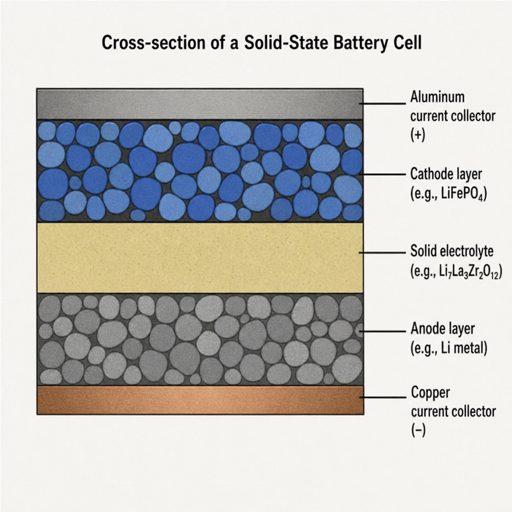
Solid-state battery technology is one of the most closely watched areas in modern energy storage because it promises safer, more efficient, and longer-lasting batteries for electric vehicles, consumer electronics, renewable energy systems, and industrial applications. Unlike conventional lithium-ion batteries that use liquid or gel electrolytes, solid-state batteries use a solid electrolyte, which can change how energy is stored, moved, and protected inside the cell. While the technology is still moving from advanced development toward broader commercial use, its progress is shaping how engineers, manufacturers, and energy planners think about future batteries.
What makes solid-state batteries different?
Solid-state batteries are different because they replace the liquid electrolyte found in many traditional rechargeable batteries with a solid material that conducts ions between the battery’s electrodes. This design can improve safety, support higher energy density, and open the door to new battery architectures that are difficult to achieve with conventional battery technology. In practical terms, solid-state battery technology aims to deliver more usable energy in a smaller, lighter, and more stable package.
A standard lithium-ion battery depends on a liquid electrolyte to help lithium ions move between the anode and cathode during charging and discharging. That liquid electrolyte works well, but it can be flammable, sensitive to damage, and limited by the materials it can safely support. By contrast, a solid electrolyte can be made from ceramic, polymer, sulfide, oxide, or composite materials, each with different performance strengths and manufacturing challenges.
The shift may sound simple, but it affects nearly every part of battery design. Electrode compatibility, ion movement, pressure management, temperature behavior, manufacturing methods, and long-term durability all have to be reconsidered. That is why solid state battery technology is not merely a material swap; it represents a wider redesign of how advanced batteries can be built.
The push for better battery efficiency
Battery efficiency matters because every bit of lost energy affects charging speed, usable range, device runtime, operating costs, and system reliability. In electric vehicles, more efficient batteries can help reduce charging frequency and improve real-world performance. In renewable energy storage, efficiency affects how much solar or wind energy can be stored and later delivered when demand rises.
Solid-state battery technology may support better battery efficiency in several ways. A stable solid electrolyte can reduce certain side reactions inside the cell, which may help preserve capacity over time. Some solid-state designs can also pair with high-capacity electrode materials, including lithium metal anodes, which could increase the amount of energy stored in the same physical footprint.
Efficiency is not only about energy density, though. It also includes how well a battery handles repeated charge cycles, how much heat it generates, how safely it operates under stress, and how predictable its performance remains over its lifetime. This is where solid-state batteries have attracted serious attention: they could eventually combine strong performance with improved thermal and chemical stability.
Key advancements moving the technology forward
The progress behind future batteries comes from many parallel improvements rather than one single breakthrough. Researchers and manufacturers are working on better materials, better interfaces, scalable production methods, and more reliable testing standards. Together, these advancements are helping solid-state batteries move closer to practical use.
Improved solid electrolyte materials
The solid electrolyte is the heart of the technology. It must allow ions to move efficiently while remaining mechanically stable and chemically compatible with the electrodes. Ceramic electrolytes can offer strong stability, while sulfide-based electrolytes may provide high ionic conductivity. Polymer electrolytes can be easier to process, though they may require careful design to perform well across different temperatures.
No single electrolyte type is perfect for every application. Some are strong but brittle. Others conduct ions well but require moisture-sensitive handling. Composite approaches are also being explored because they may combine the advantages of multiple material families. This variety is a sign of a healthy innovation landscape, but it also means commercial designs may look very different depending on whether they are intended for cars, phones, grid storage, or specialized equipment.
Better electrode compatibility
One of the biggest goals in solid-state battery technology is enabling high-capacity electrodes without sacrificing safety or cycle life. Lithium metal is especially interesting because it can store more energy than graphite-based anodes commonly used in many lithium-ion batteries. However, lithium metal can form dendrites, which are tiny growths that may damage the cell or create safety risks.
Solid electrolytes may help manage this challenge, but the solution is not automatic. The interface between the solid electrolyte and electrode must remain smooth, stable, and conductive as the battery charges and discharges. Engineers are developing coatings, interface layers, pressure-control methods, and new cell designs to reduce resistance and improve durability.
Manufacturing improvements
A battery that performs well in a lab still has to be manufacturable at scale. This is one of the most important hurdles for solid-state batteries. Production must be consistent, cost-aware, and compatible with quality control requirements. Small flaws in a solid electrolyte layer or electrode interface can have a large impact on performance.
Manufacturing progress includes thinner electrolyte layers, improved deposition methods, dry processing techniques, roll-to-roll production concepts, and better ways to assemble cells under controlled conditions. These steps matter because energy storage technologies only become transformative when they can be produced reliably and affordably.
Why does solid-state battery technology matter for electric vehicles?
Solid-state battery technology matters for electric vehicles because it could help address several of the barriers that still influence buyer confidence: driving range, charging time, safety, battery lifespan, and vehicle weight. If solid-state batteries can deliver higher energy density and improved stability at scale, automakers may be able to design EVs that travel farther, charge more conveniently, and maintain performance over many years.
Electric vehicles place unusually demanding requirements on batteries. A vehicle battery must handle vibration, temperature changes, fast charging, deep cycling, safety regulations, and long warranty expectations. It also has to be produced in large quantities. These requirements make EVs one of the most challenging but also most valuable markets for advanced battery technology.
Solid-state batteries could influence EV design in several practical ways:
- Longer usable range: Higher energy density may allow more energy storage without increasing battery pack size.
- Reduced pack weight: Lighter packs can support better efficiency and improved vehicle handling.
- Improved safety design: A less flammable electrolyte system may reduce some thermal risk factors.
- New vehicle layouts: Smaller or more energy-dense packs could give designers more flexibility.
- Potentially better longevity: Stable internal chemistry may help reduce degradation, depending on the final cell design.
These benefits are promising, but they depend on successful commercialization. Cost, supply chain readiness, cold-weather performance, charging reliability, and real-world durability must all be proven before solid-state batteries become common in mass-market vehicles.
Applications beyond transportation
Although electric vehicles receive much of the attention, solid-state batteries could affect many areas of energy storage. Smaller electronics, medical devices, aerospace systems, industrial sensors, and backup power systems all need batteries that are compact, dependable, and safe.
In consumer electronics, improved battery efficiency could mean thinner devices, longer runtime, or more power available for advanced features. Wearables and compact devices may benefit from batteries that are more stable and easier to package into unusual shapes. In medical or industrial settings, reliability may matter even more than capacity, especially when battery failure could interrupt critical monitoring or operations.
Grid storage is a more complex case. Large-scale energy storage often prioritizes cost, lifespan, safety, and ease of maintenance over compact size. Solid-state battery technology may eventually play a role in stationary storage, but it will need to compete with other battery chemistries and non-battery storage options that are also improving. The best technology for a smartphone is not always the best technology for a power grid.
Challenges still standing in the way
The excitement around solid-state batteries is justified, but the challenges are real. Many promising battery concepts take years to move from research cells to commercial products because batteries must be safe, repeatable, durable, and economically viable.
Key obstacles include:
- Interface resistance: Solid-to-solid contact can be imperfect, making it harder for ions to move smoothly between materials.
- Material fragility: Some ceramic electrolytes can crack under mechanical stress or during repeated cycling.
- Moisture sensitivity: Certain electrolyte materials require careful handling and sealed manufacturing environments.
- Production cost: Advanced materials and specialized processes can make early solid-state cells expensive.
- Scalability: Making small cells is different from producing millions of large-format cells with consistent quality.
- Performance trade-offs: A design that improves safety may reduce conductivity, while a high-conductivity material may introduce handling or stability challenges.
These challenges do not mean the technology is failing. They show why battery development is slow, detailed work. Each improvement has to be tested not just for peak performance, but for repeatability across thousands of charge cycles and many operating conditions.
How will future batteries change energy storage?
Future batteries will likely change energy storage by becoming more specialized, more efficient, and better matched to the needs of each application. Solid-state batteries may be part of that future, especially where compact size, safety, and high energy density are priorities. Rather than replacing every existing battery overnight, they are more likely to enter markets where their advantages justify the added complexity.
This matters because energy storage is no longer a niche technology. It supports transportation, digital devices, renewable power, emergency backup systems, robotics, and connected infrastructure. As electricity becomes more central to daily life, battery technology must improve not only in capacity but also in safety, sustainability, and lifecycle performance.
For businesses and consumers, the practical takeaway is to watch the use case rather than the hype. A solid-state battery in a premium electric vehicle, a medical device, or a compact sensor may appear before the same technology becomes standard in low-cost everyday products. Adoption will depend on where the performance benefit is strongest and where customers are willing to pay for it.
What to watch next
The next stage of solid-state battery technology will be defined by practical milestones. Lab results will still matter, but manufacturing scale, safety validation, supply chain development, and real-world product performance will matter more.
Important signs of progress include:
- Pilot production lines moving toward repeatable output
- Longer cycle-life testing under realistic conditions
- Partnerships between battery developers and vehicle or electronics manufacturers
- Clearer information about cost, charging behavior, and temperature performance
- Demonstrations in commercial products rather than only research prototypes
- Improvements in recycling and end-of-life planning for new battery materials
These signals help separate meaningful progress from vague promises. Strong battery innovation is usually measured in dependable performance, not dramatic announcements.
A practical takeaway on solid-state battery technology
Solid-state batteries represent a major direction in advanced battery technology because they address some of the core limitations of today’s rechargeable cells. Their potential benefits include higher energy density, improved safety characteristics, better battery efficiency, and more flexible design options for future energy storage systems.
At the same time, the technology is still evolving. Materials must become more reliable, manufacturing must scale, and real-world performance must be proven across demanding applications. The most realistic view is also the most exciting one: solid-state battery technology is not a magic shortcut, but it is a serious pathway toward better future batteries.
As development continues, the winners will be the solutions that balance performance, safety, cost, and manufacturability. For anyone following energy storage, transportation, or electronics, solid-state batteries are worth watching because they show how deeply battery technology can shape the next generation of products and infrastructure.