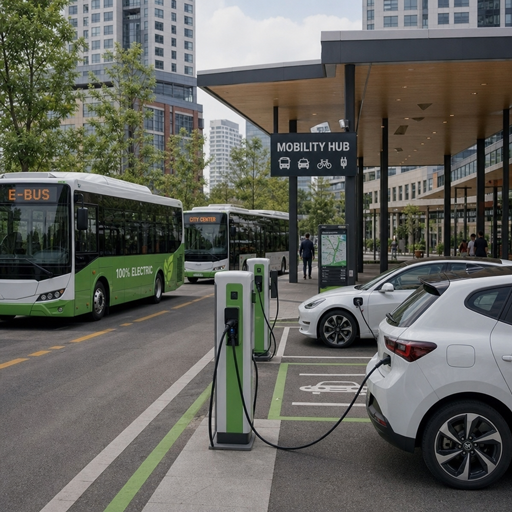
Zero-emission mobility is moving from policy ambition to infrastructure race as automakers, governments, utilities, and fleet operators scale electric mobility across cars, buses, trucks, and charging networks. The latest market signals point in the same direction: clean transportation is growing, battery costs are easing, and new charging standards are making eco-friendly vehicles more practical for daily use and commercial duty. The transition is not smooth everywhere, but the industry’s center of gravity is shifting toward sustainable transport that can cut tailpipe pollution while supporting more resilient energy systems.
What is changing now?
The biggest change is that zero-emission mobility is no longer defined only by passenger electric cars. It now includes depot-charged delivery vans, electric buses, battery-electric trucks, hydrogen fuel cell applications, public fast-charging corridors, workplace charging, smart depots, and grid-connected mobility hubs. The International Energy Agency reported that electric car sales exceeded 20 million in 2025, up 20% from 2024, and projected sales of 23 million in 2026, equal to 28% of total car sales worldwide.
That expansion is changing the competitive map for carbon-neutral transport. China remains the largest electric vehicle market, Europe is expected to see strong 2026 growth, and emerging markets in Asia Pacific and Latin America are projected to keep gaining share. The IEA also said that electric vehicles could make up around half of global car sales by 2035 in its exploratory scenarios, driven by cost competitiveness, fuel economy rules, and CO2 standards.
For consumers, the news is practical: more models, more charging options, and more price competition. For fleets, the stakes are operational. Clean transportation decisions now affect route planning, depot design, energy procurement, maintenance staffing, and long-term capital budgets.
Battery costs are reshaping the market
Battery affordability remains one of the most important forces behind green mobility. BloombergNEF’s 2025 battery price survey found that average lithium-ion battery pack prices fell 8% from 2024 to a record low of $108 per kilowatt-hour. It attributed the decline to manufacturing overcapacity, intense competition, and broader use of lower-cost lithium iron phosphate batteries.
The same report said battery-electric vehicle packs were the lowest-priced transport segment at $99 per kilowatt-hour, while average LFP battery packs across all uses came in at $81 per kilowatt-hour. Lower battery costs do not automatically make every electric vehicle cheaper at the showroom, because tariffs, software, labor, financing, and vehicle design also matter. But the trend gives manufacturers more room to offer lower-priced eco-friendly vehicles and gives fleet buyers more confidence when comparing lifetime operating costs.
The implications go beyond cars. Lower battery costs can support electric buses, last-mile delivery vehicles, light commercial vans, and stationary storage paired with charging sites. When storage is added to a depot or charging hub, operators can shift some charging away from grid peaks, manage demand charges, and improve backup capability during outages.
Charging standards are becoming a competitive advantage
Charging access has become one of the defining issues in zero-emission mobility. In North America, the move toward the SAE J3400 connector is intended to reduce fragmentation in the charging experience. The U.S. Joint Office of Energy and Transportation notes that major automakers and EV charging companies announced plans to adopt the J3400 connector as early as 2025, while adapters are expected to help existing vehicles use more charging sites.
For drivers, standardization means fewer questions about whether a plug will work. For charging companies, it can simplify site planning and equipment selection. For automakers, it reduces friction at a critical point in the ownership experience: the moment a driver needs reliable energy away from home.
Heavy-duty transport needs a different answer. CharIN’s Megawatt Charging System work targets high-power charging for electric trucks, buses, and other large vehicles that cannot wait for passenger-car charging speeds. The IEA says depot charging for buses and trucks requires route profiling, battery sizing, charging strategy, and charger planning; poor optimization can raise peak demand, costs, and grid-connection timelines.
Key developments driving clean transportation
Several developments are now converging to make sustainable transport more deployable across different vehicle classes:
- Mass-market EV growth: Global electric car sales are projected to keep rising in 2026, with Europe expected to reach about one in three new cars sold as electric and China approaching 60% of total car sales.
- Lower-cost batteries: Falling pack prices give automakers and fleet operators more flexibility to reduce upfront costs or add range, safety, and durability features.
- Charging network coordination: Public programs such as the U.S. National Electric Vehicle Infrastructure Formula Program are focused on building an interconnected charging network with data collection, access, and reliability at the center.
- Fleet depot intelligence: Route-based charging plans are becoming essential for buses, delivery vehicles, and regional trucks because the right charging schedule can reduce grid stress and operating costs.
- Policy pressure: Emissions standards in the U.S., Europe, California, and other markets continue to shape manufacturer investment, even as some governments revisit timelines and compliance flexibility.
Together, these developments show why electric mobility is becoming an ecosystem rather than a single product category. The vehicle, charger, building, utility connection, software platform, and policy framework increasingly have to work together.
Policy remains powerful, but uneven
Public policy is still one of the strongest accelerators for zero-emission mobility. In the United States, the Environmental Protection Agency finalized national pollution standards in 2024 for passenger cars, light-duty trucks, and medium-duty vehicles for model years 2027 through 2032 and beyond. The agency said the rule was designed to reduce more than 7 billion tons of carbon emissions and deliver nearly $100 billion in annual net benefits, including fuel, maintenance, and public health gains.
The U.S. policy picture has also become more contested. In May 2026, EPA proposed delaying compliance deadlines for light- and medium-duty vehicle emissions standards by two years, until model year 2029. That proposal highlights a key tension in the market: regulators want faster emissions cuts, while automakers and some policymakers argue for more time as consumer demand, charging access, and production economics evolve.
California remains a leading state-level benchmark. The California Air Resources Board’s Advanced Clean Cars II rule sets a path to 100% new zero-emission car, pickup, and SUV sales in 2035, including qualifying plug-in hybrids. California’s approach matters beyond the state because its vehicle market is large and its regulations often influence other states, automakers, and infrastructure planners.
Europe is also recalibrating. The European Commission says zero-emission vehicle registrations helped reduce average emissions from new cars and vans, but its latest proposal would adjust the 2035 compliance framework by setting a 90% tailpipe emissions reduction target while allowing the remaining share to be compensated through measures such as low-carbon steel, e-fuels, and biofuels. That shift has intensified debate over how to balance industrial competitiveness, consumer costs, and climate ambition.
Fleets are becoming the proving ground
Fleet operators are often more prepared than individual consumers to measure total cost of ownership. They know daily mileage, parking locations, dwell time, payload needs, fuel spending, and maintenance downtime. That makes buses, delivery vans, airport shuttles, municipal vehicles, and regional trucks natural testing grounds for carbon-neutral transport.
The advantage is predictability. A bus that returns to the same depot every night can charge on a planned schedule. A delivery route can be redesigned around range, loading time, and charger availability. A municipal fleet can start with vehicles that have the simplest duty cycles before electrifying harder applications.
The challenge is infrastructure. A depot with ten electric vans is not the same as a depot with 200 electric trucks. Utilities may need time to upgrade service. Fleet owners may need software to avoid charging every vehicle at the same time. Site owners may need battery storage, solar generation, or managed charging agreements to reduce peak-load costs.
This is why the next phase of sustainable transport is less about announcing electric vehicles and more about making them work at scale. The winning projects will pair vehicle procurement with energy planning from the beginning, not after delivery.
Hydrogen keeps a focused role
Battery-electric vehicles dominate much of the passenger and light-duty conversation, but hydrogen fuel cell technology remains part of the zero-emission mobility mix, especially where long range, fast refueling, or heavy payloads are operational priorities. The IEA’s reporting on Korea notes that the country raised its zero-emission vehicle deployment target at the start of 2026, aiming for electric and fuel cell electric vehicles to reach 50% of new car sales by 2030.
Hydrogen is not a universal substitute for batteries. Fuel production, distribution, station cost, and vehicle availability all affect adoption. Still, for certain heavy-duty, industrial, port, or regional freight use cases, hydrogen may complement battery-electric trucks where charging time, weight, or grid constraints are difficult to solve quickly.
That mixed-technology outlook is becoming more realistic. Cities and companies are not asking one technology to solve every transport problem. They are choosing the lowest-emission option that fits the route, vehicle class, energy supply, and budget.
What comes next
The next stage of zero-emission mobility will be decided by execution. Automakers must turn battery cost declines into compelling products. Charging providers must improve uptime and simplify payments. Utilities must prepare for new loads without slowing deployment. Policymakers must provide enough certainty for investment while adjusting rules when market conditions change.
Consumers should expect more electric models across price points, more charging options, and more focus on reliability rather than novelty. Businesses should expect clean transportation to become part of facilities planning, ESG reporting, energy management, and customer service. Public agencies should expect infrastructure equity to remain a central issue, especially for rural areas, apartment residents, small businesses, and communities that have historically carried higher pollution burdens.
The direction is clear even if the pace varies by region. Zero-emission mobility is becoming a practical industrial transition built on batteries, charging networks, software, policy, and smarter fleet operations. The companies and cities that treat green mobility as a system—not simply a vehicle purchase—will be best positioned for the next wave of sustainable transport.