Green hydrogen is usually described as hydrogen made by splitting water with renewable electricity, with oxygen released as the companion product. A newer research direction asks a sharper question: what if the same hydrogen-making process could replace low-value oxygen with a useful industrial chemical? Recent work on bromide-mediated paired electrosynthesis points to one answer, producing hydrogen alongside epoxides, a family of chemicals used as building blocks in materials, coatings, adhesives, pharmaceuticals, and other products.
For readers comparing green hydrogen production methods in 2026, this matters because the bottleneck is not only scientific feasibility. It is also economics, plant design, electricity cost, product value, and whether new clean hydrogen technologies can fit into real industrial supply chains without creating new complications.
What makes this green hydrogen method different?
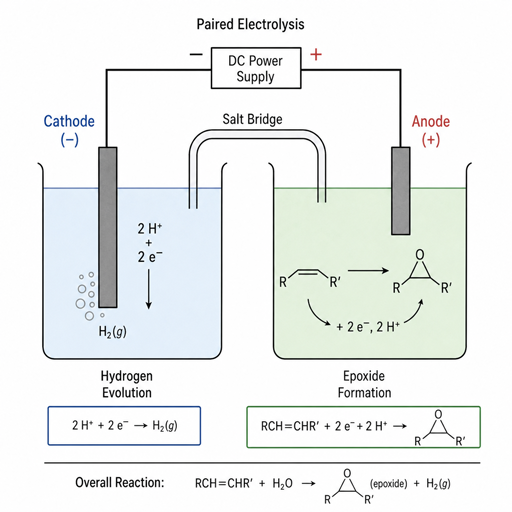
This method is different because it treats hydrogen production as a paired chemical process, not just water splitting. In conventional electrolysis, electricity splits water into hydrogen and oxygen; in the Technion-led study published in Nature Communications, the system uses bromide chemistry to produce hydrogen while converting olefins into epoxides, replacing the usual oxygen co-product with a higher-value chemical stream.
That shift may sound small, but it changes the business logic. Oxygen can be useful, yet it is often not valuable enough to transform the economics of an electrolyzer. Epoxides, by contrast, are established chemical intermediates, so co-producing them with hydrogen could help offset costs if the process proves scalable, safe, selective, and compatible with industrial operations.
The basics of green hydrogen production
A simple green hydrogen definition production methods summary is this: green hydrogen is hydrogen produced with low-carbon or renewable energy, most commonly by water electrolysis powered by wind, solar, hydropower, or other clean electricity. Electrolysis uses electricity to split water into hydrogen and oxygen, and it is the most established route for making renewable hydrogen today.
The broader family of hydrogen generation methods includes steam methane reforming, coal gasification, biomass routes, thermochemical water splitting, photoelectrochemical systems, and electrolysis. Not all hydrogen is green. Many current production pathways still rely on fossil fuels, and the International Energy Agency reports that global hydrogen production remains dominated by unabated fossil-based routes, while low-emissions hydrogen is only beginning to grow from a very small base.
That is why hydrogen energy solutions are often discussed in a practical, sector-by-sector way. Hydrogen is most compelling where direct electrification is difficult, such as certain chemical processes, fertilizer production, refining, steelmaking, long-duration energy storage, and some future fuel applications. It is not a magic substitute for every use of fossil fuels, but it may be important where molecules, heat, storage duration, or feedstock chemistry matter.
Why replacing oxygen could change the economics
The conventional electrolyzer makes two products: hydrogen at the cathode and oxygen at the anode. The hydrogen is the main target. Oxygen can be captured and used, but many project developers do not build the entire business case around selling oxygen because local demand, purity needs, compression, and logistics can limit its value.
The new paired electrosynthesis idea tries to make the anode side work harder. Instead of treating oxygen as a low-value companion, the process uses bromide as a mediator: electrochemistry first produces hydrogen and solution-confined bromine, and that bromine then helps oxidize olefins into epoxides before being regenerated back to bromide. The published study demonstrated the concept with styrene, converting water and styrene into hydrogen and styrene oxide in a membraneless system.
The economic implication is straightforward: if an electrolyzer can sell hydrogen and a valuable chemical, it may have more routes to profitability. That does not mean the method is ready to replace today’s electrolyzers. It means researchers are expanding the design space for hydrogen production techniques, especially where hydrogen plants could be integrated with chemical manufacturing.
A closer look at the bromide-mediated process
The study describes a system that combines an aqueous electrolyte with olefins in an inert organic co-solvent. Hydrogen forms at the cathode, while bromide chemistry enables the oxidation chemistry that produces epoxides. According to the research summary, the authors reported high efficiency, high rate, and high product selectivity in their demonstration.
Several details make the work notable. The system is described as membraneless, which matters because membranes add cost, complexity, and durability questions in many electrochemical systems. The researchers also emphasize that the advance is not just a single better electrode, but an integrated operating configuration involving electrodes, mediator, solvent environment, and reaction design.
Key elements include:
- Paired production: hydrogen and epoxide are generated as linked outputs rather than unrelated products.
- Bromide mediation: bromide is central to moving the anodic chemistry away from ordinary oxygen evolution.
- Olefin conversion: the chemical-side feedstock is an olefin, with styrene used in the demonstration.
- Membraneless design: the reported setup avoids a separating membrane, though crossover and selectivity remain important engineering concerns.
- Industrial relevance: epoxides are useful building blocks, making them more economically attractive than oxygen in many contexts.
The practical appeal is not just “more products.” It is targeted value creation. If the chemical co-product matches an existing market and the hydrogen has a nearby use, a paired system could support more localized and integrated production models.
How does it compare with other green hydrogen production methods?
Compared with standard water electrolysis, this approach is more chemically complex but potentially more value-rich. Alkaline, proton exchange membrane, and solid oxide electrolysis focus on efficient hydrogen production from water, while this paired approach redesigns the anodic reaction so the system makes hydrogen plus a saleable chemical rather than hydrogen plus oxygen.
A useful comparison looks like this:
|
Method |
Main input |
Main output |
Practical strength |
Key challenge |
|---|---|---|---|---|
|
Conventional electrolysis |
Water and electricity |
Hydrogen and oxygen |
Mature pathway for renewable hydrogen |
Cost depends heavily on electricity and equipment |
|
Biomass-based routes |
Organic feedstocks |
Hydrogen-rich gases or fuels |
Can use renewable carbon sources |
Feedstock logistics and emissions accounting can be complex |
|
Thermochemical water splitting |
Heat and chemical cycles |
Hydrogen and oxygen |
Potential fit with high-temperature energy sources |
Often still at research or demonstration stage |
|
Paired electrosynthesis |
Water, electricity, bromide system, olefin |
Hydrogen and epoxide |
Adds a higher-value co-product |
Needs scale-up, safety validation, and market integration |
This comparison shows why the latest green hydrogen production methods 2026 discussion is moving beyond a simple “which electrolyzer is best?” framing. The stronger question is: which production pathway fits a specific industrial site, feedstock stream, energy source, and product market?
Where this could fit in clean hydrogen technologies
The most realistic early fit may be industrial clusters where hydrogen demand and chemical manufacturing already sit near each other. A refinery, chemical park, port industrial zone, or materials manufacturing hub could theoretically value both the hydrogen and the co-product, provided the process meets safety, separation, quality, and cost requirements. IRENA notes that hydrogen is already used mainly as a feedstock in refining, ammonia synthesis, and methanol production, which is why industrial settings are central to green hydrogen deployment.
This also points to a broader trend in clean hydrogen technologies: integration. Hydrogen systems are less likely to succeed when treated as isolated machines that simply consume electricity and produce gas. They become more compelling when they connect renewable power, flexible demand, heat use, chemical production, storage, and local offtake.
For paired electrosynthesis, the most important adoption questions are practical:
- Can the system run continuously at industrial scale? Lab performance is important, but plants need long operating periods and stable components.
- Can product separation be simple and safe? Hydrogen, bromine chemistry, organic co-solvents, and epoxide products require careful handling.
- Is there enough demand for the co-product nearby? A valuable chemical only improves economics if it can be sold, used, or integrated efficiently.
- Does the total footprint beat alternatives? Electricity source, feedstocks, solvents, and downstream processing all affect the environmental case.
- Can the technology compete with established chemical routes? Epoxide production already exists, so the new process must offer a convincing advantage.
What to watch next
The most important next step is scale-up evidence. The research is promising because it reframes electrolysis around co-production, but the market will need more than promising laboratory data. It will need durability studies, pilot systems, techno-economic analysis, lifecycle assessment, safety engineering, and proof that the epoxide stream can meet industrial specifications.
The patent activity around the technology also suggests that commercialization pathways are being considered, though a patent filing is not the same as commercial readiness. The Nature Communications paper reports a pending U.S. provisional patent application covering continuous co-production systems for hydrogen and value-added chemicals, including the bromide-mediated membraneless approach.
For companies monitoring hydrogen production techniques, the takeaway is to evaluate emerging methods by the full system, not the headline reaction. Ask what the process consumes, what it produces, how it separates products, what infrastructure it needs, and whether the co-product has a dependable market.
The takeaway
This new approach does not replace the core green hydrogen story; it expands it. Conventional electrolysis will remain a central pathway, but paired electrosynthesis shows how future green hydrogen production methods could become more economically creative by making hydrogen and valuable chemicals together.
If the process can move from research to reliable industrial operation, it could become part of a more integrated generation of hydrogen energy solutions. The bigger lesson is already clear: the future of green hydrogen may depend not only on making hydrogen cleaner, but on making the entire production system more useful, efficient, and economically connected.