InterPet4D is a research dataset and motion-generation framework built to help AI understand how dogs move in response to people. Instead of treating pet animation as an isolated movement problem, it captures the shared context: human gestures, speech, body motion, and the dog’s 3D response over time. For researchers, animators, robotics teams, and AI developers, it points toward more realistic ai-based pet motion generation grounded in real human–dog interaction data.
What makes InterPet4D different from earlier pet motion research?
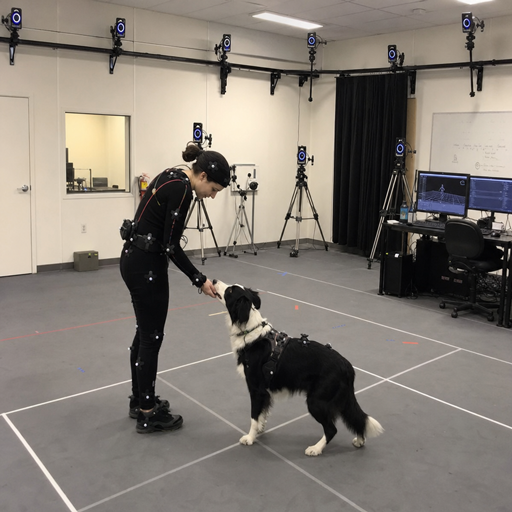
InterPet4D is different because it focuses on interaction, not just animal movement. The project presents a large-scale multimodal 4D dataset of natural human–dog interactions, combining synchronized multi-view video, egocentric video, audio, and 3D motion information for both humans and dogs. In this context, “4D” means 3D motion captured over time, so the dataset can represent not only posture and position, but also how behavior unfolds during a command, call, petting sequence, or free-form interaction.
That distinction matters because dogs rarely move in a vacuum when they interact with people. A raised hand, a spoken cue, a shift in body posture, or a person stepping closer can all change how a dog responds. Traditional animation or motion synthesis can create plausible walking, sitting, or turning, but interaction-aware models need to understand timing, context, and responsiveness. InterPet4D gives AI systems a richer starting point for learning those relationships.
The dataset was developed by researchers affiliated with the Institute of Science Tokyo and Carnegie Mellon University, with the project page listing Yichen Peng, Jyun-Ting Song, Chen-Chieh Liao, Kris Kitani, Hideki Koike, and Erwin Wu among the authors. It is associated with ECCV 2026 and has an accompanying paper, code, dataset link, and project materials.
The challenge of modeling human–dog interaction
Human–dog interaction is deceptively complex. A dog may sit after a verbal command, turn toward a hand gesture, jump toward a person, or hesitate before responding. The visible movement is only the final layer; underneath it is a coordinated exchange of signals between two very different bodies.
For AI, that creates several challenges. The system must understand human body movement, hand gestures, audio cues, and the dog’s skeletal motion as connected signals rather than separate streams. It also has to deal with practical capture problems, such as occlusion when a person and dog are close together. A hand may block the dog’s head, the dog may move behind a person’s legs, or the interaction may happen too quickly for a single camera angle to explain clearly.
InterPet4D addresses these problems by using synchronized capture from multiple viewpoints and recording both human and dog data together. According to the paper, the dataset includes annotations such as multi-view and egocentric videos, segmentations, 2D and 3D keypoints, meshes, and audio tracks. This gives researchers several ways to analyze the same interaction, from visible video to structured motion representations.
How does InterPet4D support ai-based pet motion generation?
InterPet4D supports ai-based pet motion generation by pairing human cues with corresponding dog motion, then using that paired data to train models that predict realistic dog responses. The research introduces InterPetMoGen, a MotionGPT-style framework that takes human body and hand gestures plus audio as input and generates plausible 3D dog motion as output.
In simpler terms, the model is learning a question-and-response pattern in movement. If the human raises a hand, speaks, steps forward, or performs a sequence of commands, what kind of dog motion tends to follow? The answer is not always a single fixed behavior. A realistic system must allow variation while staying aligned with the cue, because real dogs respond with different timing, body shapes, and movement styles.
The paper describes a PetVAE tokenizer that learns compact representations of dog movement and a modality-aware attention mechanism that helps the model combine different inputs during generation. That means the system is not just copying a prerecorded clip; it is learning a structured motion language for dogs, conditioned by human action and sound.
Core data signals InterPet4D brings together
- Human body motion: Helps the model understand posture, position, and movement direction.
- Hand motion: Captures gestures that are especially important in commands and close interaction.
- Audio cues: Adds spoken commands, calling, and other sound-based signals.
- Dog skeletal motion: Represents the pet’s physical response in a format useful for modeling and animation.
- Multi-view and egocentric video: Gives both outside perspectives and the human participant’s point of view.
- Interaction labels and descriptions: Provide context such as petting, commanding, calling, and free-form behavior.
Together, these signals make the dataset useful beyond simple animation. They allow AI systems to study how movement, voice, and context work together in cross-species interaction.
What the dataset includes
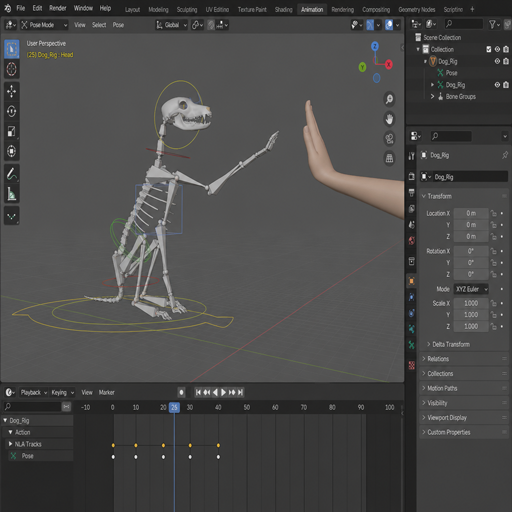
The InterPet4D paper reports 6.8 million synchronized frames collected from 13 dogs of 11 breeds interacting with 23 human participants. The Science Tokyo release describes the dataset as 6.83 million synchronized frames and notes that the team recorded 161 sessions involving the same number of participants, dogs, and breeds.
The project focuses on common obedience and interaction scenarios rather than abstract movement alone. These include petting, commanding, calling, and free-form interaction, giving the dataset a practical range of behaviors. That matters because pet motion generation becomes more useful when it can model sequences that people actually expect from dogs in real environments: turning, sitting, approaching, responding to a hand, or reacting during close contact.
A Hugging Face dataset page for InterPet4D describes time-synchronized audio, human body motion, human hand motion, and pet skeletal motion, with files organized around shared clip identifiers. That structure is important for researchers because it makes multimodal alignment easier: the audio, human movement, and pet motion can be connected at the clip level rather than reconstructed from scratch.
Why this matters for animation, robotics, and virtual companions
The most immediate application is more believable digital dogs. In animation, games, virtual production, and immersive experiences, pet characters often feel less convincing when they react late, ignore body language, or move in ways that do not match a person’s gesture. Interaction-aware generation can help create dog motion that feels more responsive to the human actor or player.
Robotics is another promising area. Socially aware robots that operate around pets, assist with training simulations, or represent companion animals need better models of animal response. InterPet4D does not solve all of those problems by itself, but it provides a standardized foundation for studying how dogs move in relation to human cues.
Behavioral analysis may also benefit. Researchers studying human–animal interaction could use structured multimodal data to explore movement patterns, timing, and responsiveness. The Science Tokyo release notes possible future relevance for behavioral analysis, animation, virtual agents, and socially aware robotics, while also acknowledging that the current work focuses on dogs and does not model physical contact forces.
Practical takeaways for teams watching this space
InterPet4D is especially relevant for teams building AI systems where animal motion must respond to human input. It suggests that the next step in pet animation is not only sharper visuals, but better behavioral alignment.
Consider these practical implications:
- Capture context, not just motion. A dog’s movement makes more sense when paired with the human cue that caused it.
- Use multimodal inputs. Gesture, body posture, and audio each contribute different information.
- Prioritize temporal alignment. For generated motion to feel natural, response timing is as important as pose quality.
- Expect variation. Dogs do not respond identically, so useful models should support plausible diversity.
- Design around limitations. Physical contact, long interactions, and unseen environments still require careful research before broad deployment.
For developers, this means future pipelines may combine motion capture, audio processing, skeleton estimation, and generative modeling more tightly. For creative teams, it means AI-generated pets may become easier to direct through human performance instead of manual keyframing alone.
The limitations are part of the story
InterPet4D is an important step, but it should not be treated as a finished solution for every animal behavior problem. The current work centers on dogs, controlled interaction tasks, and generated motion clips with defined constraints. Science Tokyo notes that the approach could later be extended to other species, physical interactions, and longer motion sequences.
That caution is healthy. Real-world dogs vary by breed, training, temperament, environment, and relationship with the human. A model trained on a dataset can learn useful patterns, but it cannot fully represent every possible dog or every social context. Responsible use should keep that boundary clear, especially if the technology is applied outside entertainment or research.
The bigger lesson is that better data changes what AI can learn. When motion generation includes human cues, speech, viewpoints, and 3D response over time, AI can move from isolated animation toward interaction-aware behavior.
A step toward more responsive digital animals
InterPet4D shows how carefully captured human–dog interaction data can push pet motion generation beyond generic movement. By connecting human gestures, audio, and dog motion, it gives researchers a practical foundation for building models that respond with more natural timing and context.
For anyone following AI animation, robotics, virtual agents, or animal-computer interaction, the project is worth watching. It points toward a future where digital pets do not simply move like dogs, but respond more like companions within a shared moment.