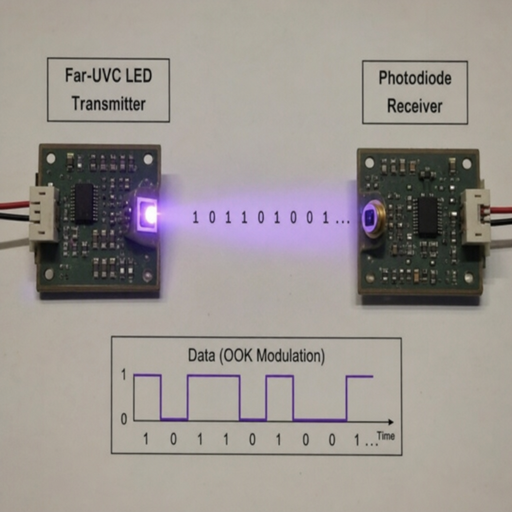
Far-UVC LEDs are moving beyond their familiar association with germ control and into high-speed optical wireless communication. A recent research demonstration used novel far-UVC LEDs to transmit data at up to 1.5 gigabits per second, setting a record for wireless optical communication at wavelengths below 235 nanometers. That matters because this part of the spectrum is largely free from solar background interference at ground level, giving engineers a new path to reliable light-based links outdoors.
What makes ar-UVC LEDs different from ordinary optical links?
Ar-UVC LEDs, more commonly discussed as far-UVC LEDs, emit ultraviolet-C light at very short wavelengths rather than visible or infrared light. Ordinary optical wireless links can be fast, but outdoor systems often fight sunlight because the sun contributes background radiation in visible and infrared bands. UVC light below 280 nanometers is mostly absorbed high in the atmosphere before reaching Earth’s surface, so a receiver tuned to this range can operate with far less solar noise.
That “solar-blind” advantage is the core reason researchers are excited. Instead of treating UVC only as a tool for uvc disinfection, engineers can also see it as a communications channel that may complement radio-frequency systems when spectrum is crowded or line-of-sight conditions are difficult. The keyword is complement: far-UVC is not replacing Wi-Fi, 5G, fiber, or conventional LiFi tomorrow. It is opening a specialized lane where light can carry data in environments that challenge other wireless methods.
Key differences include:
- Shorter wavelength: Far-UVC systems in the new demonstration operated below 235 nm, far outside the visible range.
- Lower sunlight interference: The atmosphere filters most natural UVC before it reaches the ground.
- Potentially compact emitters: LEDs can be small, rugged, and electronically modulated without the alignment demands of many laser systems.
- Different safety and design rules: UVC must be engineered carefully because artificial UVC exposure can pose skin and eye risks, even when far-UVC may penetrate tissue less deeply than longer UV wavelengths.
The record shows what UVC LED technology can become
The record-setting work came from researchers at Ferdinand-Braun-Institut in Berlin, the Institute of Photonics at the University of Strathclyde, and the LiFi Research and Development Centre at the University of Cambridge. Using far-UVC LEDs developed at FBH, the team transmitted data across a direct 30-centimeter link at rates up to 1.5 Gbps under ambient room lighting. The result was presented as a record for data transmission at such short wavelengths.
The technical trick was not simply “turning a UV LED on and off faster.” FBH optimized the LED architecture for optical communication by segmenting the emitting surface into many smaller areas. Smaller emitting areas reduce junction capacitance and allow higher current density, which improves modulation bandwidth. In plain English, the LED can change its light output quickly enough to encode a high-speed data stream.
This is where uvc led efficiency and communications performance intersect. A communication LED must provide enough optical power to reach the receiver, but it also must respond rapidly to electrical signals. For far-UVC devices, that is a demanding combination because shorter-wavelength AlGaN-based UVC LEDs still face efficiency, light extraction, and materials challenges compared with more mature visible LEDs. Recent research continues to describe external quantum efficiency as a major barrier for UVC LED development, especially at shorter wavelengths.
Why this matters for real-world wireless systems
The most obvious implication is not faster home internet through a UVC lamp. The more realistic near-term value is specialized communication where conventional radio or optical systems face limits. Autonomous vehicles, drones, robotics, industrial equipment, and emergency response tools all need reliable wireless links, and many of them operate in crowded or visually complex environments. FBH specifically frames optical wireless communication as a way to complement radio-frequency technologies as more systems compete for limited frequency bands.
The possible uv led applications are broad, but each one depends on engineering progress. A 30-centimeter line-of-sight test is not the same as a city-scale network. Longer distances, stronger receivers, safe exposure management, atmospheric testing, and packaging reliability all matter before the technology becomes practical outside the lab.
Promising use cases could include:
- Short-range machine communication: Robots, sensors, or machines could exchange data in defined industrial zones where RF congestion is an issue.
- Outdoor optical links: Solar-blind detection may help in outdoor environments that are hostile to visible or infrared optical links.
- Secure point-to-point communication: Narrow, invisible optical channels may be useful where controlled links are preferred, though security would still require encryption and system-level safeguards.
- Non-line-of-sight experiments: Because shorter wavelengths scatter more strongly in air, far-UVC may eventually support links where the transmitter and receiver are not perfectly aligned. The research team has identified this as a next area to test.
How does this connect to UVC sterilization and disinfection?
UVC sterilization and high-speed data transmission use related wavelengths, but they are not the same application. Germicidal ultraviolet systems use UV energy to inactivate viral, bacterial, and fungal organisms; CDC/NIOSH describes germicidal ultraviolet as a workplace air-cleaning and treatment technology, while also emphasizing design, testing, and safe operation.
The connection is useful because decades of interest in uvc disinfection helped drive better sources, optics, packaging, and safety practices. The uvc lamp benefits most people recognize include chemical-free air or surface treatment, compatibility with enclosed systems, and usefulness as an added layer in ventilation or decontamination strategies. However, those benefits depend heavily on dose, exposure time, geometry, maintenance, and safety controls. CDC notes that UVGI can be used as an adjunct air-cleaning measure in healthcare settings, not as a universal substitute for filtration or ventilation.
Far-UVC adds another layer to the conversation. FBH notes that radiation below 235 nm is strongly absorbed in the outer, non-living layers of skin and penetrates living tissue less deeply than longer-wavelength UV radiation. Even so, product designers cannot treat “far-UVC” as automatically safe in every context. Artificial UVC sources still require exposure limits, shielding where appropriate, reliable sensors, interlocks, and clear standards before public or occupied-space deployment.
UVC LED efficiency remains the practical bottleneck
The record is exciting because it shows speed, but practical systems also need efficiency. UVC led efficiency affects heat, battery life, package size, optical range, and total cost. If a device needs high drive current to produce useful optical power, it may become too hot, too power-hungry, or too short-lived for field use.
This is why UVC LED technology is advancing on multiple fronts at once. Researchers are not only chasing faster modulation; they are also improving epitaxial materials, chip structure, light extraction, current spreading, packaging, and thermal design. In far-UVC, these problems become tougher because high-aluminum-content materials are harder to dope and extract light from efficiently. Reviews of UVC LED development repeatedly point to material quality, hole injection, and light extraction as central obstacles.
A useful way to evaluate future claims is to ask five questions:
- What wavelength is used? A 222 nm, 235 nm, 265 nm, or 280 nm source may behave very differently.
- What data rate was achieved, and at what error rate? Peak speed alone does not define a usable link.
- What distance and alignment were required? A bench-top line-of-sight result is valuable, but it is only a first step.
- What optical power and electrical power were needed? Efficiency determines whether the design can scale.
- What safety controls are included? Any system using UVC must be designed around exposure management.
The next stage is distance, reliability, and safety
The research team’s next questions are practical ones: how far can the signal travel, how does it behave under different atmospheric conditions, and can it work without direct line of sight? Those are the right questions because a communications breakthrough becomes useful only when it survives real environments. Dust, humidity, air movement, receiver sensitivity, alignment, packaging, and long-term LED aging will all shape the answer.
For the broader UV market, the lesson is bigger than one speed record. The same platform thinking that improved UVC disinfection sources can also support new optical links, sensors, analytical tools, and industrial systems. As ar-UVC LEDs mature, they may become part of a wider family of UV LED applications where compact solid-state sources replace bulkier lamps or enable designs that older sources could not support.
The record does not mean far-UVC communication is ready for everyday networks. It does mean UVC LED technology has crossed an important threshold: it can now demonstrate data rates relevant to practical applications while operating in a spectral region with unusual outdoor advantages. If efficiency, safety, and distance continue to improve, far-UVC LEDs could become a serious tool for specialized wireless communication as well as a familiar technology in germicidal lighting.