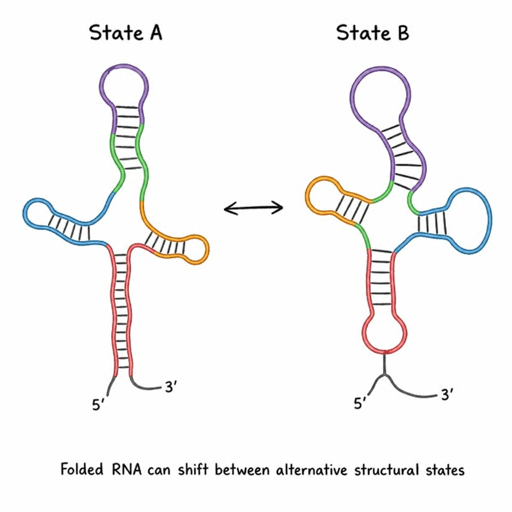
RNA is often introduced as a messenger molecule, but that description is far too small for what RNA can do. In the right structural context, RNA can fold, bind, rearrange, and accelerate chemical reactions, making RNA catalysis a central topic in RNA biology, RNA chemistry, and origin-of-life research. The most useful way to understand catalytic RNA is not as a rigid shape, but as a dynamic ensemble of related structures that shift as conditions change.
How does structure make RNA catalytic?
RNA becomes catalytic when its folded structure brings reactive groups, metal ions, and substrates into positions that favor a chemical reaction. Unlike many textbook diagrams, the active form of RNA is rarely a single frozen conformation; it is usually one state within a moving population of structures. That movement matters because rna catalysis depends on timing, proximity, charge stabilization, and the ability to sample conformations that make chemistry possible.
This is why dynamic structural ensembles are so important. An RNA molecule may spend most of its time in inactive or partially active shapes, while a smaller fraction briefly adopts a catalytically competent form. If that rare form lowers the energy barrier of a reaction, it can dominate the molecule’s functional behavior even if it is not the most populated structure.
In practical terms, catalytic activity is not simply “encoded” by sequence in a straight line. Sequence influences folding, folding creates structural possibilities, and structural motion determines which possibilities become chemically useful.
RNA is chemistry in motion
RNA chemistry is unusually rich because RNA combines information storage with chemical functionality. Its bases can pair, stack, and mispair; its backbone carries charged phosphate groups; and its ribose sugar includes a 2′-hydroxyl group that can participate in reactions or shape folding. Together, these features allow RNA to behave like both a genetic polymer and a chemical scaffold.
That scaffold is flexible. Local base pairs can open and close. Loops can dock against distant regions. Helices can bend, rotate, or stack in alternative ways. Ions and small molecules can stabilize some conformations while destabilizing others. The result is not one molecule doing one thing, but a fluctuating ensemble in which different structures are available for different tasks.
This dynamic view helps explain why catalytic rna can be sensitive to small changes. A single mutation may not directly touch the reactive site, yet it can shift the ensemble away from the active state. A magnesium ion may not be permanently bound, yet it can promote a fold that supports reaction. A substrate may not merely “fit” into a pocket; it may help organize the pocket as it binds.
The ensemble view changes how we think about catalysis
Older descriptions of rna enzymes often borrowed language from protein enzymology: active sites, substrates, cofactors, and transition states. Those terms are still useful, but RNA adds another layer. For many ribozymes, the active site is assembled through folding events that are temporary, conditional, and highly responsive to the environment.
A dynamic ensemble can support rna catalysis in several connected ways:
- Preorganization: Some conformations place reactive groups close together before the reaction begins, reducing the structural work needed for chemistry.
- Induced fit: Binding of a substrate, metal ion, or partner strand can shift the RNA toward a more active shape.
- Conformational selection: A rare active structure may already exist in the ensemble, and binding events can preferentially stabilize it.
- Electrostatic tuning: RNA’s charged backbone and associated ions can help position charges in ways that support bond breaking or bond formation.
- Product release: Motion after catalysis can help loosen the product, allowing another catalytic cycle or structural transition.
These mechanisms are not mutually exclusive. A catalytic RNA may use several of them in sequence, and the balance can change with temperature, salt conditions, sequence variation, or molecular partners.
What makes catalytic RNA different from protein enzymes?
Catalytic RNA and protein enzymes both accelerate reactions by shaping chemical environments, but they use different structural materials. Proteins have a wide range of amino acid side chains with varied chemical properties, while RNA works with nucleobases, the ribose-phosphate backbone, base pairing, stacking interactions, and bound ions. This makes RNA more chemically constrained in some ways, yet surprisingly versatile when folding and dynamics are considered.
A helpful comparison is not “which is better,” but “how does each create catalytic opportunity?”
|
Feature |
Catalytic RNA |
Protein enzymes |
|---|---|---|
|
Building blocks |
Nucleotides with bases, sugars, and phosphates |
Amino acids with diverse side chains |
|
Common structural strategy |
Base pairing, tertiary contacts, metal-ion organization |
Folded domains, active-site residues, hydrophobic packing |
|
Role of dynamics |
Often central to forming active states |
Often important for binding, specificity, and turnover |
|
Chemical toolkit |
Limited functional groups, expanded by ions and folding |
Broad side-chain chemistry |
|
Biological examples |
Ribozymes and functional RNA machines |
Most metabolic and signaling enzymes |
This comparison highlights why dynamic ensembles are so powerful for RNA. Because RNA has fewer built-in chemical groups than proteins, it often relies heavily on structure, ion coordination, and conformational rearrangement to create a reactive environment.
Laboratory selection reveals hidden catalytic possibilities
One of the most compelling ideas in the field is that rna catalysis can be selected in laboratory experiments. Researchers can begin with large pools of varied RNA sequences, apply selection pressure for a desired activity, and enrich molecules that perform the reaction better than others. Over repeated rounds, sequences with catalytic potential become easier to detect and study.
This does not mean every random RNA becomes an enzyme. It means that sequence space contains molecules capable of folding into useful structures, and selection can find them when the conditions are designed well. In this way, laboratory selection acts like a search process through possible folds, motions, and chemical behaviors.
Such experiments matter for several reasons:
- They show what RNA can do beyond known biology. Natural ribozymes are only a sample of possible catalytic forms.
- They connect sequence to structure. Selected RNAs can reveal which motifs support folding, binding, and reaction.
- They clarify the role of dynamics. Active sequences often work because they can access the right conformations, not because they are rigid.
- They inform models of early molecular evolution. If RNA can store information and catalyze reactions, it becomes a plausible bridge between chemistry and biology.
Laboratory selection also reminds us to avoid underestimating RNA. A sequence may look unremarkable until the right folding pathway, ligand, or ionic environment allows its catalytic state to emerge.
RNA synthesis and catalysis are deeply connected
RNA synthesis is both a subject of catalysis and a source of catalytic questions. In modern cells, RNA is synthesized by protein enzymes, but RNA molecules can also participate in reactions that cut, join, modify, or assemble nucleic acid strands. These activities are central to discussions about how early RNA-based systems might have copied information before protein enzymes dominated biology.
The challenge is that synthesis requires more than bond formation. A useful system must bring building blocks together, choose compatible substrates, manage side reactions, and release products without collapsing into inactive structures. Dynamic ensembles offer a way to think about these challenges. Instead of requiring a perfect static active site, an RNA molecule can sample many arrangements until some support the next chemical step.
This view is especially relevant when considering primitive or minimal systems. Early catalytic RNA would not have needed the polish of modern enzymes to matter. Even modest improvements in reaction rate, selectivity, or product stability could have influenced which molecules persisted and accumulated.
Dynamic ensembles explain sensitivity and adaptability
Anyone studying RNA biology quickly encounters a recurring pattern: small changes can have large effects. A base substitution far from a catalytic center may alter folding. A buffer change may shift activity. A partner molecule may convert an inactive RNA into an active one. These observations make sense when the active catalyst is part of an ensemble.
If an RNA sequence samples ten structural states and only one is productive, anything that increases the population of that state can increase apparent activity. Conversely, anything that stabilizes a competing state can reduce catalysis. The reaction is therefore controlled not only by the chemistry of the active state, but also by the distribution of states around it.
For researchers, this has practical implications:
- Study conditions matter, because ions, temperature, and pH can reshape the ensemble.
- Negative results may reflect poor folding rather than absence of catalytic potential.
- Mutations should be interpreted structurally, not only by their distance from the active site.
- Multiple methods are often needed to connect activity with conformation.
- Functional RNA design should account for alternative folds and kinetic traps.
This ensemble-aware approach is valuable whether the goal is to understand a natural ribozyme, improve an engineered RNA, or explore possible routes from prebiotic chemistry to early biology.
Designing better questions for RNA research
A dynamic view of catalytic RNA changes the questions scientists ask. Instead of asking only “What is the structure?” it becomes useful to ask “Which structures exist, how often do they appear, and which one performs the chemistry?” Instead of treating flexibility as disorder, researchers can investigate whether flexibility is part of the catalytic strategy.
That mindset supports better experimental design. Structural methods can be paired with kinetic measurements. Mutational studies can test whether a sequence stabilizes the active state or simply prevents misfolding. Computational models can explore transitions between conformations rather than focusing only on the lowest-energy fold.
For people approaching the topic from outside the field, the central takeaway is simple: RNA function lives in motion. Catalysis emerges when sequence, folding, chemistry, and environment align long enough for a reaction to happen.
Key takeaways
RNA is not just a passive messenger between DNA and protein. It can fold into complex shapes, form catalytic centers, and act as a chemical participant in its own right. The activity of rna enzymes often depends on dynamic structural ensembles, where rare or temporary conformations create the conditions for reaction.
The practical lesson is that rna catalysis should be understood as an emergent property. It arises from sequence, but also from folding pathways, molecular motion, ions, substrates, and environmental context. That is what makes RNA such a fascinating molecule: it is information, structure, and chemistry moving together.