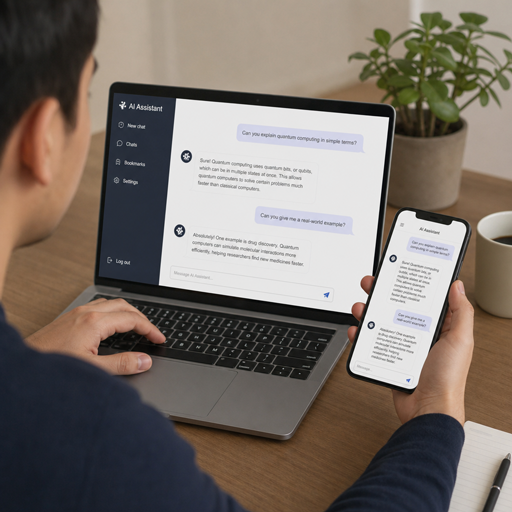
ChatGPT is evolving from a simple AI chatbot into a broader conversational AI workspace for thinking, writing, research, shopping, coding, analysis, and everyday problem-solving. The future of ChatGPT technology will likely be shaped by better natural language processing, more reliable tools, clearer trust signals, multimodal interfaces, and practical integrations that help people move from asking questions to completing tasks.
What will ChatGPT technology become next?
ChatGPT technology is likely to become less like a one-off chat window and more like an intelligent layer that helps people plan, compare, create, and act across many parts of digital life. OpenAI describes ChatGPT as a conversational AI assistant that can answer questions, explain concepts, draft and rewrite content, summarize information, translate languages, reason through problems, and adapt to conversational context. That foundation points toward a future where the assistant is not just producing text, but helping users complete multi-step work with clearer outputs and more useful context. (help-lb.openai.com)
The most important shift is from response generation to task support. Early use cases often centered on prompts like “write this email” or “explain this topic.” Newer and future use cases are more likely to involve a longer chain: gather information, compare options, draft a plan, revise it, create supporting materials, and help the user decide what to do next.
That does not mean ChatGPT will replace human judgment. It means the best versions of the technology will make judgment easier to apply. A useful assistant should reduce busywork, surface relevant options, ask clarifying questions, and help people think more clearly without pretending to be a perfect authority.
ChatGPT is moving beyond the basic chatbot
The phrase “AI chatbot” still fits ChatGPT, but it is starting to feel too small. A chatbot suggests a tool that replies to messages. ChatGPT increasingly functions as a flexible interface for writing, research, file review, image understanding, brainstorming, learning, and workflow support, depending on a user’s plan, settings, and available features. OpenAI’s own overview notes that ChatGPT can use tools such as web search, deep research, image input and generation, and file uploads in supported contexts. (help-lb.openai.com)
This matters because people do not usually want “AI” in the abstract. They want help with a specific moment: preparing for a meeting, understanding a contract clause, outlining a lesson, comparing products, debugging a confusing spreadsheet, or translating an idea into a first draft. The more ChatGPT can handle surrounding context, the more useful it becomes.
For everyday users, this future may feel less technical than expected. The interface can remain conversational while the work behind the scenes becomes more capable. Instead of learning complex software menus, people can describe what they want in plain language, refine the answer, and ask the system to adjust tone, format, depth, or next steps.
Natural language processing will become more contextual
Natural language processing is the technical foundation that allows systems like ChatGPT to interpret, generate, and respond to human language. In practical terms, better natural language processing means the assistant can understand intent more accurately, follow layered instructions, remember the thread of a conversation, and adapt its answer to the user’s goal.
The future is not only about sounding more human. It is about being more useful under messy, real-world conditions. People often ask incomplete questions, use shorthand, change their minds, upload imperfect files, or mix several goals into one request. Stronger language understanding helps the system recognize what the user is really trying to accomplish.
Several improvements will matter most:
- Better instruction following: Users should be able to set constraints such as length, audience, tone, format, and sources without repeating themselves.
- Stronger context handling: Longer conversations and larger documents can support richer, more consistent answers when the system can track what matters.
- More transparent uncertainty: When information is incomplete, the assistant should say so rather than filling gaps with confident guesses.
- Improved personalization with control: The best experience will remember useful preferences while still giving people clear ways to review, edit, or disable memory-like behavior.
- More natural collaboration: Users should be able to brainstorm, challenge, revise, and redirect the assistant without starting over.
This is where conversational AI becomes genuinely helpful. It is not just a machine that produces sentences. It becomes a working partner that can handle ambiguity, ask better follow-up questions, and shape information into something the user can act on.
Who owns ChatGPT, and why does that matter?
ChatGPT is owned and operated by OpenAI. For people searching “who owns Chatgpt,” the clearest answer is that ChatGPT is an OpenAI product, and OpenAI’s brand guidelines state that the OpenAI name, OpenAI logo, ChatGPT, GPT, and other OpenAI trademarks are property of OpenAI. OpenAI has also described its structure as including the OpenAI Foundation, which controls OpenAI Group PBC, a public benefit corporation. (openai.com)
Ownership matters because AI systems are not neutral utilities floating in the cloud. They are built, governed, branded, and maintained by organizations with policies, business models, safety processes, and product priorities. When people use ChatGPT for work, education, research, or customer-facing tasks, they need to understand who is responsible for the platform and where official guidance comes from.
It also matters for branding. Many articles, apps, and tutorials use the phrase “ChatGPT” because people recognize it, but that does not mean the name or related visual marks are free to use however someone wants. If a business wants to mention ChatGPT, display a ChatGPT logo, or show OpenAI-related marks in marketing materials, it should follow OpenAI’s brand guidelines and avoid implying endorsement or partnership where none exists. (openai.com)
The user experience will become more visual, vocal, and action-oriented
The future of ChatGPT will not be limited to typed prompts and typed answers. OpenAI’s materials already describe voice features, image input, image generation, file uploads, web browsing, and research-style tools in ChatGPT. The broader direction is clear: conversational AI is becoming multimodal, which means it can work across text, voice, images, documents, and structured tasks instead of staying inside a plain text box. (help-lb.openai.com)
Voice may be especially important because it changes when and how people use an assistant. Typing works well at a desk, but voice can support brainstorming during a walk, practicing a presentation, getting quick explanations, or working hands-free. The interaction becomes more like a conversation with a patient collaborator than a traditional search query.
Visual features also change the experience. A user might upload a screenshot and ask what is wrong, share a chart and request an explanation, or generate a mockup from a rough idea. When these features are paired with stronger reasoning, ChatGPT can help translate fuzzy concepts into clearer drafts, designs, summaries, and decisions.
Product discovery is another example of an action-oriented future. OpenAI has described shopping experiences in ChatGPT where users can explore, compare, and evaluate products with details such as price, reviews, and features in one conversational flow. That points to a larger trend: ChatGPT may increasingly help users move from “tell me about this” to “help me decide.” (openai.com)
Trust, reliability, and downtime will shape adoption
As ChatGPT becomes more embedded in work and daily routines, reliability becomes part of the product experience. People will not judge the technology only by how impressive an answer sounds. They will judge whether it is available when needed, whether it explains its limits, whether it handles sensitive tasks responsibly, and whether it gives users enough control.
That is why searches like “is ChatGPT down” are common during interruptions. The practical answer is to check OpenAI’s official status page rather than guessing from social media. As of the status page crawled on September 22, 2026, ChatGPT was listed as fully operational, though OpenAI notes that individual availability can vary by subscription tier, model, and feature. (status.openai.com)
Reliability also includes answer quality. A future-ready AI assistant should make it easier to verify important claims, especially in areas where information changes quickly. Search-backed answers, citations, document grounding, and clear uncertainty markers all help users decide how much to trust a response.
For organizations, reliability has an additional layer: governance. Teams need rules for what employees can enter into an AI system, how outputs should be reviewed, where AI can speed up work, and where human approval is required. The most successful adopters will not simply “turn on AI.” They will design workflows that combine AI speed with human accountability.
The ChatGPT logo and brand will become part of digital trust
As ChatGPT becomes more recognizable, its name and visual identity will carry more weight. A ChatGPT logo or OpenAI-related mark can signal familiarity, but it can also create confusion if used carelessly. OpenAI’s brand guidance says third parties should use OpenAI marks only when they directly relate to OpenAI services, follow the style guides and usage terms, and avoid implying endorsement, sponsorship, or partnership. (openai.com)
This is more than a design issue. In an AI-heavy internet, users will need clearer signals about what is official, what is third-party, and what is merely “powered by” or “compatible with” a model. Misleading branding can make people think they are using an official product when they are not.
For publishers, educators, developers, and businesses, the safe approach is simple: be accurate. Refer to ChatGPT when the content is actually about ChatGPT. Do not use the ChatGPT name as your own product name. Do not modify logos or place them in a way that makes your brand look officially endorsed unless you have permission.
Practical ways to prepare for the next phase of ChatGPT
The future of ChatGPT technology will reward people who learn how to collaborate with AI thoughtfully. You do not need to become a machine learning engineer to benefit. You do need to get better at asking clear questions, reviewing outputs, and deciding which tasks are appropriate for an AI assistant.
A practical preparation checklist includes:
- Build prompt habits: State your goal, audience, context, constraints, and desired format. A vague prompt often creates a vague answer.
- Use AI for drafts, not final judgment: Let ChatGPT help you outline, summarize, compare, or rephrase, then review the output with human knowledge.
- Ask for reasoning and alternatives: Request pros and cons, assumptions, edge cases, or multiple versions when the decision matters.
- Check current information: For news, prices, policies, schedules, or technical updates, use browsing or verified sources instead of relying on memory.
- Protect sensitive data: Avoid entering confidential, regulated, or personal information unless your organization has approved the tool and settings for that use.
- Document team rules: If ChatGPT is used at work, define acceptable use, review steps, privacy expectations, and who approves public-facing output.
- Stay brand-aware: If you mention ChatGPT in content or software, follow official naming and logo guidance.
These habits make the technology more useful and less risky. They also keep attention where it belongs: not on replacing people, but on improving the quality and speed of the work people already do.
The biggest opportunity is better human-computer collaboration
The most exciting future for ChatGPT is not a world where everyone passively accepts machine-generated answers. It is a world where more people can express ideas, test assumptions, understand complex topics, and complete meaningful work with less friction. ChatGPT lowers the cost of a first draft, a first explanation, a first comparison, or a first plan.
That has real implications for education, business, creativity, and accessibility. A student can ask for a concept to be explained at a different level. A small business owner can turn rough notes into a customer email. A researcher can organize questions before reading deeper. A professional can practice a difficult conversation before having it.
The risk is overreliance. If users treat conversational AI as always correct, they can miss errors, bias, outdated information, or weak reasoning. If they treat it as a collaborator, they can get the benefits while still applying experience, ethics, and common sense.
The takeaway
ChatGPT technology is moving toward a more capable, multimodal, and action-oriented future. Better natural language processing will make conversations more useful, while stronger tools will help people research, create, compare, and complete tasks with less friction.
The best way to prepare is to learn the tool without surrendering judgment to it. Understand who owns ChatGPT, check official sources when reliability matters, use the ChatGPT logo and brand responsibly, and treat conversational AI as a powerful assistant rather than an unquestionable authority. The future of ChatGPT will be shaped not only by what the technology can do, but by how thoughtfully people choose to use it.