5G expansion is more than a network upgrade; it is the practical foundation for the next era of advanced connectivity. As operators, device makers, researchers, and enterprises learn from 5G deployment, those lessons are shaping early 6G telecommunication research. This guide explains how 5G growth connects to 6G development, what 6G technology may enable, and how organizations can think about future telecommunications without getting lost in hype.
What does 5G expansion mean for early 6G research?
5G expansion means networks are moving beyond limited high-speed coverage into broader, more practical use across cities, industrial sites, transport corridors, campuses, and private environments. That matters for early 6G telecommunication research because 5G is revealing what works well, what remains difficult, and where future telecommunications must improve. Researchers are not starting from a blank page; they are using real deployment challenges, business needs, and user expectations from 5G as the starting point for 6G technology.
In simple terms, 5G is the bridge between the mobile internet era and a more deeply connected digital environment. It has introduced lower latency, higher capacity, network slicing concepts, edge computing integration, and stronger support for connected devices. Those capabilities are important, but they also expose new questions: how can networks become more energy efficient, more intelligent, more secure, more resilient, and more useful in complex real-world settings?
Early 6G development is focused on those questions. The goal is not only to make mobile networks faster. Speed will matter, but the larger shift is toward networks that can sense, compute, adapt, coordinate devices, and support immersive or mission-critical applications with far more precision than previous generations.
The role of 5G as the launchpad for future telecommunications
Each mobile generation has created the conditions for the next one. 3G made mobile data more usable. 4G made smartphones, streaming, app ecosystems, and mobile cloud services mainstream. 5G is expanding that model by supporting not only people with phones, but also machines, sensors, vehicles, production systems, and connected infrastructure.
That broader role makes 5G especially important for telecommunications innovation. It is the first generation designed with a strong focus on both consumer and industrial connectivity. Even when 5G is not fully used in every market, its architecture points toward a future where connectivity is programmable, distributed, and closely tied to computing resources.
For early 6G research, the most valuable 5G lessons often come from operational complexity. Deploying dense networks, managing spectrum, integrating cloud-native systems, securing connected devices, and balancing performance with energy use are all difficult problems. 6G development can build on these lessons by designing future networks with intelligence, automation, and sustainability in mind from the beginning.
From coverage to capability
Older network conversations often centered on coverage: whether users could get a signal and how fast a connection felt. Coverage still matters, but advanced connectivity now requires a richer view of performance. A factory robot, remote medical device, autonomous vehicle, augmented reality headset, and household smartphone do not need the same network behavior.
5G introduced the idea that networks should be able to support different service needs at the same time. This capability is still evolving, but it changes the direction of future telecommunications. 6G technology is expected to continue this shift by making networks more context-aware, more adaptive, and more closely aligned with the application using them.
From separate systems to integrated infrastructure
Another key 5G lesson is that telecom networks no longer operate in isolation. Connectivity increasingly overlaps with cloud computing, cybersecurity, artificial intelligence, data platforms, sensors, and physical infrastructure. A modern network is not just a set of antennas; it is a layered system that moves data, processes information, enforces policies, and supports digital services.
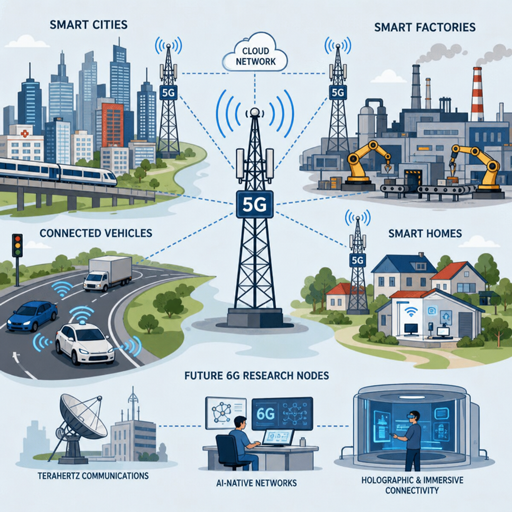
This integration is central to 6G applications. Future networks may need to support digital twins, collaborative robotics, smart transportation, immersive education, precision agriculture, and emergency response systems. None of those use cases depends on connectivity alone. They require coordination between network performance, computing location, data governance, device capability, and user experience.
Why does 6G technology matter?
6G technology matters because the next wave of digital services will require networks that are more intelligent, reliable, efficient, and responsive than current systems. While 5G improves speed and capacity, 6G research is exploring how networks can become active platforms for sensing, automation, immersive interaction, and distributed intelligence. The significance of 6G is not simply that it may offer better mobile broadband; it is that it could reshape how people, machines, and environments connect.
The demand for connectivity is becoming more diverse. A video call, a self-monitoring bridge, a warehouse robot, a drone fleet, and an extended reality training system all place different pressures on a network. Some need ultra-reliable low-latency communication. Others need massive device density, continuous sensing, strong privacy, or real-time data processing near the user.
6G development is therefore less about replacing 5G overnight and more about preparing networks for a world where digital and physical systems are increasingly blended. This future will require telecom infrastructure that can support new forms of collaboration, automation, and experience.
The shift from faster data to smarter connectivity
For many consumers, network progress has been measured by download speed. That will remain visible, but it is no longer the full story. Smarter connectivity means the network can understand service requirements, allocate resources dynamically, optimize performance, and help applications function under changing conditions.
In future telecommunications, this intelligence may appear in several ways:
- Networks that adjust performance based on the importance and urgency of a task.
- AI-assisted systems that predict congestion or failures before users feel them.
- Edge computing environments that process data close to devices instead of sending everything to distant data centers.
- Security models that continuously verify devices, users, and traffic behavior.
- Energy-aware network operations that reduce waste while maintaining service quality.
These ideas are already visible in today’s telecommunications innovation, but 6G research aims to make them more native to the network architecture.
The growing importance of trust and resilience
As connectivity becomes more embedded in daily life and critical infrastructure, trust becomes a central design requirement. Future networks will carry sensitive information, support automated decisions, and connect systems that may affect safety, business continuity, and public services. A weak or unstable network could create consequences far beyond inconvenience.
That is why 6G telecommunication research often includes topics such as security by design, privacy protection, network resilience, identity management, and dependable performance. The more society relies on advanced connectivity, the more important it becomes for networks to remain available, transparent, and protected against misuse.
Key areas of 6G telecommunication research
Early 6G research spans many technical disciplines. Some areas focus on radio performance, while others focus on intelligence, computing, sustainability, device coordination, and new service models. The common theme is that 6G development is exploring how connectivity can become more capable and more deeply integrated into the digital economy.
New spectrum possibilities
Spectrum is the invisible resource that allows wireless communication to happen. As demand grows, researchers are studying how future networks can use existing and new frequency ranges more effectively. Higher-frequency bands may support very high capacity over shorter distances, while lower and mid-band spectrum remain important for broader coverage and reliable mobility.
The practical challenge is balance. Extremely high-frequency signals can offer large capacity, but they may be more sensitive to distance, obstacles, weather, and device design constraints. Future telecommunications will likely require intelligent use of multiple spectrum layers rather than a single universal solution.
For businesses and policymakers, this means spectrum strategy will continue to be a major part of telecommunications innovation. The success of 6G applications will depend not only on laboratory breakthroughs, but also on regulatory planning, equipment ecosystems, deployment economics, and international coordination.
AI-native network operations
Artificial intelligence is expected to play a larger role in 6G technology than it has in previous generations. In 5G, AI can support network optimization, traffic analysis, predictive maintenance, and customer experience management. In 6G, researchers are exploring the idea of AI-native networks, where intelligence is built into the architecture rather than added as an external tool.
This could help networks make faster and more complex decisions. For example, an AI-assisted network might detect that a cluster of devices is moving through a transportation hub, predict the traffic pattern, and allocate resources before congestion occurs. In an industrial setting, the network might prioritize control signals for safety-critical machinery while routing less urgent data more economically.
AI-native operations also raise important questions. Models must be secure, explainable enough for operators to trust, and designed to avoid unfair or unsafe outcomes. Automation can improve efficiency, but it must be governed carefully when networks support critical services.
Integrated sensing and communication
One of the most discussed research directions is the integration of sensing and communication. Traditional networks transmit information between devices. Future networks may also help sense the environment by detecting movement, location, shapes, or changes in physical surroundings.
This does not mean every network becomes a surveillance system. It means radio signals, network data, and device interactions may be used to support context-aware services when designed with proper privacy and governance. Potential examples include traffic flow awareness, industrial safety monitoring, environmental sensing, indoor positioning, and emergency response.
Integrated sensing could make 6G applications more responsive to the physical world. A smart transportation system might detect changing road conditions. A warehouse might coordinate mobile robots with greater precision. A public safety network might help responders understand a changing environment more quickly.
Edge computing and distributed cloud
6G development is closely tied to edge computing because many advanced applications cannot rely only on distant cloud infrastructure. When an application needs rapid response, local data processing can reduce delay and improve reliability. Edge computing places compute resources closer to devices, users, factories, vehicles, or campuses.
This is especially relevant for immersive media, industrial automation, robotics, and time-sensitive analytics. If a system needs to process sensor data and respond immediately, sending every piece of information across long network paths may not be practical. Future telecommunications will likely combine central cloud, regional cloud, edge nodes, and device-level computing into one coordinated environment.
The business implication is important: telecom operators may increasingly provide not just connectivity, but also computing capabilities, developer platforms, security services, and data orchestration. That expands the role of the network from transport layer to service enabler.
Energy efficiency and sustainable design
Network growth creates an energy challenge. More devices, more data, more computing, and denser infrastructure can increase energy demand if systems are not designed carefully. Sustainability is therefore an important part of 6G telecommunication research.
Future networks may use more efficient hardware, intelligent sleep modes, renewable energy integration, adaptive coverage, and AI-assisted energy management. Researchers are also looking at how network design can reduce unnecessary data movement and optimize computing placement. A more intelligent network should not only perform better; it should use resources more responsibly.
Sustainable 6G development will matter to operators, enterprises, governments, and end users. It can affect operating costs, infrastructure planning, environmental goals, and the social acceptance of expanding digital systems.
6G applications that could define the next connectivity era
6G applications are still emerging, and many will depend on standards, devices, investment, and market demand. Still, early research points to several areas where advanced connectivity could create meaningful change. These use cases are best understood as directions rather than guaranteed products.
Immersive communication and spatial experiences
Future communication may move beyond flat screens toward more immersive forms of interaction. Extended reality, holographic-style collaboration, spatial audio, and realistic remote presence could make digital meetings, learning, design, and entertainment feel more natural.
For these experiences to work well, networks may need high capacity, low latency, consistent performance, and edge processing. A small delay or quality drop can break immersion. 6G technology may help by supporting more responsive data exchange and local processing for rich sensory content.
The practical benefit could be significant for training, healthcare collaboration, product design, remote assistance, and education. Instead of simply watching a video or joining a call, users could interact with shared digital objects, simulations, and environments.
Industrial automation and collaborative robotics
Factories, warehouses, ports, mines, and energy facilities are already exploring private wireless networks and industrial IoT. 6G development could extend these capabilities by enabling more precise coordination between machines, sensors, workers, and control systems.
Collaborative robotics may require highly reliable communication, accurate positioning, and rapid response. A mobile robot navigating a warehouse needs to understand its surroundings, coordinate with other machines, and avoid people. A production line may need connectivity that supports quality control, predictive maintenance, and flexible reconfiguration.
The value of advanced connectivity in industrial settings is not simply automation for its own sake. It is the ability to make operations safer, more adaptable, and more data-informed. However, successful adoption will depend on integration with existing systems, workforce training, cybersecurity, and clear business cases.
Connected mobility and transportation systems
Transportation is another major area for future telecommunications. Vehicles, roads, public transit systems, logistics fleets, drones, and traffic management platforms could all benefit from more advanced connectivity. 6G applications may support better situational awareness, cooperative navigation, and real-time infrastructure coordination.
A connected transport system could combine vehicle data, roadside sensors, network intelligence, and edge computing. This might help optimize routes, reduce congestion, improve safety alerts, or coordinate autonomous and human-operated systems. In aviation, ports, and rail environments, advanced connectivity could also support asset tracking and operational planning.
The challenge is that transportation networks must work across wide areas and varied conditions. Reliability, security, interoperability, and regulatory alignment will be essential. No single network generation can solve all transportation problems, but 6G research can contribute to a stronger digital foundation.
Healthcare, wellbeing, and remote support
Healthcare use cases are often discussed in future telecommunications because they require a mix of reliability, privacy, mobility, and real-time interaction. Potential 6G applications may include richer telemedicine, remote patient monitoring, connected emergency response, surgical training environments, and mobile diagnostic support.
These possibilities must be approached carefully. Medical systems require strict governance, validated tools, and human oversight. Connectivity can support care delivery, but it does not replace clinical judgment or healthcare infrastructure.
The most realistic near-term value may come from better coordination, monitoring, and access. Advanced connectivity could help specialists collaborate remotely, enable more responsive home health systems, and support medical teams in mobile or underserved environments.
Smart cities and public infrastructure
Smart city concepts often suffer from vague promises, but the underlying need is real: public infrastructure is becoming more data-driven. Transportation, energy, water, waste, emergency services, environmental monitoring, and public spaces can all benefit from better sensing and communication.
6G technology may support more integrated systems that can detect conditions, analyze data locally, and respond faster. For example, environmental sensors could help monitor air quality or flooding risk. Street infrastructure could support traffic management and public safety alerts. Utility systems could become more responsive to demand and maintenance needs.
The most important requirement is governance. Smart city connectivity must protect privacy, avoid unnecessary data collection, and serve public needs rather than becoming technology for its own sake. Successful projects will likely focus on specific civic problems, transparent data policies, and measurable service improvements.
Agriculture, environment, and remote operations
Advanced connectivity can also matter far from dense urban centers. Agriculture, forestry, energy production, and environmental monitoring often operate across large or difficult terrain. Future telecommunications may help connect sensors, autonomous equipment, drones, weather systems, and remote workers.
In agriculture, connectivity can support soil monitoring, irrigation control, livestock tracking, machinery coordination, and supply chain visibility. In environmental work, networks can help collect data from forests, waterways, coastlines, and protected areas. In energy and mining, reliable communication can improve safety and operational awareness.
The challenge is coverage economics. Remote areas are often expensive to serve. 6G research may explore hybrid networks that combine terrestrial systems, non-terrestrial networks, local edge computing, and low-power devices to make advanced connectivity more practical outside major cities.
The relationship between 5G, 5G Advanced, and 6G development
5G expansion and 6G development are not separate stories. Between them sits an important evolution often described as 5G Advanced, along with ongoing improvements to standalone 5G, private networks, edge integration, and industrial use cases. These developments allow the telecommunications ecosystem to test ideas that may later influence 6G standards and deployments.
This transition matters because network generations do not arrive as sudden replacements. They overlap for years. Devices, infrastructure, spectrum, and business models evolve gradually. Many lessons from advanced 5G deployments will shape the practical requirements for future telecommunications.
Evolution before revolution
It is tempting to describe every new mobile generation as a revolution, but real networks evolve through many incremental steps. Operators upgrade radio equipment, core networks, software, antennas, automation tools, and service platforms over time. Enterprises adopt new connectivity when it solves a practical problem, not simply because a new label exists.
That is why 6G technology should be viewed as both a research frontier and a continuation of current progress. Some concepts associated with 6G may begin appearing in earlier forms through 5G Advanced or specialized networks. Others may take longer because they require new devices, spectrum policy, standards, and deployment models.
Private networks as a testing ground
Private 5G networks are an important bridge to future telecommunications. They allow factories, campuses, hospitals, ports, and other organizations to create dedicated wireless environments tailored to their needs. These deployments can test low-latency control, secure device connectivity, edge computing, and operational automation.
The lessons are highly relevant to 6G applications. If an industrial site struggles with device onboarding, integration, cybersecurity, or return on investment in a 5G environment, those issues must be addressed before more advanced 6G capabilities can deliver value. In that sense, private network adoption can reveal both the potential and the practical barriers of next-generation connectivity.
Practical challenges facing 6G development
6G development is ambitious, but it faces technical, economic, regulatory, and social challenges. Understanding those challenges helps separate realistic planning from speculation. A future network must be deployable, affordable, secure, energy-conscious, and useful to real people and organizations.
Standards and interoperability
Telecommunications works because devices and networks from many vendors can interoperate. This depends on standards, testing, certification, and international coordination. 6G research may generate many ideas, but only some will become standardized features that can be deployed globally.
Interoperability is especially important as networks connect more industries. A smart factory, vehicle system, or healthcare platform cannot depend on isolated technology that fails outside one vendor ecosystem. Open interfaces, clear standards, and strong testing will be essential for adoption.
Cost and investment planning
Network upgrades require major investment. Operators must consider spectrum, infrastructure, power, backhaul, software systems, sites, maintenance, and customer demand. Enterprises must consider whether advanced connectivity solves problems that justify deployment and integration costs.
This is one reason 6G applications need clear value propositions. Faster speeds alone may not be enough to support widespread investment. The strongest business cases will likely connect network capability to productivity, safety, service quality, automation, resilience, or new revenue models.
Security, privacy, and governance
The more capable a network becomes, the more important governance becomes. AI-native operations, integrated sensing, edge computing, and massive device connectivity can create new security and privacy risks if they are not designed carefully.
Organizations preparing for future telecommunications should think early about data ownership, consent, access controls, encryption, identity management, vendor risk, and incident response. These issues are not side topics. They are central to whether advanced connectivity can be trusted.
Device ecosystems and battery constraints
Networks are only useful when devices can take advantage of them. Future 6G technology may require new chipsets, antennas, sensors, power systems, and software capabilities. Device cost, battery life, heat management, and size will all influence adoption.
This is especially important for wearables, sensors, industrial devices, and remote monitoring systems. A network feature that works in theory may be impractical if devices become too expensive, too power-hungry, or too complex to maintain.
Public acceptance and digital inclusion
Future telecommunications must also address social questions. Communities may care about infrastructure placement, data privacy, environmental impact, and equitable access. If advanced connectivity benefits only dense urban areas or large enterprises, its broader value will be limited.
Digital inclusion should be part of 6G research and policy conversations. Connectivity can support education, healthcare, economic opportunity, and public services, but only when networks, devices, skills, and affordability are considered together.
How organizations can prepare for future telecommunications
Organizations do not need to wait for 6G deployment to prepare for advanced connectivity. The best preparation is to build strong digital foundations now, learn from 5G expansion, and identify use cases where better connectivity would create measurable value. This approach helps businesses avoid hype while staying ready for meaningful telecommunications innovation.
A practical preparation checklist
Use the following checklist to assess readiness for 5G evolution and future 6G applications:
- Map current connectivity pain points. Identify where existing Wi-Fi, wired, 4G, or early 5G systems limit operations, mobility, safety, visibility, or customer experience.
- Define use cases before choosing technology. Start with the operational problem, not the network generation. A clear use case makes it easier to evaluate performance needs and investment.
- Assess data and computing requirements. Determine whether applications need local processing, cloud integration, edge computing, or real-time analytics.
- Review cybersecurity posture. Advanced connectivity expands the attack surface. Device identity, segmentation, monitoring, and incident response should be planned early.
- Evaluate device readiness. Consider whether sensors, machines, vehicles, wearables, or user devices can support the required network features.
- Build internal skills. Teams may need knowledge across telecom, cloud, AI, operations technology, data governance, and security.
- Pilot before scaling. Controlled pilots can reveal integration issues, performance gaps, workflow changes, and maintenance needs before a larger rollout.
- Track standards and ecosystem maturity. Avoid locking into assumptions too early. Follow credible industry standards, vendor roadmaps, and regulatory developments.
This checklist is not only for large telecom operators. Manufacturers, logistics companies, healthcare organizations, universities, utilities, cities, and technology providers can all use it to prepare for advanced connectivity.
Questions to ask before investing in new connectivity
Before adopting a new network solution, decision-makers should ask practical questions:
- What specific problem will improved connectivity solve?
- Which users, devices, or systems will depend on the network?
- How much latency, reliability, coverage, and capacity does the use case actually require?
- Does the organization need public network service, private network control, or a hybrid model?
- How will data be protected, processed, stored, and governed?
- What operational teams will support the system after deployment?
- How will success be measured beyond speed tests?
These questions keep planning grounded. They also help organizations prepare for 6G development by building the discipline to connect network investments with business outcomes.
What should leaders watch as 6G research matures?
Leaders should watch the areas where research begins turning into standards, prototypes, policy decisions, and practical ecosystem commitments. Early 6G telecommunication research is valuable, but the most important signals are those that show which ideas are becoming deployable, interoperable, and economically realistic. The path from concept to commercial network depends on alignment between technology, regulation, vendors, operators, and users.
One key signal is standardization progress. As requirements become clearer, the industry will begin narrowing broad research ideas into technical specifications. This process helps determine which capabilities become widely supported and which remain experimental.
Another signal is device and infrastructure readiness. Network features require compatible chipsets, antennas, software, testing tools, and deployment models. If the device ecosystem is slow to mature, applications may remain limited even if network research is promising.
Leaders should also watch enterprise adoption patterns. If advanced 5G and private network projects produce clear value in sectors such as manufacturing, logistics, healthcare, and transportation, they will strengthen the business case for future telecommunications investment. If deployments remain difficult or fragmented, 6G development will need to address those adoption barriers directly.
Finally, policy and public trust will matter. Spectrum allocation, security rules, sustainability expectations, infrastructure approvals, and data governance can all accelerate or slow adoption. The organizations best prepared for 6G will be those that treat connectivity as both a technical asset and a strategic responsibility.
A grounded view of the 6G future
The future of telecommunications will not be defined by one feature, one device, or one dramatic launch. It will emerge from the steady convergence of wireless networks, cloud computing, artificial intelligence, sensing, cybersecurity, and industry-specific applications. 5G expansion is teaching the market how to build and use that foundation, while 6G research is exploring what comes next.
The most realistic way to understand 6G technology is to see it as an evolution toward more intelligent and integrated connectivity. Faster performance may be part of the story, but the deeper value will come from networks that can support real-time coordination, immersive experiences, trusted automation, and efficient digital infrastructure.
For businesses, governments, and technology teams, the priority is not to chase every prediction. It is to understand the direction of change, strengthen today’s connectivity strategy, and prepare for a future where networks are more central to operations, services, and innovation.
Key takeaways
- 5G expansion is creating the technical and operational foundation for early 6G telecommunication research.
- 6G development is expected to focus on intelligence, reliability, sustainability, sensing, edge computing, and advanced connectivity, not only faster speeds.
- Potential 6G applications include immersive communication, industrial automation, connected mobility, healthcare support, smart infrastructure, agriculture, and environmental monitoring.
- The transition from 5G to 6G will be gradual, with 5G Advanced, private networks, and edge computing acting as important stepping stones.
- Practical barriers include standards, cost, security, privacy, device readiness, energy use, and digital inclusion.
- Organizations can prepare now by defining use cases, improving data and security foundations, piloting advanced connectivity, and tracking standards as they mature.
The promise of 6G is compelling, but its success will depend on disciplined development and practical adoption. The strongest telecommunications innovation will come from connecting research ambition to real human, business, and societal needs. As 5G continues to expand, the organizations that learn from it today will be better positioned to benefit from the future of advanced connectivity tomorrow.