AI is changing how mathematicians search for ideas, translate arguments into formal language, and check proofs for hidden gaps. The most important breakthroughs are not just “machines doing math,” but new workflows where language models, symbolic engines, proof assistants, and human experts each handle different parts of the reasoning process. For readers following ai mathematics, the practical takeaway is clear: AI is becoming a serious research assistant, while proof verification remains the anchor that keeps results trustworthy.
What is actually new about AI-aided mathematical proofs?
The new development is the combination of creative search with rigorous checking. Earlier proof automation could handle narrow tasks, but modern systems can propose proof strategies, generate formal proof steps, use large libraries of known results, and receive exact feedback from tools such as Lean. That turns ai mathematical proofs from a speculative idea into a workflow: generate, test, repair, and verify.
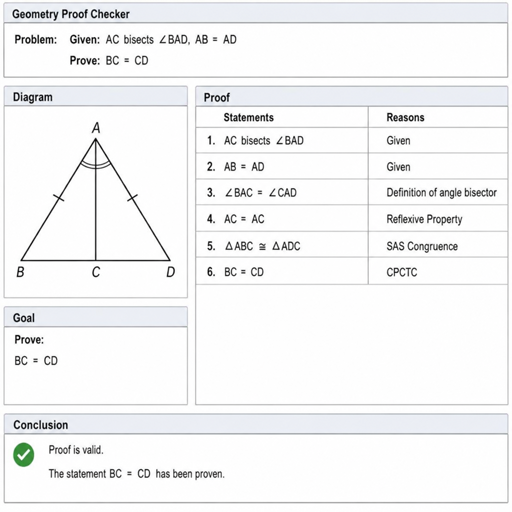
Google DeepMind’s AlphaGeometry showed how powerful this hybrid approach can be in geometry, combining a neural language model with a symbolic deduction engine to solve Olympiad-level problems; its Nature paper reported solving 25 of 30 recent Olympiad geometry problems. DeepMind later introduced AlphaProof and AlphaGeometry 2 for the 2024 International Mathematical Olympiad, reporting silver-medal-standard performance by solving four of six problems.
The shift from answer generation to proof generation
A chatbot can produce a plausible explanation. A proof assistant demands something stronger: every step must be accepted by a formal system. This distinction matters because mathematics is not only about getting the right answer; it is about showing why the answer follows from accepted assumptions.
That is where ai theorem proving becomes different from ordinary mathematical problem solving. A model may suggest a lemma, outline a path, or write code in a formal language, but a verifier decides whether the proof is valid. Lean, for example, is both a programming language and theorem prover used for formalizing mathematics and formal verification. Its community library, Mathlib, gives AI systems and human formalizers a growing base of verified mathematical knowledge to build on.
In practice, this creates a healthier role for AI. The system does not need to be trusted because it sounds confident. It needs to produce something that can be checked.
Breakthroughs pushing mathematical AI forward
Several advances are converging to make mathematical ai more useful, especially when the goal is a proof rather than a numerical answer.
- Neural-symbolic systems: AlphaGeometry is a clear example. The neural component proposes useful constructions, while symbolic reasoning checks the logical consequences. That pairing helps overcome the weakness of systems that are only statistical or only rule-based.
- Formal proof assistants: Lean and similar tools give proof automation a hard target. A proof either compiles under the rules of the system or it does not.
- Reinforcement learning for proofs: AlphaProof used reinforcement-learning ideas for formal mathematical reasoning, learning from proof attempts in a structured environment.
- AI-designed algorithms: DeepMind’s AlphaEvolve, announced in 2025, uses Gemini-powered search to design algorithms whose outputs can be automatically evaluated, including applications across mathematics and computing.
- Human-in-the-loop research: Newer systems are increasingly framed as collaborative workbenches rather than autonomous replacements, with humans steering the strategy while AI helps with formalization, search, and repair.
These breakthroughs matter because each one reduces a different bottleneck. Some help discover promising ideas. Others translate informal reasoning into formal language. Others make proof verification scalable enough to support larger projects.
Why does proof verification matter so much?
Proof verification matters because AI systems can be persuasive without being correct. In mathematics, a single invalid step can undermine an entire result, so the safest AI workflow is one that ends with a machine-checkable proof or a careful human audit. This is why formal systems are becoming central to ai logic and mathematical reasoning.
The rise of Lean-based workflows is partly a response to hallucination. Large language models are good at pattern completion, but mathematics requires durable logical structure. When an AI writes a formal proof, the proof assistant checks whether the terms, definitions, lemmas, and tactics actually establish the theorem.
That does not make the process effortless. Formalizing mathematics can be slow, strict, and sometimes far more detailed than a paper proof. But the payoff is significant: once a proof is accepted by a trusted kernel, readers can inspect it as a precise object rather than relying only on prose.
How AI fits into the mathematician’s workflow
The most realistic near-term role for AI is not “press a button, receive a theorem.” It is assistance across the proof lifecycle. A mathematician still chooses the problem, judges which ideas are meaningful, and decides whether a result is worth pursuing.
A practical AI-aided workflow might look like this:
- Explore examples: Use AI to test patterns, search for counterexamples, or rewrite a problem in simpler terms.
- Suggest lemmas: Ask the system for intermediate claims that might bridge the gap between assumptions and conclusion.
- Draft an informal proof: Generate a readable outline, then let a human identify weak points.
- Translate into formal language: Convert parts of the argument into Lean or another proof assistant.
- Run proof verification: Let the checker identify missing justifications, type errors, or invalid tactic steps.
- Repair and refine: Use AI again to propose fixes, search Mathlib, or simplify the formal proof.
This loop is where ai mathematical proofs are most compelling. The AI helps accelerate search and translation, while formal verification keeps the process honest.
The limitations are still important
The breakthroughs are real, but the field is not solved. Olympiad problems, formal benchmarks, and algorithmic challenges are valuable tests, yet research mathematics often involves ambiguous definitions, long chains of context, and judgment about what is interesting. AI can struggle when a problem requires months of conceptual reframing rather than a clever tactical search.
There is also a translation problem. Informal mathematical writing leaves many steps implicit because human readers can fill them in. Formal systems cannot. Autoformalization—the conversion of ordinary mathematical language into precise formal statements—is improving, but errors in the statement can make a verified proof less meaningful if it proves the wrong claim.
Researchers are also discovering that evaluation is difficult. A system may solve short benchmark problems but fail on longer developments that require dependency management, library navigation, and compact proof design. Recent benchmark work has emphasized this gap between proving isolated statements and handling longer, dependency-rich mathematical developments.
What these breakthroughs mean for education and research
For students, AI could become a proof tutor that gives hints, checks steps, and explains why a line of reasoning fails. That is especially useful in courses where the hardest skill is learning how to move from intuition to rigor. If the tutor is connected to a verifier, it can do more than praise a nice-looking answer; it can test whether the logic works.
For researchers, the bigger opportunity is scale. AI can scan libraries, propose reductions, formalize routine steps, and help manage sprawling proof projects. DeepMind’s research direction around AlphaEvolve points toward AI as a partner in mathematical exploration, particularly when candidate solutions can be automatically evaluated. Anthropic has also reported work on large-scale formalization, describing AI-generated Lean artifacts as robust enough to build upon in a major proof-verification project.
The cultural change may be just as important as the technical one. Mathematicians are beginning to ask not only “Can AI solve this?” but “Can AI help us make the proof clearer, more reliable, and easier to build on?”
The road ahead is collaborative
The future of ai mathematics will likely be a collaboration between human taste and machine persistence. Humans are still better at choosing fruitful questions, interpreting significance, and connecting ideas across fields. AI is increasingly good at searching, formalizing, checking, and repairing many small steps at high speed.
That combination could change the pace of mathematical work. Proof automation may reduce the burden of routine verification. AI theorem proving may make formal methods more approachable. Better proof verification may also make published mathematics easier to audit, reuse, and teach.
The real breakthrough, then, is not a single system beating a benchmark. It is the emergence of a new mathematical workflow: imaginative enough to suggest ideas, strict enough to check them, and collaborative enough to keep humans at the center of discovery.