Portable AI workmate hardware is moving from novelty gadgets toward practical work devices, with recent launches pointing to a broader market for on-device AI. The shift is visible across AI mini PCs, mobile workstations, edge developer kits, and wearable assistants that keep more processing close to the user instead of sending every task to the cloud. For buyers and teams evaluating mobile AI tools, the emerging question is no longer whether AI belongs in hardware, but which form factor fits the job.
What is changing in portable AI workmate hardware?
The biggest change is that AI capability is becoming a design requirement rather than a software add-on. IDC’s IFA 2026 coverage described AI as a force shaping device architectures, memory configurations, software environments, and deployment models across PCs, workstations, and edge systems. That matters because portable AI assistant devices need enough local compute, memory, battery efficiency, sensors, and connectivity to be useful outside a traditional desktop setup.
The latest wave of ai hardware solutions also shows a split in the market. Some products focus on general productivity, such as summarizing meetings, drafting content, searching files, and running local assistants. Others are aimed at builders who need a compact ai workstation for model testing, robotics, computer vision, or field deployment. The result is a hardware category with several competing shapes rather than one obvious winner.
Mini PCs push local AI onto the desk and into the bag
One of the clearest signals came from ASUS, which announced the Ascent QN10 on September 17, 2026. ASUS describes the device as an ultracompact AI mini PC powered by the Snapdragon X2 Elite platform, with an 18-core Qualcomm Oryon CPU and an 80 TOPS NPU. The announcement positions the mini PC as a small-form system for responsive local AI experiences that exceed Copilot+ PC requirements.
This matters because mini PCs sit between a laptop and a desktop tower. They are not pocket devices, but they can travel between offices, labs, studios, and classrooms more easily than full workstations. For many professionals, that makes portable ai workmate hardware less about replacing a phone and more about creating a movable AI node that can connect to monitors, peripherals, cameras, or local storage.
The mini PC format is especially relevant for teams that need shared workstations. A small AI box can support developers, analysts, designers, or operations teams without being tied to one person’s laptop. It also gives IT departments a more familiar management model than experimental ai tech gadgets, while still supporting newer on-device AI workloads.
Mobile workstations are absorbing AI acceleration
Portable AI hardware is also advancing through higher-performance laptops and compact workstations. AMD’s Ryzen AI Max processors, announced as part of its expanded AI PC portfolio, combine up to 16 Zen 5 CPU cores, up to 40 RDNA 3.5 graphics compute units, and an XDNA 2 NPU with up to 50 TOPS of AI processing in mobile form factors.
For users, the practical benefit is flexibility. A compact ai workstation can handle conventional productivity, creative work, code, data analysis, and AI-assisted workflows in one machine. That reduces the need to choose between a thin laptop for mobility and a heavier workstation for compute.
Still, the market is not defined by TOPS alone. Memory capacity, thermal design, battery behavior, software support, model compatibility, and security controls all affect whether AI work tools perform well in real projects. As more vendors promote local inference and agentic workflows, buyers will need to look beyond headline NPU numbers and ask how each system performs with the tools they already use.
Wearables are becoming more context-aware, not just smaller
Wearable AI hardware remains the most visible part of the category, but it has also faced the sharpest reality check. HP announced in February 2025 that it would acquire key AI capabilities from Humane, including its Cosmos platform, talent, and intellectual property, after the AI Pin struggled to establish a durable standalone device model.
At the same time, smart glasses have gained momentum because they solve a clearer problem: hands-free context. Meta introduced Ray-Ban Meta Gen 2 glasses in September 2025 with longer battery life, 3K Ultra HD video capture, and new Meta AI features. Meta also unveiled Meta Ray-Ban Display with an in-lens display and Meta Neural Band, allowing users to check messages, preview photos, and interact with visual AI prompts without pulling out a phone.
That does not mean glasses will replace phones or laptops. Instead, they suggest a narrower but more durable role for a portable ai assistant: seeing what the user sees, capturing information, translating or summarizing in context, and providing quick visual prompts. For field workers, creators, travelers, and accessibility use cases, that form factor may be more useful than another screen in the hand.
Edge kits show where serious portable AI is heading
Beyond consumer devices, developer kits and embedded systems are shaping the future of portable AI workmate hardware. NVIDIA made Jetson AGX Thor developer kits and production modules generally available in August 2025, describing them as robotics computers for physical AI and edge workloads. The platform is designed to work with NVIDIA software for robotics simulation, vision AI, and real-time sensor processing.
This class of hardware is less glamorous than smart glasses but highly important. Edge AI systems can be mounted in robots, inspection rigs, kiosks, vehicles, mobile labs, and industrial equipment. They turn portable AI from a personal convenience into infrastructure that can perceive, decide, and act close to the environment where data is created.
The form factors gaining traction
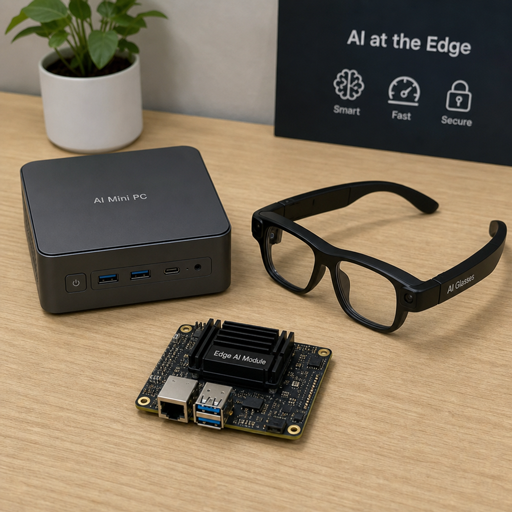
The portable AI workmate market is now separating into several practical hardware shapes:
- AI mini PCs: Best for desks, labs, shared workspaces, and teams that want local AI compute in a small fixed or semi-portable box.
- AI laptops and compact workstations: Best for professionals who need one machine for productivity, creative work, development, and AI-assisted tasks on the move.
- Smart glasses and wearables: Best for hands-free capture, contextual assistance, translation, navigation, and quick prompts.
- Edge AI developer kits: Best for robotics, sensors, vision workloads, prototyping, and field systems that cannot depend entirely on cloud connectivity.
- Specialized ai tech gadgets: Best when they solve a narrow workflow clearly, but risky when they depend on a cloud service without a strong everyday use case.
What happens next for AI work tools
The next phase will likely be defined by usefulness, not novelty. Devices that combine local AI performance with familiar workflows, strong battery life, privacy controls, and reliable software ecosystems are better positioned than products that ask users to change habits without offering a clear payoff.
For organizations, the near-term opportunity is to match hardware to workflow. A designer may need a compact ai workstation, a field technician may benefit from smart glasses, and a robotics team may need edge modules rather than consumer mobile ai tools. The portable AI workmate is becoming less like one product category and more like a set of form factors built around where work actually happens.