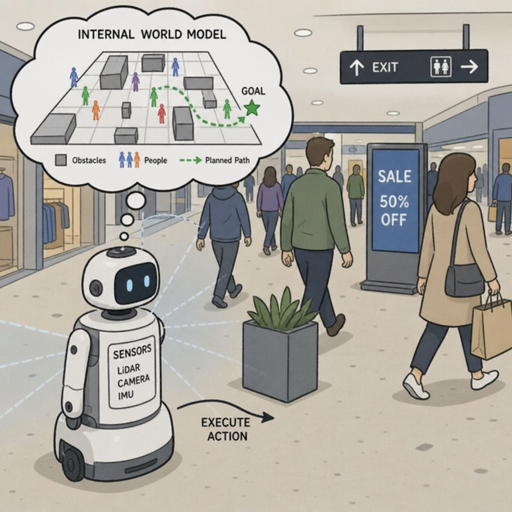
Physical AI navigation is moving beyond simple perception-and-reaction systems toward agents that can predict, plan, and adapt inside dynamic environments. World models give robots, autonomous vehicles, drones, and embodied AI systems an internal way to estimate what is happening now, what could happen next, and which action is most likely to move them safely toward a goal. For teams working with world models ai, the shift is practical: better navigation is not just about seeing more, but about understanding how the physical world changes after every decision.
What are world models in AI?
World models in AI are internal machine learning models that learn useful representations of an environment and use them to predict future states, outcomes, or consequences of actions. Instead of treating every moment as an isolated snapshot, an AI world model helps an embodied system connect perception, memory, physics, uncertainty, and control into a more coherent decision loop. In physical AI navigation, that means an agent can reason about obstacles, motion, space, and timing before it commits to movement.
The idea is not entirely new. Early and influential work by David Ha and Jürgen Schmidhuber helped popularize the term “world models” in modern machine learning by showing how an agent could learn a compressed model of its environment and use it for control. More recent research has broadened the concept across robotics, autonomous driving, embodied AI, generative simulation, video prediction, reinforcement learning, and vision-language-action systems. Surveys such as A Comprehensive Survey on World Models for Embodied AI describe world models as a unifying direction for agents that must understand and act in physical environments, while also noting open challenges around datasets, evaluation, efficiency, and long-horizon consistency.
A simple way to think about it is this: perception tells an AI system what it appears to be seeing, while a world model helps it ask, “What does this mean, what might happen next, and what should I do?” That distinction is essential for navigation because movement changes the scene. A mobile robot does not merely classify a chair, a doorway, or a pedestrian; it must understand how its own motion interacts with those objects over time.
Navigation becomes a prediction problem
Physical AI navigation is often described as a pathfinding problem, but real-world movement is rarely as clean as drawing a line from point A to point B. The agent must handle imperfect sensors, moving objects, changing lighting, unexpected barriers, slippery surfaces, human behavior, and its own mechanical limits. A world model turns navigation into a prediction-centered process: every action is evaluated not only by where it points the agent, but by what it is expected to cause.
Traditional navigation stacks often separate perception, mapping, planning, and control. That separation can be effective, especially in structured environments, but it can also create brittle behavior when the world changes faster than the pipeline can update. AI world models offer a more integrated alternative. They can learn from sequences of experience, compress relevant context, and support planning over imagined futures rather than relying only on the current observation.
This matters because physical AI lives in feedback loops. A warehouse robot turns slightly, its camera angle changes, a pallet blocks part of the aisle, another robot enters the lane, and the safest route changes. The agent needs a navigation system that can update its beliefs, simulate possible next steps, and select an action under uncertainty. That is where world models can support more flexible ai decision making.
The core ingredients of AI world models
Not every world model looks the same. Some are built for reinforcement learning, some for video generation, some for robotics control, and some for autonomous driving simulation. Still, most useful world models for navigation share a few core ingredients.
A compact representation of the environment
A robot receives high-dimensional data from cameras, lidar, depth sensors, microphones, force sensors, GPS, or inertial measurement units. Raw sensor streams are too large and noisy to reason over directly at every planning step. A world model learns a compact representation that preserves what matters for action: free space, obstacles, object locations, motion patterns, affordances, and uncertainty.
This representation may be geometric, latent, object-centric, semantic, or multimodal. The best choice depends on the task. A delivery robot navigating sidewalks may need strong object and human-motion awareness, while a drone inspecting infrastructure may need 3D structure, wind sensitivity, and collision risk.
A dynamics model for change over time
Navigation is temporal. A person crossing a hallway, a door swinging open, or a vehicle braking ahead cannot be understood from one frame alone. A dynamics component helps the system predict how the environment may evolve and how the agent’s own actions will change its future observations.
This is why world models are often associated with predictive learning. The system learns patterns such as “if I move forward, the wall expands in view,” “if the pedestrian continues at this speed, they will intersect my path,” or “if I take the narrow passage, I may not have enough room to turn.” These are not just visual predictions; they are action-relevant forecasts.
A planning or control interface
A world model becomes valuable for navigation when it can influence action. The agent may roll out possible action sequences, score them against goals and safety constraints, and choose the best next move. In other systems, the world model may support a policy network, provide simulated training experience, or help evaluate whether a proposed route is physically plausible.
This interface is where machine learning models meet real-world control. If the model is accurate but too slow, the robot cannot use it in time. If it is fast but physically unrealistic, it may choose unsafe actions. Research on physical AI world models repeatedly emphasizes this trade-off between predictive richness and real-time control needs.
Uncertainty awareness
A good navigation agent should know when it does not know. World models can represent uncertainty about hidden spaces, moving agents, sensor noise, or ambiguous object behavior. That uncertainty can then shape safer action: slowing down near blind corners, asking for human input, selecting a wider path, or gathering more information before proceeding.
Uncertainty is especially important for embodied AI because the cost of a wrong guess is physical. A chatbot can revise a sentence; a robot may collide, drop an object, block a hallway, or enter a risky zone. World models that support cautious, uncertainty-aware planning are better aligned with the demands of real environments.
How do world models improve AI decision making?
World models improve ai decision making by letting an agent evaluate possible futures before acting, rather than reacting only after the environment changes. In navigation, this creates a practical advantage: the system can compare routes, anticipate hazards, and choose actions that balance progress, safety, energy, and task constraints. The result is not perfect foresight, but a richer basis for making decisions under uncertainty.
Consider a service robot moving through a hospital corridor. A purely reactive system may detect a person and stop, then restart when the path clears. A world-model-based system can do more. It may infer that the person is pushing a cart, predict that the cart will continue across the corridor, identify an alternate side path, and slow down early to avoid an abrupt stop.
That kind of decision making depends on several capabilities working together:
- State estimation: The system estimates where it is, what surrounds it, and which parts of the scene are reliable or uncertain.
- Future prediction: It forecasts how objects, people, and the agent itself may move over the next moments.
- Counterfactual reasoning: It asks what could happen if it turns, waits, accelerates, reverses, or takes another path.
- Goal alignment: It evaluates each possible action against the navigation objective and operational constraints.
- Feedback correction: It updates the model when reality differs from prediction.
This feedback loop is central to physical intelligence. The robot is not simply executing a prewritten route; it is continuously using its internal model to reduce surprise and improve action. When world models ai systems are designed well, they become a bridge between perception and purposeful movement.
From maps to learned environments
Maps remain important. Robots still need localization, obstacle maps, semantic maps, and spatial memory. What is changing is the role of the map. In older systems, a map often acts like a fixed reference layer. In world-model-driven navigation, the “map” becomes more dynamic, predictive, and tied to experience.
A learned environment model can capture patterns that a static map misses. It may learn that a hallway is crowded at certain times, that reflective surfaces confuse depth readings, that a loading bay door frequently opens into a navigation path, or that a floor transition affects wheel traction. These patterns matter because they influence future action, not just current geometry.
This does not mean learned world models replace classical robotics overnight. In many deployments, the strongest approach is hybrid. Engineers combine proven mapping and control methods with learned predictive components that handle uncertainty and complexity. The world model may sit alongside a traditional planner, provide risk estimates, generate imagined rollouts, or help train policies in simulation before real-world testing.
The practical advantage is adaptability. A system that learns environmental dynamics can improve as it gathers more experience, provided it is trained and validated carefully. For physical AI navigation, that adaptability is one reason world models are attracting attention across robotics and embodied AI research.
The role of embodied AI in world modeling
Embodied AI refers to systems that perceive, act, and learn through interaction with an environment. A language model can reason about a room from text, but an embodied agent must move through the room, avoid the furniture, handle occlusion, and react to changes. This physical grounding makes world modeling both harder and more useful.
Surveys on embodied world models describe a fast-expanding research area that connects model-based reinforcement learning, generative AI, robotics, simulation, autonomous driving, and vision-language-action models. The common theme is that agents need internal representations that support physical interaction, not just recognition.
Embodied AI also forces world models to confront constraints that are easy to overlook in digital-only settings:
- Latency matters because a prediction that arrives too late may be useless for control.
- Physical consistency matters because objects cannot teleport, merge, or ignore contact dynamics.
- Long-horizon coherence matters because navigation goals often require many steps across changing scenes.
- Data quality matters because real robot experience is expensive, risky, and unevenly distributed.
- Transfer matters because a model trained in one building, vehicle, or robot body may not generalize cleanly to another.
These constraints explain why physical AI navigation is such a strong test case for world models. A navigation agent must connect abstract reasoning with grounded action. If it cannot predict how space, motion, and objects interact, its intelligence remains shallow.
Practical navigation use cases taking shape
World models are not a single product category. They are a design pattern appearing across many navigation systems and research directions. The most promising use cases are those where prediction, simulation, and adaptive control directly improve performance.
Mobile robots in human spaces
Indoor service robots, cleaning robots, hospital assistants, and warehouse robots operate around people, furniture, doors, carts, shelves, and temporary obstacles. A world model can help them anticipate movement, choose polite paths, and handle partial information. Instead of freezing whenever a scene becomes ambiguous, the robot can estimate likely outcomes and act cautiously.
For example, a robot approaching an intersection in a hallway may predict whether another person is likely to appear from the side. It may slow down, widen its turning radius, or choose a route that keeps more open space available. This is navigation as social and spatial reasoning, not just obstacle avoidance.
Autonomous vehicles and road agents
Driving is one of the clearest examples of navigation as prediction. A vehicle must understand lanes, traffic lights, pedestrians, cyclists, construction zones, weather, and the likely behavior of other drivers. World models can support simulation, scenario generation, risk prediction, and planning over possible futures.
A static perception system might identify a cyclist. A stronger world model can estimate where the cyclist may be in three seconds, how nearby cars might react, and whether the ego vehicle should slow, yield, or change lanes. Because road environments are high-stakes, the world model must also be tested against rare and difficult scenarios, not just common driving patterns.
Drones and aerial navigation
Drones navigate in three dimensions, often with limited onboard compute and changing environmental forces. A world model can help predict motion through space, estimate collision risk, and adapt to wind, obstacles, or uncertain depth. For inspection, delivery, agriculture, and emergency response, the ability to imagine safe future trajectories can be more valuable than simply recognizing objects.
Humanoid and legged robots
Legged robots must navigate while also managing balance, terrain, foot placement, and body dynamics. A world model for a humanoid or quadruped may need to predict not only the external environment but also the robot’s own physical state. Stairs, slopes, loose surfaces, and cluttered rooms create challenges where navigation and locomotion cannot be fully separated.
Training agents in simulation
World models can also act as learned simulators. Instead of gathering every training example from the physical world, an agent can practice inside imagined environments or generated future states. This can reduce risk and expand the variety of scenarios available during training, though the simulated world must remain grounded enough to transfer back to reality.
A practical checklist for evaluating navigation world models
Teams exploring ai world models for physical navigation need more than impressive demos. They need a way to judge whether the model is useful, safe, and operationally realistic. The following checklist can help frame early evaluation.
- Prediction quality: Does the model forecast action-relevant changes, or does it only generate plausible-looking visuals?
- Physical consistency: Do objects, motion, contact, and space behave in ways that make sense for the deployment environment?
- Latency and compute cost: Can the model support decisions within the time available for control?
- Uncertainty handling: Does the system express low confidence and adapt behavior when observations are incomplete or ambiguous?
- Long-horizon stability: Do predictions remain coherent over multiple steps, or do small errors quickly compound?
- Generalization: Can the model handle new layouts, lighting, object arrangements, and human behaviors?
- Integration path: Can it work with existing mapping, planning, safety, and monitoring systems?
- Failure behavior: When the model is wrong, does the robot slow down, seek clarification, switch to a safer mode, or continue confidently into risk?
- Data governance: Are training and evaluation data representative, consent-aware, and appropriate for the environment?
- Operational value: Does the model improve a meaningful navigation outcome, such as fewer interventions, smoother routes, better coverage, or safer interaction?
This checklist also helps separate research excitement from deployment readiness. A model that predicts beautiful video may still be unsuitable for navigation if it fails on contact dynamics, timing, or rare hazards. Conversely, a less visually impressive model may be highly valuable if it improves real-time control and risk estimation.
The difference between prediction and understanding
A central debate around world models ai is whether prediction alone creates understanding. For navigation, the distinction is practical. A model does not need human-like consciousness to be useful, but it does need representations that support reliable action.
If a system predicts pixels without understanding physical relationships, it may produce visually convincing but operationally misleading futures. If it understands object permanence, motion constraints, spatial layout, and affordances, its predictions become more useful for planning. This is why many researchers focus less on surface realism and more on whether a world model captures causal and physical structure.
The embodied AI survey literature reflects this tension. Researchers are increasingly interested in evaluation metrics that go beyond pixel fidelity and test whether models preserve physical consistency, support control, and remain coherent over longer horizons.
For navigation teams, the lesson is clear: do not judge a world model only by how realistic its generated scene looks. Judge it by whether it helps the agent move better. The model should improve decisions, reduce unsafe surprises, and support adaptation when reality differs from expectation.
Why machine learning models alone are not enough
Machine learning models are powerful, but physical AI navigation requires a complete system. Sensors, actuators, safety layers, maps, simulators, monitoring tools, human override processes, and regulatory constraints all shape the final behavior. A world model is one part of that stack, not a magic replacement for engineering discipline.
There are several reasons for caution. First, learned models can fail outside their training distribution. A robot trained mostly in clean, well-lit corridors may struggle in cluttered, reflective, or crowded spaces. Second, long-horizon prediction errors can compound. A small error in estimating motion can lead to a poor plan several steps later. Third, embodied systems face real-time constraints; even a highly accurate model may be impractical if it cannot run fast enough.
This is why many practical systems will use layered decision making. The world model may propose or evaluate actions, while rule-based safety constraints prevent obvious hazards. A classical planner may provide stable route structure, while a learned model improves local adaptation. Human supervision may remain essential in high-risk environments.
The goal is not to choose between traditional robotics and modern AI. The goal is to combine strengths. World models can add predictive intelligence, while established engineering methods add reliability, interpretability, and guardrails.
How world models change the navigation workflow
For product teams, robotics engineers, and AI researchers, adopting world models changes how navigation systems are built. The workflow becomes less about coding every possible situation and more about designing the learning loop that helps the agent model its environment.
A typical development path may include:
- Define the navigation task clearly The team identifies the environment, robot body, sensor setup, safety requirements, and success criteria. A sidewalk delivery robot and a warehouse forklift need very different world models.
- Collect action-relevant data Data should include sequences, actions, outcomes, near misses, environmental variation, and edge cases. Single images are rarely enough because the model must learn how the world changes.
- Choose the representation strategy The team decides whether the model should emphasize geometry, objects, latent dynamics, language grounding, video prediction, occupancy, affordances, or a hybrid representation.
- Train for prediction and decision support The model should learn forecasts that matter for navigation. Predicting the next visual frame may help, but predicting collision risk, reachable space, or object motion may be more valuable.
- Evaluate in simulation and controlled reality Testing should include normal routes, rare events, sensor noise, dynamic obstacles, and environmental changes. Evaluation should measure navigation outcomes, not just model loss.
- Integrate with safety systems The world model should not be the only line of defense. Conservative fallback behavior, monitoring, and human override are especially important in early deployment.
- Improve through feedback Real-world performance data can reveal blind spots. The system should be updated carefully, with regression testing to ensure improvements in one area do not create new risks elsewhere.
This workflow highlights why world models are strategic, not decorative. They influence data collection, model design, evaluation, deployment, and continuous improvement.
The open challenges are still significant
World models are revolutionizing how researchers and builders think about physical AI navigation, but major challenges remain. The field is advancing quickly, and the gap between compelling research demos and robust deployment can be large.
One challenge is dataset scarcity. Physical interaction data is harder to collect than text or images from the web. Robots need diverse environments, actions, failures, and outcomes, yet collecting that data can be expensive and slow. Synthetic data and simulation can help, but the sim-to-real gap remains a concern.
Another challenge is long-horizon consistency. Navigation often requires many decisions over time, and prediction errors can accumulate. A world model may perform well for the next second but drift over longer planning windows. This makes evaluation difficult because short-term visual realism may hide long-term planning weakness.
Efficiency is also critical. Physical AI systems often run on limited onboard hardware and must react quickly. Large generative models can be computationally heavy, while control loops demand speed. The best navigation world model is not always the biggest model; it is the model that provides the right prediction at the right time.
Finally, evaluation standards are still evolving. Researchers have called for metrics that test physical consistency, control usefulness, and real-time decision value rather than relying only on visual similarity. Recent survey work on physical AI world models also emphasizes uncertainty representation and closed-loop decision-making as central concerns.
Where world models for navigation are heading
The future of world models in navigation will likely be hybrid, multimodal, and increasingly interactive. Instead of relying on one monolithic model, physical AI systems may combine spatial maps, predictive dynamics, language instructions, object memory, affordance models, and safety constraints. The world model becomes the connective tissue that helps these components support action.
We can expect stronger links between vision-language-action models and world models. A robot may receive a natural-language instruction, ground it in a spatial scene, predict the consequences of different routes, and execute a plan while updating its beliefs. This would make navigation more flexible because the agent could connect goals such as “avoid the crowded area,” “take the accessible route,” or “bring this to the nearest open workstation” with physical movement.
Generative simulation will also play a larger role. If world models can create realistic, controllable training environments, agents can practice rare events before facing them in reality. The key will be grounding those generated environments in physics and operational constraints, not just visual plausibility.
Another likely direction is self-improving navigation through experience. A robot fleet could learn from repeated routes, failed predictions, and human interventions. Over time, its world model could become more tuned to the environments it serves. That promise must be balanced with careful validation, privacy controls, and safety review.
Key takeaways for builders and decision makers
World models are not just another AI trend. For physical AI navigation, they address a core limitation of reactive systems: the inability to reason deeply about what could happen next. When used well, they make navigation more predictive, adaptive, and context-aware.
The most important takeaways are straightforward:
- World models help AI systems move from reaction to anticipation. They allow agents to compare possible futures before choosing an action.
- Navigation depends on physical grounding. A useful world model must support space, motion, contact, uncertainty, and time.
- Visual realism is not enough. The best test is whether the model improves safe and effective movement.
- Hybrid systems are likely to dominate near-term deployment. Learned world models will work alongside classical robotics, safety rules, maps, and human oversight.
- Evaluation must be action-centered. Teams should measure real navigation outcomes, not only prediction loss or generated image quality.
- The field is still maturing. Research such as a comprehensive survey on world models for embodied ai shows both strong momentum and unresolved challenges around data, efficiency, and long-horizon consistency.
A more intelligent path through the physical world
World models are changing physical AI navigation because they give machines a more useful internal sense of how environments behave. They help agents predict, plan, adapt, and recover when the world does not match the map. That capability is essential for robots and autonomous systems that must operate safely in human, dynamic, and imperfect spaces.
The revolution is not about replacing every navigation technique with one giant model. It is about adding predictive structure to embodied intelligence. As ai world models become more efficient, better evaluated, and more tightly integrated with control systems, they will shape the next generation of machines that can move through the physical world with greater awareness, caution, and purpose.