A quantum-safe cryptography standardization wave is the global move from quantum-vulnerable public-key cryptography toward standardized post-quantum security methods. In practical terms, it means organizations are being pushed to inventory where they use RSA, elliptic-curve cryptography, and related key-exchange or signature systems, then plan migration to quantum-resistant algorithms that can be implemented consistently across products, networks, and partners.
This wave is not a single product launch or a future research idea. It is a standards-driven transition already shaped by finalized NIST Federal Information Processing Standards for ML-KEM, ML-DSA, and SLH-DSA, with additional algorithms still being evaluated to diversify the post-quantum cryptography portfolio.
What is the quantum-safe cryptography standardization wave?
The quantum-safe cryptography standardization wave is the period in which governments, standards bodies, technology vendors, and enterprises begin replacing today’s quantum-vulnerable public-key cryptography with approved post-quantum cryptography standards. It is called a “wave” because the change does not happen in one place at one time: standards are published, vendors add support, protocols adapt, regulators set expectations, and organizations gradually migrate their systems.
The core problem is that a sufficiently capable cryptographically relevant quantum computer could break widely used public-key algorithms such as RSA and elliptic-curve cryptography. Symmetric encryption and hashing are affected differently, but public-key encryption, key establishment, and digital signatures are the main focus of the migration. That is why the conversation around quantum-safe cryptography centers on key encapsulation mechanisms, digital signature schemes, certificates, secure communication protocols, code signing, identity systems, and long-lived sensitive data.
The standardization wave matters because security teams cannot migrate to “anything quantum” and call it safe. They need algorithms that have been publicly evaluated, specified in implementable standards, supported by libraries and hardware, and accepted by partners and regulators. Standardization turns quantum-resistant algorithms from academic candidates into deployable building blocks for post-quantum security.
Defining characteristics of the wave include:
- Standards replacing speculation: Organizations are moving from research tracking to implementation planning as formal standards become available.
- A focus on public-key risk: The most urgent migration areas are key establishment, encryption, signatures, certificates, and software signing.
- Crypto-agility as a design goal: Systems need the ability to swap algorithms without major redesign because standards, implementations, and risk assumptions can evolve.
- Hybrid transition patterns: Many deployments may combine classical and post-quantum methods during the transition to reduce dependence on a single new primitive.
- Enterprise-wide discovery: The work begins with finding where cryptography is used, including hidden dependencies in applications, devices, APIs, third-party platforms, and infrastructure.
The standards that define the current wave
NIST’s post-quantum cryptography project is the central reference point for much of the current standardization activity. In August 2024, NIST released its principal post-quantum cryptography standards as FIPS publications: FIPS 203 for ML-KEM, FIPS 204 for ML-DSA, and FIPS 205 for SLH-DSA. NIST describes these as the foundation for most deployments of post-quantum cryptography.
FIPS 203 specifies ML-KEM, a module-lattice-based key-encapsulation mechanism intended as the primary standard for general encryption and key establishment use cases. In everyday security architecture, that means ML-KEM is relevant wherever systems need to agree on secrets over an untrusted network, such as transport encryption, secure tunnels, and other protocols that depend on public-key key establishment.
FIPS 204 specifies ML-DSA, a module-lattice-based digital signature algorithm. Digital signatures help prove authenticity and integrity, so ML-DSA is relevant to software updates, document signing, certificates, transaction approval, device identity, and other use cases where a recipient needs confidence that a message or artifact came from the expected source and was not altered.
FIPS 205 specifies SLH-DSA, a stateless hash-based digital signature algorithm. It is also a post-quantum digital signature standard, but its design gives organizations another option with different performance and implementation tradeoffs from ML-DSA. That diversity matters because quantum-safe cryptography is not simply about choosing one algorithm forever; it is about building a portfolio that can withstand future cryptanalysis, operational constraints, and deployment differences.
The wave is still moving. In March 2025, NIST selected HQC as an additional post-quantum encryption algorithm to serve as a backup for ML-KEM, and NIST’s fourth-round status report says HQC is the only key-establishment algorithm from that round selected for standardization.
How does quantum-safe cryptography work?
Quantum-safe cryptography works by using mathematical problems that are believed to resist attacks from both classical computers and future quantum computers. Instead of relying on the integer factorization and discrete logarithm problems behind RSA and elliptic-curve cryptography, post-quantum cryptography uses other families of problems, such as lattice-based, hash-based, code-based, or other constructions.
The important point for decision-makers is that quantum safe cryptography is usually software-deployable. It does not require a quantum computer, a quantum network, or exotic physics to run. In many cases, the goal is to update the algorithms inside familiar systems: TLS, VPNs, certificates, secure messaging, identity infrastructure, signing pipelines, and embedded device firmware.
This is where the terms can become confusing. Post-quantum cryptography refers to classical cryptographic algorithms designed to resist quantum attacks. Quantum cryptography often refers to approaches that use quantum physics, such as quantum key distribution. Both may appear in broad quantum security solutions discussions, but they are not the same thing. The standardization wave discussed here is mainly about post-quantum cryptography: practical, standardizable algorithms that can be implemented in conventional computing environments.
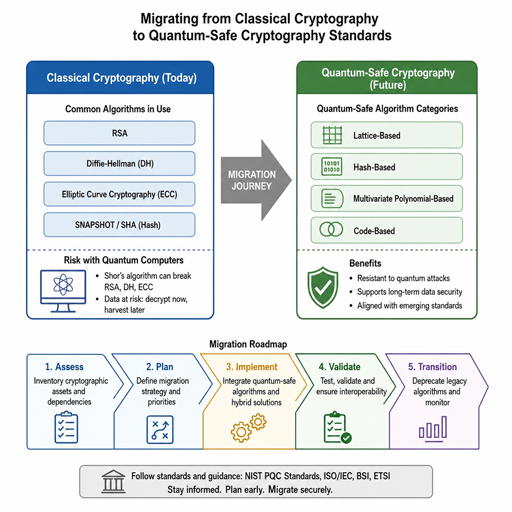
A simplified migration path looks like this:
- Identify cryptographic assets. Map where public-key encryption, key exchange, certificates, digital signatures, and signing keys are used.
- Classify risk. Prioritize systems that protect long-lived confidential data, critical infrastructure, regulated information, or durable digital signatures.
- Select standards-aligned algorithms. Align future designs with approved or emerging standards such as ML-KEM, ML-DSA, SLH-DSA, and, where appropriate, future standardized alternatives.
- Test performance and interoperability. Post-quantum algorithms can change key sizes, signature sizes, handshake behavior, bandwidth needs, and device constraints.
- Deploy through crypto-agile architecture. Design systems so algorithm updates can happen through configuration, protocol negotiation, or planned upgrade paths instead of emergency rewrites.
- Monitor standards and vendor support. Keep track of library maturity, protocol updates, product roadmaps, compliance expectations, and cryptanalytic developments.
Why standardization matters for post-quantum security
Standardization matters because cryptography fails when every organization invents its own answer. Security depends not only on strong mathematics but also on precise specifications, interoperable implementations, rigorous testing, and broad review. A standardized algorithm gives vendors and enterprises a shared target for building products, validating behavior, and communicating safely.
For post-quantum security, standardization also reduces paralysis. Before standards are finalized, teams may hesitate to deploy because candidates can change, parameter sets can shift, and interoperability is uncertain. Once a standard exists, organizations can begin serious engineering work: updating procurement requirements, testing vendor support, building migration roadmaps, and training teams.
NIST’s transition guidance frames the shift as a large stage of work beyond publication of the first standards. Its draft transition report describes an expected approach for moving from quantum-vulnerable algorithms to post-quantum digital signatures and key-establishment schemes, and NIST’s project page states that quantum-vulnerable algorithms are expected to be deprecated and ultimately removed from its standards by 2035, with higher-risk systems moving earlier.
That timeline should not be read as permission to wait. Cryptographic migration often takes years because algorithms are embedded in software, hardware, certificates, authentication flows, cloud services, operational technology, payment systems, and third-party dependencies. The systems most exposed to “harvest now, decrypt later” risk need earlier attention because encrypted data stolen today could potentially be decrypted later if it remains valuable long enough.
Standardization creates several practical benefits:
- Interoperability: Products from different vendors can communicate using the same algorithm specifications.
- Procurement clarity: Buyers can ask for standards-based post-quantum security rather than vague “quantum ready” claims.
- Implementation consistency: Developers have stable references for libraries, protocols, and validation.
- Auditability: Security, risk, and compliance teams can evaluate progress against recognized standards.
- Long-term resilience: A standards-based roadmap helps organizations avoid ad hoc deployments that become difficult to replace.
What it includes and what it does not include
Quantum-safe cryptography includes the cryptographic methods, standards, and migration practices intended to protect systems against future quantum-enabled attacks. It is not a single algorithm, a one-time software patch, or a guarantee that every system becomes secure simply because one post-quantum library is installed.
A complete view includes both technology and governance. On the technology side, teams need algorithm selection, protocol support, certificate updates, signing changes, key management, test environments, monitoring, and rollback plans. On the governance side, they need ownership, asset inventories, risk rankings, vendor requirements, policy updates, and exception handling.
It does not include magical protection for weak architecture. If an application leaks secrets, mishandles keys, skips authentication, or uses poor random number generation, changing the public-key algorithm will not fix those problems. Quantum-safe cryptography is one layer in a larger security program.
It also does not automatically mean quantum key distribution. Quantum cryptography can be part of a specialized security discussion, especially in high-assurance networking scenarios, but the mainstream enterprise transition is focused on post-quantum cryptography standards that run on ordinary digital systems. This distinction helps prevent confusion when evaluating quantum security solutions from vendors, consultants, and cloud providers.
Common components of a quantum-safe program include:
- Cryptographic inventory: A record of algorithms, protocols, keys, certificates, libraries, devices, and services in use.
- Data sensitivity mapping: A view of which data must remain confidential for years or decades.
- Standards alignment: A plan to adopt approved quantum-resistant algorithms as product support matures.
- Crypto-agility requirements: Architectural rules that make future algorithm changes manageable.
- Vendor due diligence: Questions for suppliers about standards support, timelines, dependencies, and interoperability.
- Testing and staged rollout: Controlled pilots before broad production deployment.
- Policy and training: Updated engineering standards, procurement language, and security awareness for teams that build or operate systems.
The main algorithm families behind the wave
The current wave is not built on one mathematical idea. Different quantum-resistant algorithms rely on different hard problems, and that diversity helps reduce the risk that one breakthrough undermines an entire security strategy. It also gives implementers options when use cases have different constraints.
Lattice-based cryptography is central to the first NIST standards. ML-KEM and ML-DSA are both module-lattice-based, which is why lattice assumptions are prominent in modern post-quantum cryptography planning. These algorithms are attractive for many general-purpose deployments, but they still require careful implementation, side-channel resistance, and performance testing.
Hash-based signatures provide another path for digital signatures. SLH-DSA is stateless and hash-based, making it conceptually different from lattice-based signature schemes. It can be useful as a diversity option, although practical deployment choices depend on performance, signature size, and application requirements.
Code-based cryptography remains part of the broader standards portfolio. NIST’s selection of HQC as an additional encryption algorithm reflects the value of having a backup to ML-KEM based on a different design family. That does not mean every organization will deploy every algorithm; it means the ecosystem is preparing for resilience and choice.
Other algorithm families have been studied in the broader post-quantum field, and additional digital signature work continues. NIST initiated an additional digital signature process to diversify its post-quantum signature portfolio, which is important because signature use cases vary widely across certificates, software, identity, documents, devices, and constrained environments.
Practical examples and common misconceptions
The easiest way to understand the standardization wave is to look at where cryptography appears in real systems. Most organizations use public-key cryptography far more often than they realize. It may be visible in web servers and certificates, but it is also buried inside APIs, service meshes, developer tools, mobile apps, device enrollment, file transfer systems, backups, authentication platforms, and supply-chain workflows.
Practical examples include:
- TLS and web traffic: Browsers, servers, APIs, and load balancers need post-quantum-ready key establishment as protocols and vendor implementations mature.
- VPNs and secure tunnels: Remote access and site-to-site connectivity often rely on public-key mechanisms that will need migration planning.
- Code signing: Software updates and release artifacts need signatures that remain trustworthy over time.
- Device identity: IoT, medical, industrial, and network devices may have long replacement cycles, making early planning important.
- Public key infrastructure: Certificate authorities, certificate lifetimes, enrollment systems, and trust stores must evolve together.
- Encrypted archives: Data with long confidentiality requirements may need protection before large-scale quantum computers exist.
- Cloud and SaaS dependencies: Organizations must understand when providers will support standards-based quantum-safe encryption and how that support affects shared responsibility.
Common misconceptions include:
- “Quantum-safe means quantum-powered.” Post-quantum cryptography normally runs on classical computers; it is designed to resist quantum attacks.
- “Only governments need this.” Any organization with long-lived confidential data, durable signatures, or critical infrastructure dependencies has exposure.
- “We can wait until quantum computers arrive.” Migration can take years, and stolen encrypted data may remain valuable in the future.
- “One vendor feature solves the problem.” A product setting may help, but enterprise migration requires inventory, architecture, governance, and testing.
- “Bigger keys are the whole answer.” Post-quantum migration changes algorithms, protocols, certificates, performance characteristics, and operational processes.
- “Quantum cryptography and post-quantum cryptography are interchangeable.” They are related in purpose but different in method, infrastructure, and standardization path.
These examples also explain why searches for terms such as “accenture quantum safe encryption or post-quantum cryptography” often lead to consulting, assessment, and roadmap services rather than a single downloadable tool. The challenge is not only choosing an algorithm; it is coordinating a long, multi-system transition.
Business impact for security and technology leaders
The standardization wave changes quantum-safe cryptography from a specialist research topic into a planning issue for boards, CISOs, CTOs, architects, procurement teams, and product leaders. Once standards exist, stakeholders can ask concrete questions: Which systems depend on vulnerable algorithms? Which vendors support the new standards? Which products have upgrade paths? Which data needs protection for the longest time?
For many organizations, the hardest step is not algorithm selection. It is visibility. Cryptography is often scattered across application code, open-source libraries, cloud services, hardware security modules, identity providers, network appliances, databases, backup systems, endpoint tools, and vendor-managed platforms. Without an inventory, leaders cannot estimate scope, prioritize risk, or write meaningful requirements.
The second challenge is dependency timing. A company may be ready to adopt quantum-safe cryptography, but its browsers, operating systems, hardware, cloud platforms, partners, regulators, or customers may still be moving. That is why crypto-agility matters: systems should be designed to support multiple algorithms and staged transitions rather than brittle all-or-nothing upgrades.
The third challenge is assurance. New cryptographic implementations need testing, validation, and monitoring. Post-quantum security is not just about using a named standard; it is about using it correctly, integrating it safely, and preserving reliability at production scale.
Security leaders can start with a simple prioritization checklist:
- Does the system protect information that must remain confidential for many years?
- Does it use RSA, elliptic-curve cryptography, Diffie-Hellman, or ECDH for key establishment or signatures?
- Is it exposed to the internet or a high-threat environment?
- Is it difficult to patch, replace, or reconfigure?
- Does it rely on third-party products with unclear post-quantum roadmaps?
- Does it create signatures that must be trusted far into the future?
- Would failure affect safety, operations, regulated data, customer trust, or revenue?
Systems with several “yes” answers should move toward assessment and roadmap work earlier than low-impact, easily replaceable systems.
The role of vendors, consultants, and quantum security solutions
Quantum security solutions can be useful when they help organizations discover cryptographic exposure, test standards-based implementations, improve crypto-agility, or coordinate migration across complex environments. They are less useful when they rely on vague language without explaining which standards, protocols, products, and risks they address.
A good solution should make the migration more concrete. It should help identify where vulnerable cryptography exists, map dependencies, prioritize workloads, and support staged deployment. It should also clarify whether it uses standardized post-quantum cryptography, experimental algorithms, hybrid modes, quantum key distribution, or a combination.
When evaluating vendors or advisory partners, ask practical questions:
- Which NIST post-quantum standards do you support today?
- Do you support ML-KEM for key establishment and ML-DSA or SLH-DSA for signatures where relevant?
- How do you handle hybrid classical and post-quantum modes?
- What products, protocols, and platforms are covered?
- How do you discover cryptographic usage in custom applications and third-party systems?
- What performance, bandwidth, storage, and interoperability impacts should we expect?
- How will your roadmap change if standards evolve or new algorithms are approved?
- Can we export inventory and risk data for governance, audit, and procurement use?
These questions keep the discussion grounded. They also help separate genuine quantum-safe encryption planning from marketing language that uses “quantum” without a standards-based implementation story.
A sensible path to readiness
A sensible path to quantum-safe readiness begins before a forced migration date. The goal is not to replace every cryptographic primitive immediately; it is to understand exposure, reduce high-risk dependencies, and build the ability to migrate without panic.
Start with discovery. Create a cryptographic inventory that covers applications, infrastructure, cloud services, identity systems, certificates, APIs, source code, open-source packages, devices, and vendor platforms. The inventory does not need to be perfect on day one, but it should become a living asset that improves over time.
Next, rank systems by risk. Long-lived confidential data, critical operations, externally exposed services, and hard-to-upgrade devices deserve earlier attention. Short-lived, low-sensitivity, easily patched systems may follow later as vendor support matures.
Then pilot standards-aligned changes. Test post-quantum-capable libraries, hybrid key exchange, certificate impacts, signing workflows, and performance in controlled environments. Capture what breaks, what grows, what slows down, and what requires coordination with partners.
Finally, embed quantum-safe requirements into normal technology governance. Add post-quantum security language to procurement, architecture reviews, software development standards, vendor risk management, and incident planning. The transition will be easier if it becomes part of ordinary modernization instead of a separate emergency program.
A practical readiness plan should include:
- Inventory: Find where vulnerable public-key cryptography is used.
- Prioritization: Rank systems by data lifetime, exposure, criticality, and upgrade difficulty.
- Architecture: Define crypto-agile patterns for applications, platforms, and devices.
- Standards mapping: Align target designs with NIST-standardized and emerging algorithms.
- Pilot projects: Test post-quantum security in selected low-risk environments before broad rollout.
- Vendor coordination: Track supplier roadmaps and require clear standards support.
- Governance: Maintain policies, ownership, exceptions, and progress reporting.
- Continuous monitoring: Follow standards updates, implementation guidance, and cryptanalytic developments.
The standardization wave is a migration signal
The quantum-safe cryptography standardization wave is a clear signal that post-quantum security has moved from “watch the research” to “prepare the migration.” The first major standards give organizations a practical starting point, while ongoing work on additional algorithms reinforces the need for agility and long-term planning.
For beginners, the simplest definition is this: quantum-safe cryptography is the use of cryptographic methods designed to remain secure against quantum-enabled attacks, and the standardization wave is the process of turning those methods into deployable, interoperable, trusted standards. Organizations that start with inventory, risk ranking, and standards-aligned pilots will be better positioned than those waiting for a last-minute mandate.
The work is complex, but the direction is now visible. Build crypto-agility, understand your dependencies, ask vendors specific questions, and treat quantum-resistant algorithms as part of a broader modernization of trust, identity, encryption, and digital assurance.