GTT Energy and Hudong-Zhonghua have secured Approvals in Principle from five classification societies for a 174,000 m³ LNG carrier design equipped with GTT NEXT1® membrane technology, adding fresh momentum to the system’s path toward shipyard and shipowner adoption. The approvals, announced during Gastech 2026 activity in September, cover a large LNG carrier design that targets a guaranteed boil-off rate of 0.07%, a figure positioned by GTT as an efficiency gain for LNG transportation.
The news matters because containment technology sits at the center of LNG carrier economics: less cargo evaporation can mean better energy use, stronger operational flexibility and a clearer route to meeting tightening vessel-performance expectations. For shipowners, charterers and yards tracking next-generation membrane solutions, the latest milestone places gtt next1 membrane technology closer to practical deployment on mainstream LNG carrier designs.
What did the approval cover?
The approvals cover a 174,000 m³ liquefied natural gas carrier design developed with Hudong-Zhonghua and equipped with GTT NEXT1® membrane technology. GTT said the design received Approvals in Principle from the American Bureau of Shipping, Bureau Veritas, China Classification Society, DNV and Lloyd’s Register, and that the vessel concept enables a guaranteed boil-off rate of 0.07%, improving overall vessel efficiency.
Bureau Veritas separately reported that it awarded an Approval in Principle certificate to Hudong-Zhonghua for a 174,000 cbm NEXT1 LNG carrier during a ceremony at Gastech 2026. BV said the design features GTT’s next-generation NEXT1 membrane containment system and is intended to achieve an ultra-low boil-off rate of 0.07% per day.
Key details from the announcements include:
- Vessel type: a 174,000 m³ LNG carrier design, a size class widely used for large-scale LNG transport.
- Containment system: GTT NEXT1®, described by GTT as a next-generation LNG cargo containment system.
- Approval status: Approvals in Principle from ABS, BV, CCS, DNV and Lloyd’s Register for the GTT-Hudong-Zhonghua design.
- Performance target: a guaranteed boil-off rate of 0.07%, according to GTT’s September 22, 2026 Gastech announcement.
- Operational intent: improved overall vessel efficiency, with BV also pointing to cargo evaporation reduction, energy-efficiency support and CII performance optimization.
An Approval in Principle is not the same as a shipbuilding order, a delivery schedule or a final fleet rollout. It is, however, an important technical checkpoint: classification societies review whether a design concept appears acceptable against applicable rules and safety expectations before more detailed engineering and project-specific approvals proceed.
The system targets membrane efficiency at the cargo level
The most closely watched number in the announcement is the 0.07% boil-off rate. In LNG shipping, boil-off gas is the vapor that forms when some LNG warms during transport despite cryogenic insulation. Lower boil-off supports membrane efficiency because more cargo can remain in liquid form while operators gain more control over fuel use, cargo management and voyage planning.
BV linked the lower evaporation target to improved energy efficiency and continued optimization of Carbon Intensity Indicator performance. That framing is important: containment is no longer only about holding cargo safely at very low temperature. It is also tied to the wider performance profile of the vessel, including how efficiently the ship handles cargo and how it performs under emissions-related operating metrics.
The 174,000 m³ NEXT1 carrier design is also expected to incorporate an intelligent energy-efficiency system integrating fuel management, real-time monitoring and decision-support functions. BV said the design is intended to provide broad terminal compatibility and operational flexibility, which are practical concerns for LNG carriers moving between different loading and receiving networks.
That combination helps explain why the announcement is broader than a single containment-system milestone. For owners and charterers, a lower boil-off design can support better voyage economics only if it fits real operating patterns, terminal interfaces and crew workflows. The latest approval package suggests that GTT and Hudong-Zhonghua are positioning NEXT1 as part of an integrated vessel concept rather than a standalone insulation upgrade.
NEXT1 combines familiar GTT technology families
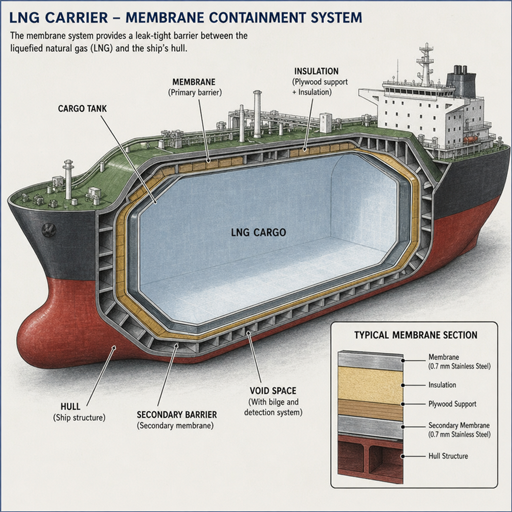
GTT has described NEXT1 as a system that combines strengths from its Mark III and NO96 technology families. In its earlier approval announcement from June 2024, GTT said NEXT1 aims to provide a thermal performance level equivalent to Mark III Flex+ while using two metallic barriers. The system uses prefabricated reinforced polyurethane foam panels to support the two membranes, with an Invar secondary barrier and a primary barrier based on the corrugated stainless-steel concept associated with GTT’s Mark technologies.
That architecture is significant because it seeks to pair performance improvement with materials and components that are already familiar within the LNG carrier ecosystem. In other words, the pitch is not only that NEXT1 can reduce boil-off; it is that it can do so while drawing from existing industrial know-how, yard experience and proven membrane concepts.
This matters for adoption. Shipyards are typically cautious about introducing new containment systems because the tank, insulation, hull interface and cargo-handling arrangements must work together under cryogenic, sloshing and structural loads. A system that advances performance while relying on known families of components may be easier to evaluate, qualify and integrate than a solution that requires a completely new construction philosophy.
GTT’s 2026 materials also describe NEXT1 as using a double metallic membrane and reporting a boil-off rate of 0.07% of volume per day for a standard 174,000 m³ LNG carrier. The company characterizes the result as one of the lowest levels on the market and says the thermal performance reduces cargo losses during transport.
The approval path has widened since 2024
The September 2026 Gastech milestone builds on earlier approvals for the underlying cargo containment system. In June 2024, GTT obtained Design Approval from Bureau Veritas and General Approval for Ship Application from Lloyd’s Register for the GTT NEXT1 LNG cargo containment system. GTT said those approvals confirmed compliance with applicable rules and regulations, including the IMO International Gas Carrier Code, and stated that the technology was ready for commercial deployment.
In February 2026, the system also received General Design Approval from the American Bureau of Shipping, according to industry reporting and GTT’s own public posting around LNG2026 in Doha. That ABS step followed the 2024 BV and Lloyd’s Register approvals and further widened the technology’s class-approval base.
The latest 174,000 m³ LNG carrier approvals are therefore best understood as design-level validation for a specific vessel concept using NEXT1, not as the first recognition of the technology itself. The distinction matters for readers following the LNG carrier market: system approval helps establish that a containment technology can meet class and regulatory expectations, while vessel-design approvals show how that system can be applied to a particular ship configuration.
GTT’s September 22, 2026 Gastech update also placed the NEXT1 carrier within a larger slate of LNG carrier developments. The company highlighted a 200,000 m³ LNG carrier concept with hybrid-electric propulsion being explored with Shell and Lloyd’s Register, and an Approval in Principle from Lloyd’s Register for a 7.5-year dry-docking interval for LNG carriers equipped with GTT membrane containment systems.
Hudong-Zhonghua adds shipbuilding weight to the development
Hudong-Zhonghua’s role gives the approval news practical relevance for the shipbuilding market. BV said the Chinese shipbuilder has developed capabilities across the LNG vessel value chain, including design, construction and supporting services, and continues to expand its high-end gas carrier portfolio.
The yard’s involvement also reflects the expanding geography of advanced LNG carrier construction. South Korean yards have long dominated high-end LNG carrier orders, but Chinese shipbuilders have been increasing their presence in large LNG carrier design and construction. A NEXT1-equipped Hudong-Zhonghua design approved by multiple classification societies gives potential owners another reference point as they assess vessel availability, yard capacity and technology options.
For GTT, the collaboration aligns with its broader model as a technology and engineering group that licenses and supports cryogenic membrane containment systems rather than building vessels itself. GTT describes its expertise as spanning LNG carriers, floating terminals, onshore storage tanks and multi-gas carriers, and says it also develops digital solutions intended to improve vessel economic and environmental performance.
The result is a three-part value chain: GTT provides the membrane technology and engineering support, Hudong-Zhonghua develops the vessel design and shipbuilding pathway, and classification societies review the concept against safety and rule requirements. That structure is typical of how complex LNG carrier innovations move from engineering concept toward commercial readiness.
Commercial implications remain measured but important
The announcements do not, by themselves, confirm a newbuilding contract, a named shipowner or a delivery date for a NEXT1-equipped LNG carrier. What they do confirm is that a mainstream-size LNG carrier design using NEXT1 has passed a meaningful concept review with five leading classification societies. For a conservative sector such as LNG shipping, that type of multi-class recognition can reduce uncertainty for future project discussions.
The main commercial implication is optionality. Shipowners comparing membrane solutions can now evaluate NEXT1 not only as an approved containment system but also as part of a class-reviewed 174,000 m³ carrier design. Charterers may also view lower boil-off performance as relevant to cargo economics, especially where voyage length, fuel strategy and emissions performance are under close scrutiny.
For shipyards, a design built around familiar GTT technologies may offer a way to market higher-value LNG carriers without requiring a full break from existing membrane construction practices. GTT has emphasized that NEXT1 uses proven materials and components while seeking performance improvements, a point likely to matter in yard qualification, workforce training and production planning.
Still, the next phase will depend on commercial decisions. Owners must weigh capital cost, yard slots, charter requirements, delivery timing, regulatory expectations and confidence in operational performance. The approval news strengthens the technical case, but market uptake will be determined by whether buyers see enough lifetime value to specify NEXT1 on future LNG carrier orders.
What comes next for NEXT1 and LNG carrier design
The next step is likely project-specific engagement among shipowners, charterers, shipyards, class societies and GTT. Detailed engineering, contract negotiations and vessel-specific approvals would be required before any individual ship enters construction with the NEXT1 system.
The approval also arrives as LNG carrier design is moving in several directions at once. GTT’s Gastech 2026 update pointed to larger vessel concepts, hybrid-electric propulsion studies, longer dry-docking intervals and digital performance services alongside containment-system development.
For the market, the immediate takeaway is clear: GTT NEXT1 has moved beyond a technology concept and into a class-reviewed LNG carrier design supported by a major Chinese shipbuilder. If the promised membrane efficiency translates into compelling total-voyage economics, NEXT1 could become one of the more closely watched membrane solutions in the next wave of LNG carrier procurement.