Copper is essential to clean tech because it moves electricity efficiently through renewable energy systems, electric vehicles, charging infrastructure, batteries, grid equipment, and advanced electronics. Closed-loop copper recycling helps manufacturers recover copper scrap, process it for reuse, and return it to production instead of treating waste as a one-way cost. This guide explains how closed-loop recycling works, why it matters for supply chains, and how businesses can build better copper waste management practices without sacrificing material quality.
What is closed-loop copper recycling?
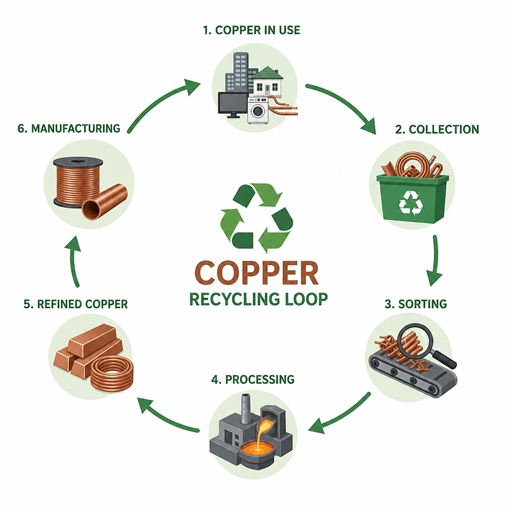
Closed-loop copper recycling is a system where copper waste from production, installation, maintenance, or end-of-life equipment is collected, sorted, processed, and reused in new copper products or components. Instead of sending scrap into a broad waste stream, the material stays within a controlled recovery loop, making it easier to preserve value, traceability, and quality.
In a clean tech supply chain, that loop may include manufacturers, fabricators, contractors, recyclers, refiners, logistics partners, and procurement teams. The goal is not simply to “recycle more,” but to create a reliable material pathway where copper can move from waste back into productive use with minimal loss. That makes closed-loop recycling both an environmental strategy and a supply chain strategy.
Traditional recycling can still deliver meaningful value, but it often blends materials from many sources. Closed-loop systems are more intentional. They focus on keeping copper streams cleaner, documenting where material comes from, and aligning recovered copper with the technical requirements of future production.
Why copper matters in clean tech supply chains
Copper plays a central role in electrification because it is conductive, durable, workable, and widely used across electrical infrastructure. Clean tech systems depend on reliable current flow, and copper is often found in wiring, busbars, motors, transformers, inverters, connectors, heat exchangers, and charging equipment.
As clean energy, electric mobility, and grid modernization expand, copper demand can place pressure on procurement teams. New mining and refining capacity can be complex, capital-intensive, and exposed to permitting, geopolitical, energy, labor, and transportation risks. Recycling does not remove the need for primary copper, but it can reduce dependence on virgin supply and help businesses make better use of material already in circulation.
For manufacturers, copper is also too valuable to manage casually. Offcuts, defective parts, stripped wire, obsolete assemblies, and returned components can represent recoverable material. A strong copper recycling process turns those streams into a managed resource rather than an uncontrolled disposal problem.
Core copper recycling benefits for clean tech companies
The copper recycling benefits are practical as well as environmental. A closed-loop approach can help companies lower waste, improve material accountability, support sustainability goals, and create more resilient sourcing models.
Key benefits include:
- Material value recovery: Copper scrap can retain significant value when it is separated, protected from contamination, and routed to qualified processors.
- Lower waste burden: Cleaner sorting reduces landfill reliance and makes it easier to manage production scrap responsibly.
- Supply chain resilience: Recovered copper can provide an additional material stream when market conditions, lead times, or supplier availability become difficult.
- Improved traceability: Closed-loop systems can document scrap origin, handling steps, and return pathways more clearly than unmanaged recycling.
- Reduced environmental impact: Reusing copper can help reduce the need for new extraction and the impacts associated with raw material production.
- Operational discipline: Scrap tracking often reveals process inefficiencies, excessive offcuts, quality defects, or design choices that create avoidable waste.
These benefits are strongest when recycling is designed into operations rather than added as an afterthought. A bin in the corner may collect scrap, but it does not automatically create a closed-loop system. The value comes from consistent segregation, clear ownership, reliable logistics, and a recycling partner capable of meeting quality expectations.
How does the copper recycling process work?
The copper recycling process typically moves through collection, identification, sorting, preparation, processing, quality control, and reintegration. In a closed-loop model, each step is managed to protect material value and make the recovered copper suitable for reuse in manufacturing or supply chain applications.
Collection and source separation
The process starts where copper waste is generated. This may be on a factory floor, at an installation site, in a repair facility, or during product takeback. Source separation is critical because clean copper scrap is easier to process and usually more valuable than mixed or contaminated material.
Common copper streams include bare bright copper wire, insulated wire, copper tubing, busbar offcuts, stamped scrap, cable assemblies, and copper-bearing components. Each stream may require different handling. For example, clean production offcuts can often move through the loop more efficiently than mixed electronic assemblies that need disassembly.
Sorting and contamination control
After collection, copper is sorted by grade, alloy, coating, insulation, and attachment to other materials. Contamination can reduce recovery efficiency and limit reuse options, so teams should keep copper away from oils, adhesives, plastics, ferrous metals, and incompatible alloys whenever possible.
Sorting may involve visual inspection, magnets, stripping, shearing, granulation, density separation, or analytical testing. The level of sorting depends on the material and the quality required for the next use. Clean tech applications can have tight electrical, mechanical, or thermal performance needs, so “close enough” material handling is not always acceptable.
Processing and refining
Prepared copper scrap may be chopped, stripped, shredded, melted, cast, refined, or otherwise converted into usable feedstock. Some material can be reused with minimal processing, while lower-grade or mixed material may require more advanced recovery.
In closed-loop recycling, the processor and manufacturer should agree on specifications before material moves. That may include acceptable alloy ranges, contamination limits, documentation requirements, packaging, and delivery format. Clear specifications reduce disputes and help ensure recycled copper can re-enter production smoothly.
Return to production
The loop closes when recovered copper becomes usable material again. It may return as rod, billet, sheet, wire, component feedstock, or another form suited to the supply chain. The exact route depends on the company’s products, quality requirements, and recycling partners.
A successful loop is measurable. Teams should know how much copper was generated, how much was recovered, how much was returned to use, and where losses occurred. Without measurement, recycling remains a good intention rather than a managed system.
Building better copper waste management systems
Copper waste management works best when it is treated as part of production planning, procurement, and sustainability reporting. The most effective systems make the correct behavior easy for operators, contractors, and logistics teams.
A practical setup should include:
- Defined material categories: Label copper streams by grade, form, and contamination risk so employees know where each type belongs.
- Dedicated containers: Use clearly marked bins, gaylords, reels, pallets, or secure storage areas to prevent mixing and theft.
- Handling rules: Create simple instructions for keeping copper dry, clean, and separated from incompatible materials.
- Tracking methods: Record weight, source department, date, material type, and transfer destination.
- Approved partners: Work with recyclers, processors, or refiners who can document material movement and meet quality expectations.
- Feedback loops: Review scrap data with engineering, purchasing, and operations to identify waste reduction opportunities.
Good copper waste management also depends on training. People need to understand why separation matters and what contamination costs the business. Short visual guides near collection points can be more effective than long policy documents that nobody reads during a busy shift.
Security should not be overlooked. Copper is valuable, and unmanaged scrap can attract loss, shrinkage, or inaccurate reporting. Secure storage, controlled pickup schedules, and documented chain of custody help protect both material and data integrity.
Designing a closed-loop recycling program
A closed-loop recycling program should be built around the materials a company actually generates, not around an abstract sustainability goal. Start with a material map that shows where copper enters the business, where waste is created, and where recovered material could realistically go.
Start with a copper flow audit
A copper flow audit identifies the main sources of copper waste and the reasons they occur. Production offcuts may come from cutting patterns. Defective components may come from quality issues. Field scrap may come from installation practices, design changes, or packaging constraints.
The audit should answer practical questions: Which copper streams are clean enough for direct recycling? Which are mixed with insulation, coatings, or other metals? Which departments generate the most recoverable value? Which materials are currently being downgraded because they are poorly sorted?
Match material streams to reuse pathways
Not every copper stream will return to the same product line. Some may be suitable for high-value applications after processing, while others may be better routed to broader recycling markets. The goal is to preserve the highest reasonable value for each stream.
Procurement and engineering teams should work together here. If recycled copper must meet a specific performance requirement, that requirement needs to be built into the recycling specification. If a stream cannot meet that standard, it should still be recovered responsibly rather than forced into an unsuitable use.
Build agreements around quality and documentation
Closed-loop systems depend on trust, but trust should be supported by documentation. Agreements with recycling partners should clarify acceptable materials, inspection rights, reporting frequency, contamination thresholds, settlement methods, and return material specifications.
Documentation also helps sustainability and compliance teams. If a company wants to report recycling progress, it needs consistent records. Vague claims about waste reduction are less useful than traceable data showing material collected, processed, and returned to use.
Where closed-loop systems create the most value
Closed-loop copper recycling is especially useful when a business generates consistent copper scrap or has recurring access to copper-rich materials. Predictable streams are easier to sort, process, and return to production.
Strong opportunities often include:
- Wire and cable manufacturing: Offcuts, reels, rejected runs, and setup scrap can often be separated by type.
- Electrical equipment production: Busbar, connector, transformer, and motor component scrap may be suitable for controlled recovery.
- Solar and wind supply chains: Installation scrap, cable waste, and electrical component returns can be captured through contractor programs.
- EV and charging infrastructure: Copper from harnesses, charging cables, power electronics, and service parts may support structured takeback.
- Industrial maintenance: Replaced motors, panels, cables, and heat exchange components can be routed into documented recycling channels.
The highest-value programs usually connect design, operations, and end-of-life planning. For example, a product designed for easier disassembly may support cleaner copper recovery later. Packaging choices, fastener selection, labeling, and material compatibility can all affect how efficiently copper is recovered.
Common obstacles and how to avoid them
The main barriers to closed-loop copper recycling are not always technical. Many are operational. Mixed scrap, inconsistent labeling, poor storage, unclear ownership, and weak communication can all reduce recovery value.
To avoid common problems:
- Do not mix clean copper with general scrap. Once a stream is contaminated, it may require extra processing or lose value.
- Do not rely on informal habits. Written procedures and visible labels reduce confusion across shifts and sites.
- Do not ignore small streams. Smaller sources can add up, especially when they are generated every day.
- Do not choose partners on price alone. Documentation, reliability, processing capability, and quality control also matter.
- Do not separate recycling from design. Engineering decisions can make future recovery easier or harder.
A useful rule is to manage copper scrap as inventory until it leaves the loop. That mindset changes behavior. Instead of asking, “How do we dispose of this?” teams begin asking, “How do we preserve its value?”
A practical checklist for getting started
Companies do not need a perfect system on day one. A focused pilot can prove value, reveal problems, and build internal support before the program expands.
Use this checklist to begin:
- Identify the top three copper waste streams by volume or value.
- Place dedicated, labeled containers at the point of generation.
- Train employees and contractors on what belongs in each container.
- Track weights and sources for at least one full production or project cycle.
- Review contamination issues and adjust handling instructions.
- Select recycling partners based on quality, transparency, and processing fit.
- Define what documentation is required for financial, operational, and sustainability reporting.
- Meet with engineering and procurement to discuss how recovered copper could re-enter the supply chain.
- Set realistic improvement targets based on actual data rather than assumptions.
Once the pilot is stable, expand to additional sites, materials, or suppliers. The best programs improve over time by using data from the recycling loop to reduce waste at the source.
Closed-loop copper recycling supports cleaner growth
Clean tech supply chains need materials that are reliable, responsibly managed, and available at scale. Closed-loop copper recycling helps companies capture the value of copper already moving through their operations while supporting better waste control and stronger material accountability.
The approach works best when it is practical: separate copper early, prevent contamination, document material movement, and build partnerships that can return recovered copper to productive use. For companies involved in electrification, renewable energy, grid infrastructure, EVs, or advanced manufacturing, closed-loop recycling can turn copper waste management into a durable supply chain advantage.