Deepfake detection has moved from simple visual spot-checking to a layered discipline that combines forensic AI, provenance records, watermarking, human review, and policy controls. The goal is no longer just to ask whether a clip “looks real,” but to run a video authenticity check that weighs technical signals, context, source history, and risk. As deepfake technology improves, the strongest defense is a workflow that treats fake video detection as an evidence-gathering process rather than a one-click verdict.
What is deepfake detection, and why is it changing?
Deepfake detection is the process of identifying whether media has been synthetically generated, manipulated, or presented in a misleading way. It is changing because modern ai-generated video can preserve facial motion, lighting, audio timing, and camera realism far better than earlier face-swap clips. That shift has pushed Deepfake detection tech toward multi-layered analysis: content-based detectors look for hidden artifacts, provenance tools examine where media came from, and watermark systems look for signals embedded at creation. NIST describes synthetic content risk reduction as a combination of provenance tracking, labeling, watermarking, automated detection, testing, and maintenance rather than a single technical fix.
This matters because the practical question is not always “Is this entire video fake?” A video may be authentic but misleadingly edited, synthetic in one section, AI-enhanced without changing meaning, or generated for legitimate creative use. Effective synthetic media detection therefore needs to separate fabrication, editing, context, and intent as much as the technology allows.
The detection landscape has expanded beyond visual artifacts
Early fake video detection often focused on visible oddities: mismatched blinking, distorted teeth, warped glasses, unnatural head movement, or blurred facial edges. Those clues still matter, but they are less reliable as generative models improve. Today’s systems increasingly inspect signals that viewers cannot easily see, including compression patterns, sensor noise, frame-level inconsistencies, audio-visual synchronization, and traces left by generation or editing pipelines.
Research and industry efforts have also shifted toward broader benchmarks. Meta’s Deepfake Detection Challenge dataset was created to help researchers test models on a large collection of research deepfakes and learn from shared approaches, while the dataset page itself encourages thinking beyond image and video analysis alone. More recent benchmark work, such as the Microsoft-Northwestern-WITNESS benchmark, focuses on evaluating and improving AI-generated content detection algorithms across realistic conditions.
Content-based forensic analysis
Content-based detection examines the media itself. For video, that may include frame-to-frame face consistency, skin texture patterns, lighting geometry, shadows, reflections, lip movement, and motion blur. For audio, it may include cadence, breath noise, spectral artifacts, room tone, and whether the voice track aligns naturally with the mouth and body.
The main advantage is that content-based analysis can be applied even when metadata has been removed. The limitation is that detectors can overfit to known generators, editing styles, or benchmark datasets. A model that performs well on yesterday’s deepfake technology may struggle with a new generator, a compressed upload, a cropped clip, or a video recorded from a screen.
Multimodal detection
Multimodal systems compare signals across image, audio, text, and context. A suspicious video might show a person speaking fluently, but the voice timbre, mouth shapes, background acoustics, and claimed location may not align. This approach is especially useful for ai-generated video because convincing visuals can still conflict with audio, source records, or real-world context.
DARPA’s Semantic Forensics program reflects this broader direction by seeking forensic technologies that help mitigate threats from synthetic and manipulated media, including methods that go beyond pixel-level inspection. In practice, this means stronger systems look for inconsistencies in meaning and context, not only technical artifacts.
Watermarking and provenance are becoming central controls
Watermarking and provenance are two of the most important advancements because they move detection closer to the point of creation. Instead of waiting for a detector to infer whether media is fake, these approaches can help show whether a file was generated, edited, signed, or distributed through a trusted workflow.
Google DeepMind’s SynthID is one example of invisible watermarking for AI-generated media. Google describes SynthID as adding an imperceptible digital watermark to AI-generated images or video segments, and its documentation says the technology can help check whether content was generated or edited by Google AI tools. This kind of system does not solve every case, because it generally applies to content from participating tools, but it adds a valuable signal when present.
C2PA takes a different approach through Content Credentials. The C2PA specification supports provenance records that describe the origin and history of media, and its explainer says these credentials can include assertions about origin, modifications, and use of AI. The current specification also supports embedded manifests across media types including images, video, audio, fonts, and documents.
Watermarks, metadata, and cryptographic signatures are not the same
A clear distinction helps teams choose the right tools:
|
Technology |
What it does |
Strength |
Limitation |
|---|---|---|---|
|
Invisible watermarking |
Embeds a hidden signal into generated media |
Can survive normal viewing and may be machine-detectable |
Usually works only for participating generators or supported formats |
|
Provenance metadata |
Records creation and editing history |
Helps establish chain of custody and tool use |
Can be stripped if platforms or workflows do not preserve it |
|
Cryptographic signing |
Verifies that a file or credential came from a trusted signer |
Useful for publishers, campaigns, agencies, and official sources |
Confirms source integrity, not necessarily truthfulness of the message |
|
Content-based detection |
Analyzes the media for artifacts or inconsistencies |
Can work even without metadata |
May produce uncertain results and needs ongoing updates |
The practical takeaway is simple: do not rely on one signal. A strong video authenticity check asks whether the file has trustworthy credentials, whether a watermark is detectable, whether forensic models find manipulation, and whether the surrounding context supports the claim.
How do modern systems perform a video authenticity check?
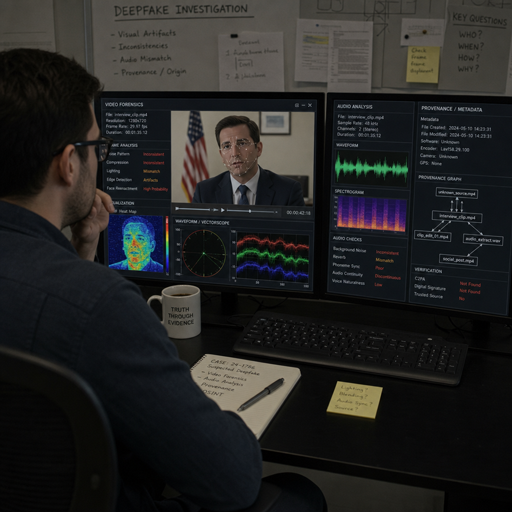
A modern video authenticity check usually starts with source preservation, then layers automated analysis, provenance review, contextual verification, and human judgment. The goal is to keep the original file intact, inspect both visible and hidden signals, and document the reasoning behind any decision. This is especially important for journalism, legal review, brand safety, elections, finance, and incident response, where a rushed “real” or “fake” label can cause harm.
A practical workflow often looks like this:
- Preserve the original file. Avoid re-exporting, trimming, or uploading it to tools that may strip metadata before analysis.
- Check provenance first. Look for Content Credentials, source signatures, upload history, creation tools, and whether the claimed publisher is consistent with the file’s origin.
- Scan for watermarks. If the media may come from a known AI generator, use supported tools to check for embedded signals.
- Run content-based detection. Analyze faces, motion, compression, audio, lighting, and cross-frame consistency.
- Compare audio and visuals. Check whether speech, mouth movement, room acoustics, emotion, and body language align.
- Verify the context. Confirm dates, locations, weather, public records, original uploads, and independent reporting where relevant.
- Assign confidence, not certainty. Use categories such as verified authentic, likely authentic, inconclusive, likely manipulated, or synthetic.
- Document the evidence. Keep tool outputs, hashes, timestamps, screenshots, source notes, and reviewer comments.
This process is slower than clicking a detector, but it is far more defensible. It also helps avoid false accusations when media is unusual but authentic, heavily compressed, translated, dubbed, edited for accessibility, or artistically stylized.
AI models are improving detection, but uncertainty remains
Machine learning remains the engine behind much of modern deepfake detection. Detectors can learn patterns across large datasets and identify subtle signals that humans miss. They are especially helpful for triage, where a platform, newsroom, or security team must prioritize which clips deserve deeper review.
However, detection models face a moving target. Generators improve, attackers adapt, and social platforms compress or transform video in ways that can erase useful clues. This creates an arms race: detectors learn yesterday’s artifacts, generators reduce them, and detection teams must retrain, validate, and monitor performance. NIST’s framing of synthetic content risk reduction emphasizes ongoing testing, evaluation, and maintenance, which reflects this reality.
The most useful model outputs are explainable
A probability score alone is rarely enough. Better tools show why a clip was flagged: a suspect face region, an unnatural audio segment, missing provenance, mismatched frame boundaries, or a detection confidence drop after compression. Explainability makes results easier to review, challenge, and communicate.
For enterprise use, this is critical. A trust and safety team may need to explain a content decision. A financial firm may need to justify why a video message from an executive was escalated. A newsroom may need to decide whether to publish, pause, or label footage while verification continues.
Detection is becoming a governance issue, not only a technical issue
Regulation and platform policy are accelerating the move from optional detection to required transparency. In the European Union, Article 50 of the AI Act includes transparency obligations for providers of AI systems that generate synthetic audio, image, video, or text content, requiring such content to be marked in a machine-readable format and detectable as artificially generated or manipulated. The same guidance addresses disclosure for deepfake content, with specific treatment for artistic, creative, satirical, fictional, or similar works.
For organizations, this changes the role of Deepfake detection tech. It is not just a defensive tool used after something goes wrong. It becomes part of publishing workflows, vendor selection, compliance reviews, incident response, and customer trust programs.
A useful internal policy should define:
- When synthetic media must be labeled in ads, training materials, social posts, product videos, or executive communications.
- Which tools are approved for watermarking, provenance, and fake video detection.
- Who can approve high-risk media involving public figures, employees, customers, financial instructions, or crisis communications.
- How evidence is stored when a clip is investigated or challenged.
- What confidence levels mean so teams do not treat every detector score as a final answer.
Best practices for choosing synthetic media detection tools
The best tool depends on the risk, volume, and environment. A newsroom verifying breaking footage needs speed, provenance support, and human review features. A bank may prioritize real-time executive impersonation detection and secure evidence logs. A platform may need scalable triage, policy integration, and model monitoring.
Use this checklist when evaluating vendors or internal systems:
- Modality coverage: Does the tool analyze video, image, audio, and metadata, or only one channel?
- Provenance support: Can it read C2PA Content Credentials or other trusted metadata?
- Watermark compatibility: Can it detect watermarks from relevant AI systems, where available?
- Explainability: Does it show the regions, frames, or signals behind its assessment?
- Robustness testing: Has it been tested on compressed, cropped, re-encoded, low-light, and screen-recorded media?
- Confidence reporting: Does it distinguish between synthetic, manipulated, authentic, and inconclusive outcomes?
- Audit trail: Can reviewers export reports, timestamps, hashes, and decision notes?
- Human workflow: Does it support escalation rather than forcing an automated final decision?
The strongest systems combine detection with operational discipline. A detector can flag risk, but people still need policies for what happens next.
The future is layered trust
Deepfake detection is advancing quickly, but the most important change is strategic: trust is becoming layered. Content-based AI, invisible watermarking, Content Credentials, cryptographic signing, and human verification each answer a different part of the authenticity question. Used together, they make it harder for synthetic media to pass unnoticed and easier for legitimate creators to prove where their media came from.
The next generation of synthetic media detection will likely be less about catching every fake after publication and more about building trustworthy creation and distribution chains from the start. For businesses, publishers, platforms, and public institutions, the smart move is to treat video authenticity check workflows as core infrastructure. Deepfake technology will keep evolving, so deepfake detection must evolve as a living system: tested, documented, updated, and supported by people who understand both the tools and the stakes.