Decentralized finance is a way of using blockchain-based tools to access financial services without relying on a traditional bank, broker, or payment processor as the central gatekeeper. Often shortened to DeFi, it uses smart contracts, crypto assets, and open networks to let people lend, borrow, trade, save, and earn rewards through software-driven systems.
The future of decentralized finance is not simply about replacing banks with apps. It is about rethinking how financial access, ownership, transparency, and risk management can work when more of the system is programmable and open to anyone with an internet connection.
What is decentralized finance?
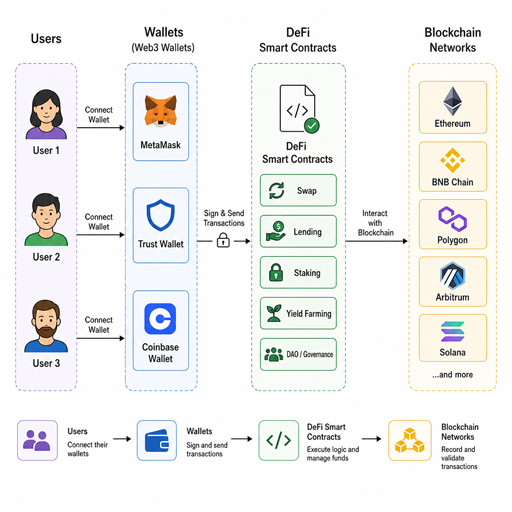
Decentralized finance, DeFi for short, is a financial ecosystem built on public blockchain networks where transactions and rules are executed by code instead of being managed entirely by centralized institutions. In practice, that means users can interact with financial applications directly through a digital wallet, often without opening a conventional account or asking permission from an intermediary.
At its core, DeFi turns familiar financial activities into blockchain-based services. A lending platform may allow users to supply crypto assets and earn interest. A decentralized exchange may let users trade tokens with one another through liquidity pools. A savings-style protocol may distribute rewards according to rules written into smart contracts.
The defining idea is not that every middleman disappears. Developers still build interfaces, communities still govern protocols, and users still depend on infrastructure. The difference is that the basic transaction logic is visible, automated, and available on-chain, which can make financial activity more open and composable than many traditional systems.
How does DeFi work?
DeFi works by combining blockchain networks, smart contracts, digital wallets, tokens, and user-facing applications. A user connects a wallet to a DeFi application, reviews the proposed transaction, and approves it. Once confirmed on the blockchain, the smart contract carries out the action according to its programmed rules.
Smart contracts are central because they act like automated agreements. If a lending protocol requires collateral before a user can borrow, the contract can lock the collateral, release borrowed assets, track repayment, and trigger liquidation rules if requirements are not met. The process is not based on a loan officer’s approval; it is based on code, collateral, and market conditions.
This structure also allows DeFi applications to connect with one another. A token earned in one protocol may be used in another. Liquidity from one market may support trading in a different application. This composability is one reason decentralized finance can evolve quickly, but it is also why problems can spread when one component fails.
Core characteristics of decentralized finance
A useful definition of decentralized finance should focus on what makes it distinct, not just on the fact that it uses cryptocurrency. DeFi is best understood through a few defining characteristics:
- Open access: Many DeFi applications are available to anyone with a compatible wallet and internet access.
- Self-custody: Users often hold and control their own crypto assets rather than depositing them with a traditional institution.
- Programmable rules: Smart contracts automate transactions, rewards, collateral requirements, and other functions.
- Transparency: Activity and contract code may be publicly visible on the blockchain, depending on the network and protocol design.
- Composability: DeFi tools can often connect, combine, or build on one another like financial building blocks.
- Token-based incentives: Protocols may use tokens to reward users, support governance, or encourage liquidity.
These features create the foundation for a more open financial environment. They also shift responsibility toward the user. In DeFi, there may be no customer service desk that can reverse a mistaken transaction, recover a lost private key, or undo a risky trade.
The main building blocks of DeFi
Decentralized finance is not a single product. It is a collection of tools that recreate or redesign financial functions using blockchain infrastructure.
Decentralized exchanges allow users to trade crypto assets without relying on a traditional order book controlled by one company. Many use automated market makers, where liquidity pools help set prices and enable trades.
Crypto lending and borrowing protocols let users supply assets to earn interest or borrow against collateral. These systems are often overcollateralized, meaning borrowers usually need to lock up assets worth more than the amount they borrow.
Stablecoins are tokens designed to track the value of another asset, often a fiat currency. They can make DeFi easier to use by reducing exposure to constant price swings, though their safety depends on design, reserves, and governance.
Yield farming refers to strategies where users move or allocate crypto assets across DeFi protocols to earn rewards, fees, or token incentives. It can be attractive, but returns often come with smart contract risk, market risk, and liquidity risk.
Governance tokens may give holders the ability to vote on protocol changes. This can include decisions about fees, reward structures, upgrades, and treasury use.
How is DeFi different from traditional finance?
DeFi differs from traditional finance in how access, trust, custody, and execution are handled. Traditional finance usually depends on regulated intermediaries such as banks, brokerages, payment networks, and clearinghouses. DeFi replaces part of that institutional trust with blockchain records and smart contracts.
That does not automatically make DeFi better in every situation. Traditional finance may offer consumer protections, legal recourse, identity verification, insurance structures, and established compliance processes. DeFi may offer faster access, greater transparency, and more user control, but it can also expose users to technical complexity and irreversible mistakes.
A simple comparison helps clarify the difference:
|
Area |
Traditional finance |
Decentralized finance |
|---|---|---|
|
Access |
Usually account-based and institution-approved |
Usually wallet-based and protocol-enabled |
|
Custody |
Assets often held by institutions |
Users often control their own assets |
|
Execution |
Managed by banks, brokers, or processors |
Automated through smart contracts |
|
Transparency |
Internal systems may be private |
On-chain activity may be publicly visible |
|
Risk support |
Legal and customer service channels may exist |
Users often bear more direct responsibility |
The practical takeaway is that DeFi changes both power and responsibility. It can support financial freedom by reducing dependence on centralized gatekeepers, but it also demands stronger personal risk awareness.
Why decentralized finance matters
DeFi matters because it expands the design space for money, markets, and financial participation. Instead of assuming every service must be built around a central company, DeFi asks what happens when financial functions become open software.
For users, this can mean more direct control over crypto assets and new ways to participate in lending, trading, governance, or liquidity provision. For developers, it can mean building financial products on shared infrastructure rather than starting from scratch. For global communities, it can create access points where traditional banking is expensive, limited, or unavailable.
The broader promise is financial freedom: the ability to store value, transfer assets, and interact with financial tools without unnecessary barriers. Still, freedom in this context does not mean freedom from risk. It means users have more choice, and with that choice comes the need to understand what they are using.
Practical examples and common use cases
DeFi becomes easier to understand when it is connected to everyday financial actions. While the tools can be complex, the goals are often familiar.
Common examples include:
- Trading tokens: A user swaps one crypto asset for another through a decentralized exchange.
- Earning lending interest: A user supplies assets to a crypto lending protocol and receives yield from borrower activity.
- Borrowing against collateral: A user locks crypto assets in a smart contract and borrows another asset without selling the original holding.
- Providing liquidity: A user deposits assets into a liquidity pool and may earn a share of trading fees or incentives.
- Participating in governance: Token holders vote on proposed changes to a protocol.
- Using stable digital value: A user holds or transfers stablecoins inside DeFi applications to reduce exposure to volatile tokens.
There are also common misconceptions. DeFi is not automatically anonymous, because blockchain activity can often be traced. It is not always cheap, because network fees can rise. It is not guaranteed passive income, because yield depends on market demand, incentives, and risk. And it is not risk-free simply because the rules are written in code.
Risks that shape the future of DeFi
The future of decentralized finance depends heavily on how the ecosystem handles risk. DeFi can make financial systems more open, but openness can also attract poorly designed projects, speculative behavior, and technical exploits.
Some of the most important risks include:
- Smart contract vulnerabilities: Bugs or design flaws can lead to losses.
- Market volatility: Crypto assets can move sharply in price, affecting collateral, liquidity, and returns.
- Liquidation risk: Borrowers can lose collateral if asset values fall or debt positions become unsafe.
- Protocol governance risk: Poor decisions, concentrated voting power, or rushed upgrades can weaken a project.
- Regulatory uncertainty: Rules may affect how protocols, interfaces, developers, and users operate.
- User error: Sending funds to the wrong address, approving malicious contracts, or losing wallet keys can be costly.
These risks do not erase DeFi’s potential, but they define its next stage. Better audits, clearer interfaces, stronger education, and more resilient protocol design will matter as much as innovation itself.
The future of DeFi is likely to be more connected and more practical
The next phase of DeFi will likely focus less on novelty and more on usability, safety, and real-world usefulness. Early decentralized finance often appealed to technically confident users who understood wallets, gas fees, liquidity pools, and token incentives. Broader adoption will require simpler design and clearer explanations.
One major direction is improved user experience. Wallets may become easier to recover, transactions may become easier to understand, and applications may better explain risk before a user commits funds. If DeFi is to serve more people, it cannot feel like a test of technical endurance.
Another direction is stronger integration with real-world assets and traditional financial rails. Tokenized assets, compliant access layers, and hybrid systems may connect DeFi infrastructure with familiar financial products. This does not mean DeFi becomes traditional banking under a new name. It means the boundary between on-chain and off-chain finance may become less rigid.
A third direction is better risk transparency. Users will need clearer data about collateral, liquidity, protocol exposure, audits, governance, and historical performance. The protocols that explain risk plainly may earn more trust than those that only advertise high rewards.
What should beginners understand before using DeFi?
Beginners should understand that DeFi is powerful because it gives users direct access, but that same direct access can make mistakes harder to fix. Before using a protocol, a user should know what asset they are depositing, what smart contract they are approving, how returns are generated, and what could cause a loss.
A practical beginner checklist includes:
- Start with education before depositing funds.
- Use small amounts while learning how wallets and transactions work.
- Check whether a protocol has clear documentation and visible risk explanations.
- Understand the difference between holding a token and earning yield from it.
- Review approval permissions before connecting a wallet.
- Avoid assuming that high yield means low risk.
- Keep private keys and recovery phrases offline and secure.
- Remember that crypto lending, yield farming, and liquidity provision can all involve loss.
The best mindset is cautious curiosity. DeFi rewards learning, but it can punish impatience.
Key takeaways
Decentralized finance is a blockchain-based approach to financial services that uses smart contracts and crypto assets to enable lending, borrowing, trading, saving, and governance without the same central gatekeepers found in traditional finance.
Its future will be shaped by a balance between innovation and responsibility. DeFi can support financial freedom, open access, and programmable markets, but it must also solve challenges around security, usability, regulation, and user protection.
For beginners, the most important lesson is simple: DeFi is not just a new set of financial apps. It is a new model for how financial activity can be built, accessed, and controlled. Understanding that model is the first step toward using it wisely.