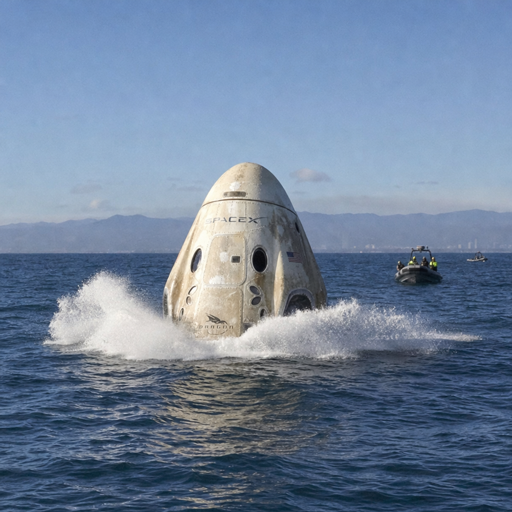
NASA’s SpaceX Crew-12 astronauts returned to Earth on Thursday, Oct. 8, 2026, after a long-duration mission aboard the International Space Station. The SpaceX Crew Dragon Freedom completed its spacecraft landing in the Pacific Ocean off the coast of Los Angeles, closing a space mission return that NASA said covered more than 100 million miles and more than 3,792 orbits around Earth.
The astronaut splashdown brought home NASA astronauts Jessica Meir and Jack Hathaway, European Space Agency astronaut Sophie Adenot, and Roscosmos cosmonaut Andrey Fedyaev. Their return adds another completed NASA splashdown to the agency’s commercial crew record and shifts attention to the science results, spacewalk milestones, and follow-up briefing planned at Johnson Space Center.
What happened during the NASA splashdown?
The Crew Dragon Freedom splashed down at 8:34 a.m. PDT on Oct. 8 in the Pacific Ocean off Los Angeles, with recovery teams moving in shortly afterward to secure the spacecraft and bring the crew aboard recovery vessels. NASA said the astronauts would undergo standard postflight medical checks before traveling to shore and then returning to the agency’s Johnson Space Center in Houston.
The return followed more than seven months on the International Space Station, where the crew lived and worked in orbit while conducting research tied to human health, spaceflight operations, and future exploration. The NASA landing was not simply the end of a trip home; it was the final step in a mission designed to test how people, vehicles, and scientific systems perform during extended operations in low Earth orbit.
NASA Administrator Jared Isaacman said the mission’s safe conclusion reflected the work of teams across NASA, SpaceX, and international partners. In practical terms, the successful astronaut splashdown shows that routine crew rotation, recovery coordination, and long-duration orbital science remain central to NASA’s strategy for preparing for missions beyond the station.
Crew-12 completed a 237-day mission in orbit
Crew-12 spent 237 days living and working in orbit, traveling more than 100 million miles before the astronauts return to Earth. NASA said the mission logged more than 3,792 orbits around the planet, underscoring how quickly distance accumulates for a crew circling Earth roughly every 90 minutes aboard the space station.
The mission launched at 5:15 a.m. EST on Feb. 13, 2026, from Cape Canaveral Space Force Station in Florida and docked with the International Space Station the following day. For Meir and Fedyaev, Crew-12 marked a second spaceflight; for Hathaway and Adenot, it was a first mission to space.
NASA also noted that Meir’s cumulative time in space reached a significant career total, placing her among the agency’s most experienced astronauts by days in orbit. That experience matters because long stays on the station continue to provide data on how crews adapt physically and operationally to conditions that future Moon and Mars missions will demand for longer periods.
Mission at a glance
- Crew: Jessica Meir and Jack Hathaway of NASA, Sophie Adenot of ESA, and Andrey Fedyaev of Roscosmos.
- Spacecraft: SpaceX Crew Dragon Freedom, used for the crew’s return and Pacific Ocean splashdown.
- Splashdown site: Pacific Ocean off the coast of Los Angeles, California.
- Landing time: 8:34 a.m. PDT on Thursday, Oct. 8, 2026.
- Mission duration: 237 days in orbit, including more than seven months aboard the International Space Station.
- Distance and orbits: More than 100 million miles traveled and more than 3,792 orbits completed.
- Next public update: NASA scheduled a crew news conference for 3:30 p.m. EDT on Thursday, Oct. 15, at Johnson Space Center.
Science work connected the station to future exploration
The Crew-12 mission supported research intended to help astronauts stay healthier and more self-sufficient during future exploration missions. NASA said the crew worked on investigations involving stem cell production for potential cell-based therapies, on-demand IV fluid generation for future missions, pneumonia-causing bacteria and long-term heart damage, nutrition in space, and how physical characteristics can affect blood flow during spaceflight.
Those studies are important because deep-space crews will not have the same immediate access to Earth-based medical care, supply chains, or emergency return options that crews have in low Earth orbit. A technology that can help produce medical fluids on demand, for example, could reduce dependence on prepacked supplies during longer trips. Research into circulation, nutrition, infection, and cardiac effects can also help mission planners better understand risks that may grow during extended stays away from Earth.
NASA’s Low Earth Orbit Program frames the space station as a platform for research, transportation operations, and risk reduction. In that context, the Crew-12 space mission return is part of a larger pattern: use the station to gather evidence, test procedures, and mature commercial crew operations before committing astronauts to more distant destinations.
Spacewalk milestones added historic weight
The mission also produced notable extravehicular activity milestones. Meir completed four spacewalks during Crew-12, bringing her career total to seven; NASA said that places her third among NASA women for total career spacewalks, behind former astronauts Peggy Whitson and Suni Williams.
Adenot completed three spacewalks and became the first French woman to venture outside the International Space Station. That achievement gives the mission significance beyond the spacecraft landing itself, highlighting the international nature of station operations and the growing depth of experience among partner-agency astronauts.
Spacewalks are among the most complex activities astronauts perform because they combine suit operations, robotics coordination, engineering tasks, communications discipline, and strict timelines outside the station’s protected interior. Each successful outing adds operational experience that can inform future maintenance work in orbit and eventual surface or gateway operations tied to lunar exploration.
The return underscores NASA’s commercial crew rhythm
Crew-12’s return is another example of NASA’s continuing reliance on commercial spacecraft for crew transportation to and from the space station. NASA said its Low Earth Orbit Program works with private U.S. companies, including SpaceX, to transport astronauts while maximizing station research and development.
That rhythm matters because the station depends on dependable crew rotations, cargo support, and recovery operations. A NASA landing is the visible final moment, but the process includes weather monitoring, spacecraft readiness checks, undocking, deorbit burn, re-entry, parachute deployment, splashdown, recovery, medical evaluation, and return logistics. NASA and SpaceX had monitored recovery conditions off the California coast before the crew departed the station.
The successful NASA astronauts splash down event also preserves continuity for research aboard the orbital laboratory. As one crew comes home, other station residents continue experiments and maintenance work, keeping the station active as both a scientific facility and a testbed for exploration systems.
What happens next
NASA scheduled a news conference for 3:30 p.m. EDT on Thursday, Oct. 15, 2026, at Johnson Space Center, where returning crew members are expected to discuss their mission and research work. NASA said U.S.-based media could attend with Meir, Hathaway, and Fedyaev, while Adenot would return to Europe and would not be available for that briefing.
The postflight period will also include continued medical monitoring, debriefs, and scientific analysis. For the public, the splashdown is the headline moment; for researchers and mission planners, the more lasting value may come from data gathered during 237 days in orbit and from lessons learned during launch, station operations, spacewalks, and recovery.
Crew-12’s homecoming closes a high-mileage mission but keeps the broader exploration campaign moving. The astronauts return with results that NASA says will help prepare for future human exploration of the Moon and Mars, while the completed spacecraft landing reinforces the operational chain needed to send crews up, keep them working safely, and bring them home again.