Quantum cryptography is the use of quantum physics to protect information, most commonly by helping two parties create and share secret keys in a way that reveals attempted eavesdropping. In everyday security planning, the term is also used more broadly to discuss quantum-safe methods, including post-quantum algorithms that run on classical computers but are designed to resist future quantum attacks.
The future of this field is not a single invention replacing today’s cybersecurity. It is a layered shift in how organizations protect secure data: stronger mathematical algorithms, specialized quantum technology, better key management, and more crypto-agile systems that can change as the threat landscape changes.
What is quantum cryptography?
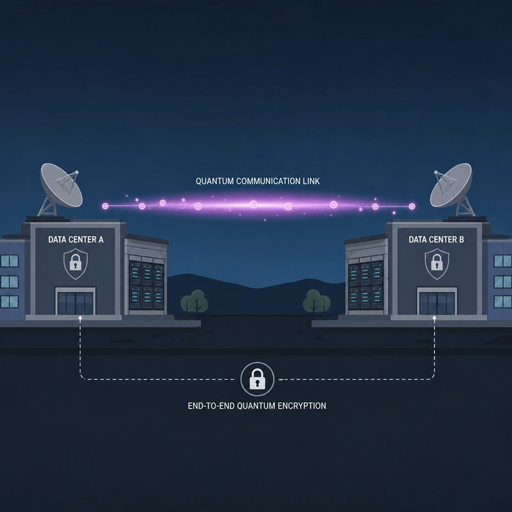
Quantum cryptography is a security approach that uses properties of quantum mechanics—such as measurement disturbance and uncertainty—to support protected communication. Its best-known form is quantum key distribution, or QKD, which lets two parties generate a shared secret key over a quantum channel and detect whether someone has tried to observe the exchange. ETSI describes QKD as a quantum-safe security technique that uses quantum properties of optical signals to generate shared random secret keys.
That definition matters because quantum cryptography is often confused with ordinary encryption. Encryption turns readable data into unreadable ciphertext using a key. Quantum cryptography usually does not encrypt the whole message by itself; it helps create, distribute, or protect the key that conventional encryption then uses. In practice, quantum encryption is often a shorthand for systems that combine quantum key distribution with classical encryption protocols.
A simple way to understand it is this: current public-key security depends on mathematical problems that are hard for classical computers to solve quickly. Quantum cryptography looks to physics for part of its security model. If the quantum state used to exchange key material is disturbed by an observer, the communicating parties can detect signs of that disturbance and reject the compromised key.
The defining characteristics of quantum cryptography
Quantum cryptography is not just “stronger encryption” with a futuristic label. It has distinct features that make it different from most familiar information security tools. These characteristics also explain why it is promising, difficult to deploy, and unlikely to replace every existing security method on its own.
Key characteristics include:
- Physics-based key protection: QKD relies on the behavior of quantum states rather than only on the difficulty of solving a mathematical puzzle.
- Eavesdropping detection: A well-designed QKD system can reveal signs that a quantum channel has been measured or disturbed.
- Dependence on specialized infrastructure: Many QKD systems require optical fiber, free-space optical links, trusted nodes, or dedicated hardware.
- Combination with classical cryptography: Quantum-generated keys still need conventional encryption, authentication, network security, and endpoint protection.
- Limited but valuable scope: Quantum cryptography is especially relevant where key exchange and long-term confidentiality are critical.
- Close relationship to quantum security planning: It belongs in the same strategic conversation as post-quantum cryptography, crypto-agility, and risk-based migration.
These traits make quantum cryptography both powerful and constrained. It can strengthen one of the most sensitive parts of secure communication, but it does not automatically secure databases, applications, identities, devices, or human workflows. A future-ready security program treats it as one layer in a broader architecture.
How does quantum cryptography work?
Quantum cryptography works by encoding key information into quantum states, transmitting those states, and checking whether the transmission shows evidence of interference. If the error rate or disturbance is too high, the parties assume the exchange may have been observed and discard the key. If the exchange passes the checks, they use additional classical steps to reconcile and strengthen the final shared key.
In a typical QKD-style scenario, one party sends photons—tiny units of light—prepared in specific quantum states. The receiving party measures them using agreed methods. Because measuring a quantum state can change it, an eavesdropper cannot simply copy and inspect the signal without creating detectable effects. After transmission, both parties compare selected information over an authenticated public channel to estimate whether the key material is safe to use.
The process usually includes several practical stages:
- Quantum transmission: Quantum states are sent across fiber or a free-space optical path.
- Measurement: The receiver measures those states and records the results.
- Sifting: The parties keep only the results that match the protocol’s rules.
- Error estimation: They test part of the data to look for noise or possible interception.
- Error correction: They reconcile differences without revealing the final secret.
- Privacy amplification: They compress the shared data into a shorter, stronger secret key.
- Classical encryption use: The final key is applied to protect secure data through conventional encryption systems.
This workflow shows why the word “quantum” can be misleading if it is used too casually. The quantum part helps with key establishment, but the security of the full system also depends on authentication, implementation quality, device integrity, random number generation, network design, and operational discipline. A flawed endpoint or misconfigured application can still expose data even if the key exchange method is advanced.
Quantum cryptography and post-quantum cryptography are different
Quantum cryptography and post-quantum cryptography both respond to the rise of quantum technology, but they are not the same thing. Quantum cryptography uses quantum hardware or quantum communication effects. Post-quantum cryptography, often called PQC, uses new quantum-resistant algorithms that run on ordinary classical computers and networks.
This distinction is central to planning. QKD may require specialized links and equipment, which can make it suitable for high-value connections but less practical for broad software deployment. PQC is designed to be integrated into existing digital systems: browsers, servers, applications, certificates, devices, virtual private networks, and code-signing processes.
NIST’s post-quantum cryptography project reached a major milestone in 2024 with the publication of its first finalized PQC standards: FIPS 203, FIPS 204, and FIPS 205, specifying ML-KEM, ML-DSA, and SLH-DSA. NIST states that these standards are intended to provide a foundation for most deployments of post-quantum cryptography.
A practical comparison looks like this:
|
Area |
Quantum cryptography / QKD |
Post-quantum cryptography |
|---|---|---|
|
Main idea |
Uses quantum physical effects to support secure key distribution |
Uses quantum-resistant mathematical algorithms |
|
Hardware needs |
Often requires specialized optical equipment or channels |
Runs on classical hardware and software |
|
Typical role |
Protects key exchange on selected high-value links |
Upgrades public-key encryption, key establishment, and signatures at scale |
|
Deployment challenge |
Distance, infrastructure, interoperability, device assurance |
Inventory, compatibility, performance, standards adoption, migration planning |
|
Best fit |
Critical links, research networks, financial or government-grade use cases |
Broad internet, enterprise, cloud, software, and device ecosystems |
The future is likely to involve both categories, not a winner-takes-all replacement. PQC is the more scalable path for many mainstream systems, while QKD and other quantum security tools may serve specialized environments where physical-layer key protection is worth the added complexity.
Why quantum security matters now
Quantum security matters now because encrypted data can remain sensitive for many years. Attackers may capture protected information today and store it until future capabilities make decryption easier. This risk is often called “harvest now, decrypt later,” and it is especially concerning for government records, intellectual property, health data, legal files, infrastructure plans, and financial information.
The most discussed threat comes from future cryptographically relevant quantum computers. Such machines could weaken or break widely used public-key systems, especially those based on integer factorization or discrete logarithms. That does not mean every password, file, or encryption method fails overnight. Symmetric encryption and hashing are affected differently from public-key cryptography, and larger key sizes or different algorithms can reduce certain risks. But the public-key layer is deeply embedded in modern trust: TLS, VPNs, software updates, identity systems, digital signatures, and certificates.
NIST explains post-quantum cryptography as work to create electronic defenses against potential attacks by quantum computers, and it released the first three finalized PQC standards in 2024 for organizations to begin using. That timeline is important because migration takes longer than many teams expect. Cryptography is often hidden inside libraries, appliances, cloud services, legacy applications, vendor products, firmware, and third-party integrations.
The practical implication is straightforward: organizations should not wait for a large-scale quantum computer to appear before they start preparing. Good preparation does not require panic. It requires visibility, planning, testing, and the ability to swap cryptographic components without redesigning every system from scratch.
The role of quantum algorithms in the future threat model
Quantum algorithms are specialized procedures designed to run on quantum computers. They matter for information security because some of them could solve certain mathematical problems much faster than known classical methods. The best-known example in security discussions is Shor’s algorithm, which is relevant to cryptosystems based on factoring and discrete logarithms.
This does not mean quantum computers will instantly break all cybersecurity. Quantum algorithms are not magic tools that solve every hard problem. They apply to specific problem types, require suitable quantum hardware, and must be implemented at a scale and reliability level that is far beyond small demonstrations. Still, security planning has to account for possibility, not just present-day availability.
For cryptography, the effect is uneven:
- Public-key encryption and key exchange: Systems such as RSA and elliptic-curve cryptography are the main concern because powerful quantum algorithms could undermine their mathematical assumptions.
- Digital signatures: Signature schemes used for software updates, certificates, documents, and authentication also need quantum-resistant replacements.
- Symmetric encryption: Algorithms such as AES are generally less exposed, though key-size choices still matter in long-term planning.
- Hash functions: Hashing is affected differently; stronger output lengths and conservative choices remain important.
- Randomness and key management: Better algorithms cannot compensate for poor key storage, weak random number generation, or bad operational controls.
The future of quantum security therefore depends on both algorithm design and system engineering. New quantum algorithms may change what is considered safe. New classical quantum-resistant algorithms may be refined, standardized, attacked, improved, or replaced. The winning organizations will be those that can adapt without chaos.
Practical examples and common misconceptions
Quantum cryptography becomes easier to understand when it is separated from hype. It is useful in some scenarios, less relevant in others, and often misunderstood because the vocabulary overlaps with quantum computing, quantum encryption, and post-quantum algorithms.
Practical examples and use cases include:
- Securing data center links: A financial institution, research organization, or government agency may explore QKD for high-value connections between facilities.
- Protecting long-lived confidential data: Organizations that store sensitive records for decades may prioritize quantum-safe migration earlier than teams handling short-lived data.
- Modernizing VPNs and TLS: PQC can help upgrade the key establishment layer used in encrypted sessions.
- Protecting software supply chains: Quantum-resistant signatures can help preserve trust in code signing, firmware updates, and release verification.
- Strengthening national infrastructure: Energy, telecom, transport, and defense environments may evaluate quantum security as part of resilience planning.
- Supporting hybrid security models: Some systems may combine classical and post-quantum methods during transition to reduce dependence on any single technique.
Common misconceptions include:
- “Quantum cryptography encrypts everything by itself.” In most practical discussions, it supports key distribution; the data still needs encryption, access control, and secure implementation.
- “Post-quantum means quantum hardware.” PQC runs on classical systems. It is called post-quantum because it is designed to resist future quantum attacks.
- “Quantum-safe means permanently unbreakable.” No security method should be treated as permanent. Algorithms, devices, protocols, and implementations can all evolve.
- “Only governments need to care.” Any organization with long-lived sensitive data, regulated information, or critical trust systems should at least assess exposure.
- “Migration can happen at the last minute.” Cryptographic dependencies are widespread and often hard to find, so late migration increases operational risk.
These examples show why the future of Quantum cryptography is as much about governance as physics. A brilliant protocol is not enough if an organization cannot locate where keys are used, update certificates, test compatibility, or coordinate vendors.
Quantum encryption will be part of a layered security model
Quantum encryption is often used as a broad phrase for encryption systems influenced by quantum technology. In a strict sense, many real deployments will not replace classical encryption with purely quantum encryption. Instead, they will combine quantum-safe key exchange, classical symmetric encryption, identity controls, monitoring, and policy enforcement.
Layering is necessary because attackers do not care which part of a system is theoretically strongest. They look for the weakest path: stolen credentials, exposed backups, vulnerable APIs, unpatched servers, insecure endpoints, compromised administrators, or weak vendor access. A quantum-safe channel does not fix those problems. It protects one layer of confidentiality, which must sit inside a complete security program.
A future-ready layered model may include:
- Crypto inventory: A living map of where cryptographic algorithms, keys, certificates, libraries, and protocols are used.
- PQC migration: Replacement of quantum-vulnerable public-key methods with standardized quantum-resistant alternatives.
- Hybrid key exchange: Temporary or transitional combinations of classical and post-quantum methods to manage uncertainty.
- Selective QKD adoption: Use of quantum key distribution where infrastructure, risk level, and cost justify it.
- Strong symmetric encryption: Continued use of well-reviewed symmetric algorithms with appropriate key lengths.
- Certificate and identity modernization: Updates to public key infrastructure, signing workflows, and trust stores.
- Monitoring and response: Detection of misconfiguration, downgraded protocols, expired certificates, and abnormal access.
- Crypto-agility: The ability to replace algorithms quickly without rebuilding the whole environment.
This is where quantum security becomes practical rather than theoretical. The goal is not to buy a single “quantum-proof” product. The goal is to make secure data protection flexible enough to survive changes in computing power, standards, regulation, and attacker capability.
The future will depend on standards and interoperability
Quantum cryptography will advance only if systems can interoperate safely. Security teams need products, protocols, and standards that work across vendors, networks, cloud environments, and legacy infrastructure. Without interoperability, quantum security remains a set of isolated demonstrations rather than a dependable foundation for information security.
Standards bodies are already shaping this transition. NIST’s PQC standards provide a path for broad software deployment, while ETSI’s work on QKD addresses specialized quantum key distribution topics and implementation security. These efforts matter because organizations need more than algorithms. They need implementation guidance, test methods, certification paths, operational profiles, and consistent terminology.
Interoperability will be especially important in four areas:
- Protocols: TLS, IPsec, SSH, S/MIME, code-signing systems, and other protocols must support quantum-safe choices without breaking reliability.
- Public key infrastructure: Certificate authorities, hardware security modules, trust stores, and validation tools must handle new key and signature formats.
- Devices and embedded systems: Long-lived equipment may need firmware updates, replacement plans, or compensating controls.
- Vendor coordination: Cloud providers, software suppliers, network vendors, and managed service providers must align roadmaps with customer migration needs.
As standards mature, the market will likely move from experimentation toward managed transition. Early adopters will test hybrid modes, measure performance, and identify compatibility issues. Later adopters will benefit from clearer playbooks, but they may also face tighter compliance expectations and shorter migration windows.
Benefits and limitations of quantum cryptography
The promise of quantum cryptography is significant, but it should be evaluated with practical discipline. Its strongest benefit is not that it makes every system invincible. Its value is that it can improve key security in situations where long-term confidentiality and high assurance are worth the investment.
Potential benefits include:
- Early detection of eavesdropping on the quantum channel: QKD can reveal disturbance patterns that indicate possible observation.
- Protection for high-value communication links: Dedicated links between sensitive sites may justify specialized quantum technology.
- Support for long-term confidentiality: Quantum-safe planning reduces exposure to future decryption risks.
- Stronger strategic resilience: Organizations that build crypto-agility can adapt faster as standards and threats evolve.
- Alignment with future security expectations: Regulated and critical sectors may increasingly need evidence of quantum-risk planning.
Important limitations include:
- Infrastructure requirements: QKD often needs special hardware, optical paths, and operational expertise.
- Distance and network design constraints: Real-world networks may require trusted nodes, repeaters, or satellite/free-space approaches, each with trade-offs.
- Endpoint risk: Quantum-protected key exchange does not secure compromised devices or careless users.
- Implementation risk: Side channels, device flaws, poor randomness, and software bugs can undermine theoretical security.
- Cost and complexity: Not every organization or use case will justify quantum cryptography deployment.
- Terminology confusion: Vendors may use “quantum-safe,” “quantum encryption,” or “quantum security” in ways that require careful scrutiny.
The balanced view is that quantum cryptography is important but not universal. It is most compelling when matched to a specific risk: long-lived sensitive data, high-value communications, critical infrastructure, or national security requirements. For many organizations, the first move will be PQC readiness rather than immediate QKD deployment.
Building a quantum-ready information security strategy
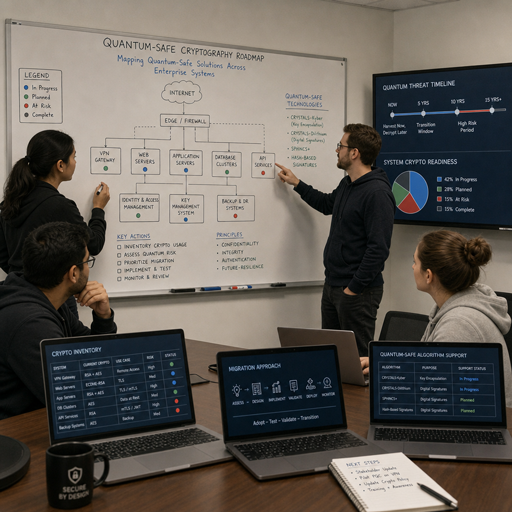
A quantum-ready strategy begins with visibility. Many organizations do not have a complete picture of where cryptography exists in their environment. It may be embedded in web servers, APIs, databases, mobile apps, containers, hardware appliances, identity platforms, backup systems, industrial equipment, and third-party services. Without that map, migration becomes guesswork.
The next step is risk prioritization. Not every system needs the same urgency. A public marketing page and a database of sensitive legal records do not carry equal long-term exposure. Systems that protect long-lived secrets, validate software, manage identities, or secure critical operations should usually move higher in the queue.
A practical quantum-readiness checklist includes:
- Create a cryptographic asset inventory covering algorithms, protocols, certificates, keys, libraries, and vendors.
- Identify long-life data that must remain confidential for years or decades.
- Map public-key dependencies in TLS, VPNs, SSH, PKI, code signing, device identity, and email security.
- Review vendor roadmaps for post-quantum cryptography support and migration timelines.
- Test PQC in controlled environments before changing production systems.
- Plan for hybrid deployments where appropriate, especially during transition periods.
- Evaluate QKD selectively for links where the assurance benefits justify infrastructure demands.
- Update policies and procurement language so new systems support crypto-agility.
- Train security, architecture, and compliance teams on terminology and migration risks.
- Monitor standards and guidance so decisions remain aligned with trusted authorities.
This checklist is intentionally operational. Quantum security is not only a research topic; it is becoming a lifecycle management challenge. The organizations that treat cryptography as an asset class—not just a technical detail—will be better positioned for the next decade of secure data protection.
The likely future of quantum cryptography
The future of quantum cryptography will be hybrid, gradual, and risk-based. Rather than one dramatic cutover, the world will see overlapping waves: PQC adoption in mainstream software, selective deployment of QKD on sensitive links, continued research into quantum networks, and stronger requirements for crypto-agile systems.
In the near term, post-quantum algorithms will likely have the broadest impact because they can be deployed through software and protocol upgrades. Organizations will work through inventories, compatibility testing, certificate changes, and vendor dependencies. Performance, key sizes, signature sizes, and implementation quality will be practical concerns, especially for constrained devices and high-volume services.
At the same time, quantum cryptography in the narrower QKD sense will continue to mature. It may become more common in metropolitan networks, financial exchanges, government communications, research environments, and critical infrastructure corridors. Wider use will depend on cost, distance, hardware assurance, standards, and integration with existing network operations.
Longer term, quantum security may expand beyond today’s categories. Research into quantum networks, device-independent protocols, quantum random number generation, and advanced verification methods could influence future systems. A 2024 NIST-linked publication noted progress across areas such as device-independent random number generators, device-independent QKD, quantum memories, and related quantum technologies. These developments are promising, but they should be understood as evolving research and engineering paths, not instant replacements for today’s security controls.
The safest prediction is that cryptography will become more dynamic. Algorithms once considered permanent infrastructure will be treated as replaceable components. Security teams will need dashboards, policies, vendor accountability, and tested migration playbooks. Quantum technology will push organizations to design for change.
Key takeaways
Quantum cryptography is best understood as a physics-informed approach to protecting keys and communications, while post-quantum cryptography is the software-scalable path for replacing vulnerable public-key algorithms. Both are part of quantum security, and both matter for organizations that need durable information security.
The most important takeaways are:
- Quantum cryptography is not a complete security program. It strengthens key exchange or communication layers but still depends on secure endpoints, authentication, implementation, and operations.
- PQC and QKD solve different problems. PQC will fit many mainstream systems; QKD may serve specialized high-assurance links.
- The risk is already relevant. Long-lived secure data can be collected now and attacked later when technology improves.
- Standards are turning theory into migration work. NIST’s PQC standards give organizations a concrete starting point for planning and testing.
- Crypto-agility is the real future-proofing principle. No algorithm or technology should be assumed permanent.
The future of quantum cryptography is not about fear of quantum computers alone. It is about building security systems that remain trustworthy as computing changes. Organizations that begin with inventory, prioritize their most sensitive data, follow credible standards, and design for cryptographic change will be far better prepared for the quantum era.