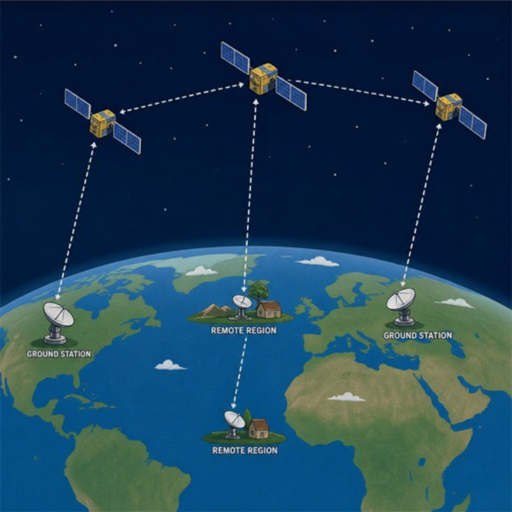
Satellite internet is entering a more crowded, more competitive phase as operators expand low earth orbit networks, regulators approve larger systems, and new services move from demonstration to commercial rollout. The latest activity points to a future in which satellite broadband is not only a rural connectivity option, but also a backup layer for governments, maritime fleets, airlines, mobile carriers, and enterprises that need resilient global internet. The central question now is whether operators can scale coverage, capacity, affordability, and space safety at the same time.
What is changing in satellite internet constellations?
The biggest change is that the satellite internet constellation market is shifting from a single dominant deployment story to a multi-operator infrastructure race. SpaceX’s Starlink remains the reference point for large low earth orbit broadband, but 2026 brought new regulatory approvals, Amazon Leo’s continued deployment plans, and Eutelsat’s moves to renew and expand OneWeb. These developments suggest the next generation of satellite network buildouts will focus less on proving that LEO broadband works and more on improving capacity, redundancy, specialized services, and international market access.
Low earth orbit systems are attractive because satellites orbit much closer to Earth than traditional geostationary spacecraft. That shorter distance can reduce latency and make satellite broadband feel more like terrestrial internet for video calls, cloud software, field operations, and mobile backhaul. The tradeoff is complexity: thousands of leo satellites may be needed for continuous coverage, and each operator must coordinate spectrum, launch schedules, ground infrastructure, user terminals, debris mitigation, and national approvals.
2026 marks a new deployment phase
Regulators and operators have made several recent moves that signal where the industry is heading. In the United States, the Federal Communications Commission granted SpaceX authority to deploy a second tranche of 7,500 Gen2 Starlink satellites, bringing the authorized Gen2 Starlink constellation to 15,000 satellites. The FCC described the authorization as part of a push toward expanded global broadband connectivity, including mobile and supplemental coverage from space.
Amazon Leo, formerly Project Kuiper, is also moving deeper into deployment. Amazon says the network began full-scale deployment in April 2025 and is supported by more than 80 planned launches with Arianespace, Blue Origin, SpaceX, and United Launch Alliance. Amazon has said service will roll out gradually as more satellites are deployed, starting with regions where the network has enough coverage and capacity.
Eutelsat is working on the next phase of OneWeb as well. On October 2, 2026, the company announced that Airbus Defence and Space had completed the first 32 new OneWeb LEO satellites for Eutelsat in Toulouse, France. Earlier in 2026, Eutelsat also announced a contract for 340 additional OneWeb satellites, positioning renewal and capacity growth as a central part of its low earth orbit strategy.
Key developments shaping the market include:
- Larger authorized constellations: Operators are seeking permission for more satellites to improve density, service continuity, and bandwidth.
- More launch partnerships: Amazon Leo’s multi-provider launch strategy shows how constellation operators are trying to reduce schedule risk.
- Renewal cycles: OneWeb’s next-generation satellites show that early LEO networks are already moving from initial deployment to replacement and enhancement.
- Specialized markets: Maritime, aviation, enterprise, government, and direct-to-device services are becoming central to business plans, not side products.
- More regulatory scrutiny: Spectrum sharing, orbital debris, astronomy impacts, and national licensing are now core issues for every satellite network.
Competition is moving beyond home broadband
The next wave of satellite internet will not be measured only by residential dishes on rooftops. Operators are targeting markets where terrestrial connectivity is weak, expensive, vulnerable, or unavailable. That includes ships, aircraft, mining sites, disaster zones, defense operations, offshore energy platforms, and rural regions where fiber buildouts are slow.
Amazon Leo’s early commercial partnerships illustrate this direction. In February 2026, Amazon announced maritime reseller agreements with ELCOME and MTN to bring its low earth orbit satellite internet network to vessels across major oceans and remote waters. The announcement positioned the service for merchant shipping, offshore energy, commercial fishing, yachting, and other maritime users that need connectivity far from terrestrial networks.
Aviation is another important frontier. Amazon has said JetBlue will be the first airline to implement its satellite technology for next-generation inflight Wi-Fi, with implementation expected to begin in 2027. For airlines, the future value of satellite broadband is not just passenger browsing; it can also support aircraft operations, crew communications, maintenance data, and more consistent connectivity across routes.
International market access is becoming just as important as launch cadence. The Associated Press reported in July 2026 that Amazon planned to launch Amazon Leo in South Africa in 2027, while also noting company-linked plans or partnerships in countries including Thailand, Kazakhstan, Australia, Argentina, Brazil, Chile, Colombia, Ecuador, Peru, and Uruguay. That kind of expansion shows that global internet coverage depends on local licensing, distribution, and policy decisions as much as orbital capacity.
Direct-to-device service could reshape expectations
The industry’s next major shift may be direct-to-device connectivity, where satellites connect to ordinary or lightly modified phones and connected devices. This will not immediately replace terrestrial mobile networks, but it could fill coverage gaps in rural areas, oceans, deserts, mountains, and emergency situations. If the technology scales, consumers may begin to expect basic connectivity in places where “no signal” has long been normal.
SpaceX’s Gen2 authorization includes capabilities tied to enhanced mobile and supplemental coverage from space, according to the FCC’s January 2026 announcement. Amazon Leo has also filed plans for a direct-to-device system, and industry reporting indicates that the proposed system would use mobile-satellite spectrum and work alongside Amazon’s broadband constellation. These moves suggest that the future satellite network will increasingly overlap with mobile telecom infrastructure, not sit apart from it.
For carriers, direct-to-device can become a roaming extension, an emergency coverage layer, or a way to serve low-density regions without building towers everywhere. For users, the most valuable first applications may be messaging, emergency alerts, tracking, and basic data rather than full broadband. Over time, however, improved satellite power, antennas, spectrum coordination, and device integration could expand what these services can deliver.
Capacity, latency, and terminals remain the practical tests
The promise of satellite broadband is simple: connect people and machines where fiber, cable, and mobile networks are unavailable or unreliable. The execution is harder. A satellite internet constellation must deliver enough capacity in the right places, manage congestion, keep latency low, and offer terminals that customers can install and afford.
LEO architecture helps with latency because signals travel a shorter distance than they do to geostationary satellites. But capacity depends on many other factors, including satellite design, spectrum availability, inter-satellite links, ground gateways, beam steering, network software, and how many users share service in a given area. This is why a constellation can perform very well in one region or use case and face constraints in another.
The terminal market will also influence adoption. Consumer equipment must become easier to install, more portable, and more power-efficient, while enterprise and mobility terminals must handle harsh environments. For satellite broadband to become a mainstream connectivity layer, the customer experience has to feel less like specialist equipment and more like ordinary broadband service.
Space sustainability is becoming a business constraint
The future of leo satellites depends on keeping low earth orbit usable. ESA’s 2026 Space Environment Report warned that the number and scale of commercial satellite constellations continue to increase and that projected objects and collisions in low-Earth orbit are rising sharply. That warning matters because every operator’s business model relies on predictable access to safe orbital lanes.
The International Telecommunication Union has also emphasized that space sustainability is tied to spectrum management, interference prevention, and responsible coordination between satellite systems. The ITU’s 2026 NGSO licensing toolkit highlights issues such as consumer protection, regional harmonization, cross-border terminal enforcement, and orbital sustainability. These are no longer background policy topics; they are operational requirements for any satellite network that wants to scale across borders.
Sustainability pressure will likely shape constellation design. Operators may need more reliable propulsion, faster post-mission disposal, better collision avoidance data sharing, lower-reflectivity designs, and clearer coordination with astronomy and civil space agencies. The companies that treat debris mitigation and spectrum coexistence as engineering priorities, rather than regulatory paperwork, will be better positioned for long-term growth.
The next phase will be defined by integration
Satellite internet is becoming part of a broader connectivity stack. In the coming years, the strongest use cases will likely combine fiber, mobile, fixed wireless, Wi-Fi, and satellite broadband rather than forcing one technology to replace another. A farm, ship, aircraft, school, clinic, or emergency response team may use satellite as the primary connection in one location and as backup in another.
This integrated model changes how buyers evaluate service. Speed still matters, but resilience, coverage maps, installation time, cybersecurity, service-level commitments, data policies, and local support matter too. Enterprises will ask whether a satellite network can connect remote assets securely to cloud platforms. Governments will ask whether providers can support public safety, education, and national connectivity goals. Consumers will ask whether the service is reliable and affordable enough to compete with available terrestrial options.
What happens next
The near-term future will be measured in launches, licenses, and early customer rollouts. SpaceX will continue building on its large authorized Gen2 system, Amazon Leo will need to convert deployment momentum into service availability, and Eutelsat will work to renew OneWeb while positioning its LEO capacity for enterprise and government demand. National regulators will decide how quickly services can enter local markets, especially where telecom policy, competition rules, and spectrum rights are politically sensitive.
The broader direction is clear: satellite internet is moving from a niche solution into a strategic layer of global internet infrastructure. The winners will not simply be the operators with the most satellites. They will be the networks that combine coverage, capacity, affordability, regulatory trust, sustainability, and practical customer experience at scale.