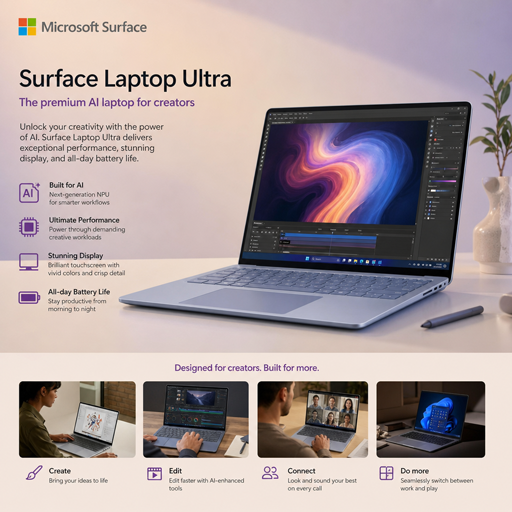
Microsoft is moving its Surface line deeper into the AI PC race with Surface Laptop Ultra, a premium Windows laptop built around Nvidia RTX Spark silicon and aimed at creators, developers, engineers, and businesses that want local AI performance. The device is positioned well above mainstream Surface models, with Microsoft’s business store listing Surface Laptop Ultra for Business from $2,749.99 and a release date of October 16, 2026.
The launch gives Microsoft a more forceful answer to a question that has followed the first wave of Copilot+ PCs: what should a surface laptop ai machine actually do beyond adding a Copilot key? This time, the pitch is less about light productivity features and more about running larger AI workloads, graphics-heavy creative apps, and technical tools directly on the laptop.
Why is Microsoft making a more expensive AI Surface laptop?
Microsoft is making a more expensive AI Surface laptop because it wants Windows PCs to become credible local AI workstations, not just thin clients for cloud-based chatbots. At its October 7 event in San Francisco, Microsoft used Surface Laptop Ultra and other Nvidia-powered Windows PCs to frame the next PC upgrade cycle around hybrid AI: some work happens on the device, while larger or more general models remain in the cloud.
That strategy matters because the first Copilot+ PC push had a mixed start. Microsoft promoted on-device AI features heavily, but its Recall feature was delayed after security and privacy concerns, weakening the original consumer-facing story around AI PCs. With Surface Laptop Ultra, the company is shifting attention toward higher-end users who can more easily justify dedicated local compute: software developers, data workers, 3D creators, engineers, and teams experimenting with private AI workflows.
The result is not a mass-market Microsoft AI laptop in the traditional Surface Laptop sense. It is a flagship device designed to show PC makers, enterprise buyers, and professional users where Microsoft thinks premium Windows hardware is headed. That makes the price part of the message: Surface Laptop Ultra is expensive because Microsoft is presenting it as a new performance tier, not as a replacement for standard Surface Laptop or Surface Pro models.
Surface Laptop Ultra brings Nvidia RTX Spark into the Surface line
The most important Microsoft Surface specs start with Nvidia RTX Spark N1X. Microsoft lists configurations with either a 5120-core GPU and 18-core CPU or a 6144-core GPU and 20-core CPU, paired with an Nvidia NPU and Blackwell RTX graphics. Microsoft says select configurations can deliver up to one petaflop of AI compute, a claim tied to FP4 performance and Nvidia’s sparsity feature.
Memory is central to the product. Surface Laptop Ultra uses LPDDR5x unified memory options ranging from 24GB to 128GB, with SSD storage options from 512GB to 2TB. Microsoft says unified memory allows CPU, GPU, and AI acceleration to share the same memory pool, which is useful for larger local models, complex creative projects, heavy multitasking, and technical workloads that would strain conventional laptop configurations.
The screen is also aimed at high-end users. Microsoft lists a 15-inch PixelSense Ultra touchscreen with a 3270 x 2180 resolution, 3:2 aspect ratio, up to 120Hz dynamic refresh rate, 100% DCI-P3 color, individual color calibration, and up to 1000 nits SDR brightness with 2000 nits peak HDR luminance. Those display details place the device closer to a mobile creative workstation than a typical productivity laptop.
Key details announced so far
For buyers comparing a Microsoft Surface AI laptop with other premium Windows machines, the launch details are unusually specific for a new category. The headline is that Surface Laptop Ultra is a 15-inch clamshell Surface built for AI, graphics, and professional workloads rather than basic office use.
- Price and timing: Microsoft’s business store lists Surface Laptop Ultra for Business from $2,749.99, with release scheduled for October 16, 2026. Event coverage also reported a Surface Ultra starting price of $2,599, suggesting pricing may vary by channel or configuration.
- Processor and graphics: The laptop uses Nvidia RTX Spark N1X options with Blackwell RTX graphics and an Nvidia NPU. Microsoft says the highest listed GPU configuration has 6144 cores and pairs with a 20-core CPU.
- Memory and storage: Configurations include 24GB, 32GB, 48GB, 64GB, or 128GB of unified memory, plus removable SSD options from 512GB to 2TB.
- Display: The 15-inch PixelSense Ultra touchscreen offers a 3:2 layout, 120Hz dynamic refresh, Dolby Vision IQ support, and anti-reflective strengthened glass.
- Ports: Microsoft includes three USB-C/USB4 ports, HDMI 2.1b, USB-A 3.1, an SD card reader, and a headphone jack. One USB-C port supports Microsoft’s magnetic connect cable, a breakaway-style approach meant to reduce the risk of pulling the laptop off a desk.
- Battery claims: Microsoft lists up to 15 hours of local video playback and up to 12 hours of active web usage, though both figures are based on controlled testing and will vary with workload.
Microsoft’s AI PC strategy is splitting into tiers
Surface Laptop Ultra does not arrive alone. Microsoft has spent 2026 broadening Surface around several kinds of AI PC buyers, including Intel-powered business systems, Snapdragon-based mobile devices, and now Nvidia-powered high-performance machines. That segmentation makes the product line more complicated, but it also gives Microsoft room to address different definitions of “AI laptop.”
For business buyers, Microsoft announced Surface Pro for Business and Surface Laptop for Business models powered by Intel Core Ultra Series 3 processors earlier this year. Those devices target enterprise productivity, AI at the edge, security, serviceability, and mobility, with 13-inch, 13.8-inch, and 15-inch options across the broader portfolio.
That means a search for a microsoft ai focused surface pro laptop intel device may point to a different class of machine than Surface Laptop Ultra. Intel Surface Pro and Surface Laptop for Business models are positioned for professional productivity and managed deployments; Surface Laptop Ultra is positioned for demanding local AI, graphics, software development, engineering, and creative workloads.
Qualcomm is another piece of the plan. Microsoft recently introduced updated 12-inch Surface Pro and 13-inch Surface Laptop models with Snapdragon X2 Plus processors, emphasizing travel-friendly performance, battery life, and responsive on-device AI. In other words, Microsoft’s Surface lineup now has AI PCs for portability, business deployment, and workstation-like local compute.
Early Surface Laptop review verdict depends on the workload
A full Surface Laptop review will have to wait for independent testing, especially around heat, fan noise, battery life under AI loads, and real-world model performance. Microsoft’s own claims are ambitious, but AI workloads vary widely: a laptop that handles coding assistants, image tools, or smaller local models smoothly may still behave differently when pushed with large language models, simulation work, or long rendering sessions.
The strongest case for Surface Laptop Ultra is for users who already know why local AI matters. Running work locally can reduce latency, preserve sensitive data on the device, and limit dependence on cloud AI subscriptions, all points Microsoft highlights in its business positioning. For companies working with prototypes, source code, regulated data, or internal models, those advantages may be more compelling than a lower starting price.
The weaker case is for general productivity buyers. If the daily workload is email, documents, browser tabs, video calls, and occasional creative work, a standard Surface Laptop, Surface Pro, or another Copilot+ PC is likely to be the more sensible purchase. Surface Laptop Ultra is less about making every Windows user buy a more expensive laptop and more about proving that Windows can host a premium local AI development and creation class.
What happens next
The next test is whether Microsoft can turn the Surface Laptop Ultra announcement into real demand after shipments begin on October 16, 2026. Nvidia-powered Windows machines are also expected from other PC makers, which means Microsoft’s own device will serve as both a flagship product and a reference point for the broader AI PC market.
For now, the message is clear: Microsoft wants the AI PC conversation to move beyond lightweight assistant features and toward serious on-device compute. Surface Laptop Ultra is expensive, but that is precisely how Microsoft is defining it—as a high-end microsoft surface laptop ai machine for people whose work can benefit from powerful local AI hardware, not as the default laptop for everyone.