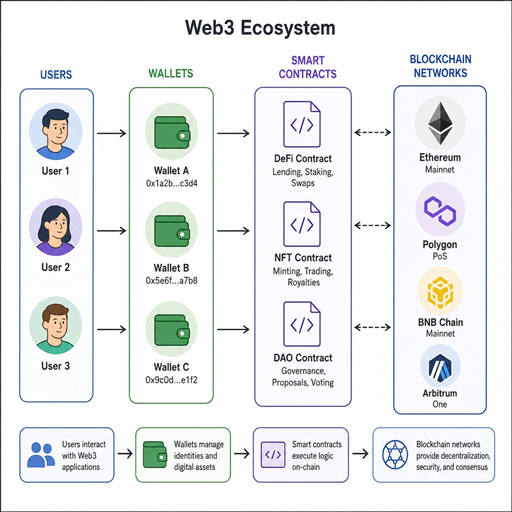
Web3 technology describes a shift toward internet services where ownership, identity, transactions, and governance can be coordinated through blockchain technology rather than controlled only by centralized platforms. For readers, the practical promise is not just “crypto,” but a new architecture for digital assets, smart contracts, decentralized finance, marketplaces, communities, and data control. This guide explains what Web3 is, where it is already useful, what still needs to mature, and how individuals or organizations can approach it with clear judgment.
What does Web3 technology actually mean?
Web3 technology is a broad term for internet applications that use decentralized networks to let people own, transfer, verify, or program digital value without relying entirely on a single platform operator. Instead of every account, asset, and transaction being managed inside a company-owned database, Web3 systems can use blockchain technology to create shared records that many participants can inspect and, depending on the network, help validate.
That does not mean every Web3 product is fully decentralized or automatically better than a conventional app. In practice, Web3 sits on a spectrum. Some projects use public blockchains, self-custody wallets, and community governance; others blend blockchain rails with familiar interfaces, customer support, and centralized components.
The most useful way to understand Web3 is to focus on what changes for the user:
- Ownership can become portable. A digital asset may be held in a wallet rather than locked inside one company’s app.
- Transactions can become programmable. Smart contracts can automatically execute rules when conditions are met.
- Communities can coordinate with tokens. A token economy can reward participation, fund development, or grant governance rights.
- Markets can become more open. Assets, data, and services can move across compatible platforms.
- Trust can shift from institutions to systems. Code, cryptography, and network consensus can reduce the need for some intermediaries, although they do not remove every form of risk.
This is why Web3 conversations often include decentralized finance, NFTs, digital identity, gaming assets, supply chain records, data marketplaces, and community-owned networks. They all use similar building blocks, but they solve different problems.
The evolution from read-only pages to owned digital experiences
The early web was mostly about publishing and reading information. Websites were directories, blogs, forums, and digital brochures. Users could access content, but the relationship was largely one-way: a publisher posted something, and visitors consumed it.
The next phase made the internet social, interactive, and platform-driven. People created profiles, uploaded media, built audiences, stored files, and participated in global communities. This version of the web unlocked enormous convenience, but it also concentrated power. User data, monetization rules, audience access, and content visibility often depended on centralized platforms.
Web3 proposes another layer: a web where people can participate as owners, not only users. A creator might sell digital collectibles through an nft marketplace, a community might manage a shared treasury with smart contracts, or a borrower might access decentralized finance protocols without going through a traditional gatekeeper. The difference is not simply technical; it changes incentives.
In a conventional platform model, value often flows toward the company that owns the network. In a token-based model, some value can flow toward the people who use, secure, build, or govern the network. This is the foundation of many Web3 ideas, although successful execution requires thoughtful design, legal awareness, user protection, and genuine utility.
Core building blocks of Web3
Web3 can feel complicated because it combines finance, software, governance, cybersecurity, and culture. Breaking it into building blocks makes the subject easier to evaluate.
Blockchain technology as the shared record
Blockchain technology is a method for maintaining a ledger across a network of participants. Instead of one administrator controlling the database, the network follows rules for adding and validating records. This makes it possible to track transactions, asset ownership, and contract activity in a way that can be independently verified.
Different blockchains make different trade-offs. Some prioritize decentralization and security, while others emphasize speed, low transaction costs, or specialized use cases. The future of Web3 will likely involve multiple chains, scaling systems, and interoperability tools rather than one universal network.
For users and businesses, the key question is not “Which blockchain is most popular?” but “Which network is appropriate for this use case?” A payment product, gaming environment, enterprise record system, and art marketplace may all need different performance, privacy, cost, and governance characteristics.
Smart contracts as programmable agreements
Smart contracts are pieces of code that run on a blockchain or related network. They can hold assets, define rules, and execute transactions automatically. For example, a smart contract might distribute funds when a sale is completed, issue tokens when someone meets eligibility criteria, or enforce the supply rules for a collection of digital assets.
The benefit is automation with transparency. Participants can inspect the logic, and once the contract is deployed, it can operate without constant manual administration. This makes smart contracts especially important for decentralized finance, marketplaces, royalties, token distribution, and governance.
The risk is that code can contain errors, and automated systems can execute flawed rules quickly. A smart contract should not be treated as trustworthy simply because it exists on a blockchain. Strong security reviews, simple design, upgrade planning, and clear user communication all matter.
Digital assets as ownable units of value
Digital assets are blockchain-based items that can be owned, transferred, or used within an application. They may represent currency-like tokens, governance rights, access passes, collectibles, in-game items, financial positions, credentials, or claims on real-world assets.
The most visible digital assets have often been speculative, but speculation is only one part of the picture. The more durable opportunity is programmability: assets can carry rules, permissions, histories, or utility across digital environments. A token might grant access to a private community, represent a share of protocol governance, or unlock functionality inside a software product.
Good digital asset design starts with purpose. If a token is only added to create hype, it can become a liability. If it solves a real coordination, ownership, or incentive problem, it can become a useful part of a larger system.
Wallets as identity, access, and custody tools
A Web3 wallet is more than a place to store tokens. It can function as a login method, transaction approval tool, identity layer, and record of on-chain activity. Instead of creating a new username and password for every service, a user may connect a wallet and selectively interact with applications.
This creates portability, but it also changes responsibility. If users control their own keys, they must protect them. If a business offers wallet-based access, it must consider onboarding, recovery, fraud prevention, and customer education. The future of Web3 depends heavily on wallets becoming safer and easier for ordinary people to use.
Why does decentralization matter for everyday users?
Decentralization matters because it can reduce dependence on single gatekeepers and give users more control over assets, identity, and participation. For everyday users, that can mean the ability to move digital assets between compatible services, verify ownership without asking a platform for permission, and participate in networks where rules are more transparent.
The idea is powerful, but the user experience must be realistic. Most people do not want to think about seed phrases, gas fees, bridges, contract approvals, or network settings. They want products that work. The next phase of Web3 will be shaped by teams that hide unnecessary complexity while preserving the benefits of user ownership.
A useful comparison is email. People do not need to understand every mail server protocol to send a message. Web3 applications will need a similar level of abstraction. Wallets, smart contracts, and blockchains may operate in the background while the user experiences a simple action: join, buy, verify, vote, earn, lend, collect, or transfer.
Decentralization also matters for creators and communities. A creator who builds an audience entirely on one platform may lose reach if the rules change. A Web3 approach can give supporters portable proof of membership, ownership, or patronage. That does not replace social platforms, but it can give communities an additional foundation that is less dependent on any one company.
Decentralized finance and the redesign of financial access
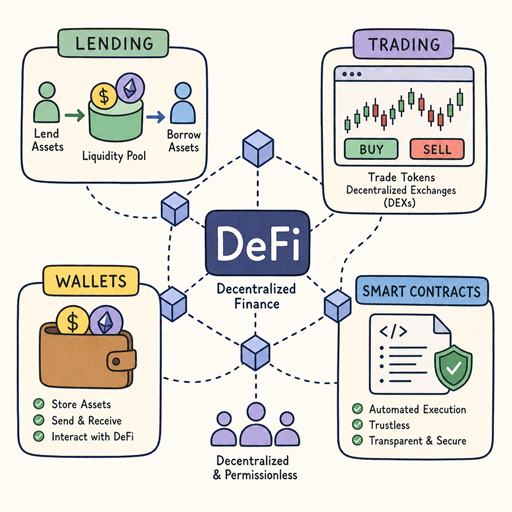
Decentralized finance, often called DeFi, applies blockchain technology and smart contracts to financial activities such as trading, lending, borrowing, staking, payments, and asset management. Instead of relying exclusively on banks, brokers, or centralized exchanges, users can interact with protocols that execute financial rules through code.
The attraction is open access and composability. A lending protocol, exchange protocol, stable-value asset, and wallet can work together like financial building blocks. Developers can build new products by integrating existing protocols, and users can access services from anywhere the underlying network is available.
However, decentralized finance also illustrates the trade-offs of Web3. Users may face smart contract risk, market volatility, unclear regulation, liquidity issues, scams, and confusing interfaces. A protocol may be transparent on-chain but still difficult for non-experts to evaluate. This is why responsible participation requires more than excitement about yield or innovation.
A practical DeFi evaluation checklist includes:
- Purpose: What financial problem does the protocol solve, and who needs it?
- Transparency: Are the rules, fees, risks, and governance processes understandable?
- Security: Has the code been reviewed, tested, and monitored?
- Liquidity: Can users enter or exit positions without unreasonable friction?
- Custody: Who controls the assets at each step?
- Regulatory context: Could the product create compliance obligations for users or operators?
- Sustainability: Are rewards based on real activity or only new participant inflows?
The future of decentralized finance may be less about replacing every financial institution and more about creating new rails that institutions, developers, and users can access. Hybrid models may become common, combining blockchain settlement with regulated interfaces, risk controls, and familiar customer experiences.
NFTs, marketplaces, and the next phase of digital ownership
NFTs introduced many people to Web3 because they made digital ownership visual and easy to discuss. An NFT is a unique or distinguishable token that can represent a digital item, access right, credential, collectible, membership, media file, game item, or other asset. The token is not always the same as the file or benefit it points to, which is why buyers need to understand what they actually receive.
An nft marketplace helps users discover, buy, sell, or trade these assets. Early marketplaces often focused on art and collectibles, but future marketplaces may support broader use cases: event tickets, gaming assets, loyalty memberships, professional credentials, music access, brand communities, and digital-to-physical products.
The next phase of NFTs is likely to be less about novelty and more about utility, rights, and context. A digital asset becomes more valuable to users when it does something useful: unlocks access, proves achievement, travels across games, supports creator revenue, or gives a community a shared object around which to organize.
For brands and creators, the best NFT projects begin with a clear relationship between the asset and the audience. Questions to ask before launching include:
- What does the holder receive beyond ownership of a token? Access, participation, content, status, benefits, or interoperability should be clear.
- How will the experience continue after the initial sale? A launch is not a community strategy by itself.
- What rights are included? Commercial use, display rights, resale terms, and metadata dependencies should be explained plainly.
- How will customer support work? Many buyers will need help with wallets, transactions, and security.
- What risks should users understand? Prices can fluctuate, marketplaces can change, and technical dependencies can fail.
NFTs have a future when they become invisible infrastructure for ownership and access, not just objects of speculation. The strongest projects will likely feel less like buying a token for its own sake and more like joining an experience where blockchain adds portability and proof.
The token economy changes incentives
A token economy uses digital tokens to coordinate behavior, distribute value, or represent participation inside a network. Tokens can reward contributors, fund development, grant access, support governance, or create internal marketplaces. When designed well, they align participants around shared growth.
The challenge is that incentives are delicate. If a token rewards shallow activity, users may farm rewards without creating real value. If governance tokens concentrate among a few holders, a project may become decentralized in branding but centralized in practice. If token value depends only on speculation, the system may struggle when attention fades.
A healthier token economy starts with the activity the network wants to encourage. For example, a storage network may reward reliable storage providers. A creator community may reward meaningful contribution, moderation, or patronage. A software protocol may give governance influence to people who help maintain the ecosystem.
Strong token design usually considers:
- Utility: What can the token actually do?
- Distribution: Who receives tokens, when, and why?
- Governance: What decisions can token holders influence?
- Supply rules: How are issuance, scarcity, or burning handled?
- Incentive quality: Does the model reward long-term value or short-term extraction?
- User clarity: Can a non-expert understand the token’s role?
The token economy is one of the most important ideas in Web3 because it turns users into stakeholders. But stakeholder status is meaningful only when rights, risks, and responsibilities are clear.
How should businesses prepare for a token economy?
Businesses should prepare for a token economy by identifying where ownership, verification, incentives, or programmable transactions could improve an existing customer, partner, or community experience. The goal is not to “add a token” to every product; it is to understand whether Web3 technology solves a real problem better than conventional infrastructure.
A practical starting point is to map friction. Where do customers struggle to prove membership, transfer value, claim rewards, access services, or trust records? Where do partners spend time reconciling data? Where could smart contracts reduce manual administration? These questions reveal whether blockchain technology belongs in the solution.
Businesses should also separate experimentation from core operations. A small pilot can test assumptions without overcommitting. For example, a company might test token-gated content, blockchain-based certificates, loyalty digital assets, or a limited community governance feature before building a larger system.
A sensible business roadmap looks like this:
- Define the use case. Start with the customer problem, not the technology.
- Choose the ownership model. Decide whether users need transferable assets, non-transferable credentials, access tokens, or no token at all.
- Assess legal and compliance needs. Token design, promotions, custody, and financial features can create obligations.
- Design the user experience. Make onboarding, recovery, fees, and support understandable.
- Plan security from the beginning. Include wallet safety, smart contract testing, permission controls, and incident response.
- Measure real engagement. Track whether the system improves retention, participation, efficiency, or trust.
- Communicate plainly. Users should understand benefits and risks without decoding jargon.
This approach helps businesses avoid a common mistake: treating Web3 as a marketing layer rather than a product architecture choice. The most credible projects will be those where the technology is necessary, useful, and easy to explain.
Web3 and digital identity
Digital identity is one of the most important long-term areas for Web3. Today, identity is fragmented across platforms, governments, employers, financial institutions, and apps. Users repeatedly prove who they are, rebuild reputations, and surrender data to access services.
Web3 identity tools can allow people to hold verifiable credentials, reputation signals, or access rights in a wallet or identity system. A person might prove they completed a course, belong to a community, are eligible for a service, or own a certain asset without revealing unnecessary personal information. This can support privacy-preserving verification, although implementation quality matters greatly.
Not every identity record should be public or permanent. Sensitive information requires careful privacy design, consent, revocation methods, and compliance with applicable rules. The future of Web3 identity will depend on selective disclosure: proving what is needed while exposing as little as possible.
For users, better digital identity could reduce repetitive signups and make online reputation more portable. For organizations, it could simplify verification, access control, certification, and customer trust. The best systems will balance convenience with privacy, security, and human recovery options.
Governance and community ownership
Web3 often uses governance mechanisms to let participants influence the direction of a protocol, treasury, marketplace, or community. This can include voting on upgrades, funding proposals, parameter changes, partnerships, or ecosystem grants. In theory, governance turns users into active stewards rather than passive customers.
In practice, governance is hard. Many participants do not vote. Some voters lack technical context. Token concentration can give large holders outsized influence. Proposal systems can become slow, political, or vulnerable to manipulation.
Still, governance remains a meaningful experiment in digital coordination. The most effective models tend to combine clear decision boundaries, transparent discussion, delegated expertise, participation incentives, and safeguards against abuse. Not every decision needs a public vote, and not every token holder is qualified to decide every technical issue.
For communities, the lesson is to design governance around the type of decision being made. Strategic direction, budget allocation, and community standards may benefit from broad input. Security patches, legal matters, and urgent operational responses may require trusted teams with accountability. Good governance balances participation with competence.
Key challenges shaping the future of Web3
Web3 technology will not reach mainstream maturity through vision alone. It must solve practical barriers that affect users, developers, businesses, and regulators.
Usability and onboarding
Many Web3 experiences still ask too much from beginners. Wallet setup, transaction approvals, network fees, private key safety, and bridge selection can overwhelm users. Better onboarding will require simpler wallets, clearer language, embedded education, safer defaults, and recovery methods that do not compromise user control.
Security and trust
Smart contracts, wallets, bridges, and marketplaces can all become attack targets. Users may also encounter phishing, fake tokens, impersonation, and misleading promotions. Security must become part of product design, not a final audit checkbox. Clear permissions, transaction previews, monitoring, and emergency controls can help users understand what they are approving.
Regulation and compliance
Web3 intersects with finance, consumer protection, data privacy, intellectual property, tax, and securities rules. Regulation can vary by jurisdiction and use case. Projects that handle payments, lending, investment-like tokens, custodial services, or personal data need legal review. The most durable Web3 companies will likely treat compliance as infrastructure, not an obstacle to ignore.
Scalability and cost
For Web3 applications to support large audiences, transactions must be fast, affordable, and reliable. Scaling solutions, alternative networks, and improved infrastructure can help, but they add complexity. Users should not need to understand the full architecture to complete basic actions.
Interoperability
The promise of portable digital assets depends on systems working together. If assets are technically owned by users but practically trapped inside incompatible apps, the benefit is limited. Standards, bridges, APIs, and cross-chain tools will shape whether Web3 becomes an open ecosystem or a collection of isolated networks.
Practical ways to evaluate a Web3 project
Whether you are a user, investor, creator, or business leader, the most useful habit is to evaluate Web3 projects by substance rather than momentum. Hype can move quickly, but durable systems answer basic questions clearly.
Use this checklist before participating:
- Problem fit: Does the project solve a real problem that needs blockchain technology?
- User benefit: What improves for the user compared with a conventional app?
- Asset clarity: What do the digital assets represent, and what rights or limitations come with them?
- Smart contract quality: Are the contracts documented, reviewed, and understandable at a high level?
- Team transparency: Is it clear who is building, maintaining, or governing the project?
- Economic design: Does the token economy support useful behavior or only speculation?
- Security posture: Are risks, permissions, and recovery processes explained?
- Community health: Are discussions thoughtful, or driven mostly by price talk and urgency?
- Exit options: Can users leave, transfer assets, or recover value without unreasonable friction?
- Long-term maintenance: Who updates the system, funds development, and handles failures?
This checklist does not remove risk, but it slows the decision down. In Web3, that pause is valuable. Many poor decisions happen when people act before understanding what they are signing, buying, approving, or joining.
The future will be hybrid, not purely decentralized
A realistic future for Web3 is not a total replacement of today’s internet. More likely, Web3 features will blend into existing products where they add clear value. Users may not always know that a loyalty pass, game item, payment rail, credential, or marketplace listing relies on blockchain technology behind the scenes.
This hybrid future makes sense because decentralization is not always the best answer to every problem. Some services need speed, privacy, moderation, customer support, or regulatory controls that are easier to manage with centralized components. The strongest products will choose decentralization where it improves ownership, verification, or coordination, and use conventional infrastructure where it improves safety and usability.
For example, a marketplace might use blockchain records for digital asset ownership while keeping search, recommendations, customer support, and fraud detection in a managed system. A financial app might use decentralized finance protocols for settlement but provide a regulated interface for users. A brand community might use tokens for access while still relying on traditional content platforms for distribution.
The question is not whether centralization or decentralization “wins.” The better question is which parts of a system should be open, user-owned, and verifiable, and which parts should be optimized for performance, privacy, support, or compliance.
Best practices for users entering Web3
For individuals, the safest path into Web3 is gradual and informed. Start with small actions, learn how wallets and transactions work, and avoid pressure-driven decisions. If a project promises easy gains, requires urgency, or discourages questions, treat that as a warning sign.
Practical habits include:
- Use reputable wallets and keep software updated.
- Learn the difference between custodial and self-custody options.
- Never share private keys or recovery phrases.
- Review transaction prompts before approving them.
- Be cautious with links in messages, social posts, and search results.
- Separate experimental wallets from wallets holding important assets.
- Understand fees, lockups, permissions, and withdrawal limits.
- Keep records for tax, accounting, or personal tracking purposes.
- Treat digital assets as risky unless you clearly understand their function.
Web3 gives users more control, but control comes with responsibility. The best mindset is curiosity with caution: explore, learn, test, and verify before committing meaningful value.
Best practices for builders and creators
For builders, Web3 success depends on solving real problems with less friction than the alternatives. A product should not require users to become blockchain experts before they receive value. The technology can be sophisticated; the experience should feel simple.
Creators and product teams should focus on:
- Clear utility: Explain what users can do, not just what they can own.
- Plain language: Replace jargon with familiar actions and outcomes.
- Responsible economics: Avoid incentive systems that reward extraction over contribution.
- Security-first design: Minimize permissions, test thoroughly, and prepare incident responses.
- Community trust: Set expectations, communicate changes, and avoid overpromising.
- Accessible onboarding: Support users who are new to wallets, tokens, and transaction approvals.
- Long-term commitment: Plan for maintenance after launch, not only initial attention.
A Web3 product earns trust when it makes ownership useful and understandable. If users cannot explain why the blockchain component matters, the product may need a simpler design or a clearer purpose.
What to watch next
The future of Web3 technology will be shaped by several overlapping developments. Wallets will become more user-friendly. Smart contracts will become more modular and security-focused. Digital assets will expand beyond collectibles into access, identity, gaming, commerce, and real-world coordination. Decentralized finance will continue influencing how financial products are built, even when users access them through familiar interfaces.
The most important shift may be cultural. Web3 asks people to rethink what it means to own something online, participate in a network, and share in the value they help create. That idea will continue to influence product design, creator communities, finance, gaming, and digital identity, even as specific platforms rise and fall.
For readers, the practical takeaway is simple: Web3 is not a single product or trend. It is a set of tools for building more programmable, portable, and participatory digital systems. The opportunity is real, but so are the risks. The smartest approach is to understand the building blocks, evaluate use cases carefully, and support projects where blockchain technology creates clear benefits that ordinary people can actually use.