A new materials discovery is drawing attention because it changes where researchers look for clean-energy breakthroughs. Instead of studying only the starting chemicals and final products, scientists examined the short-lived “in-between” phases that appear during heating—and found hidden materials for batteries and solar fuels that may have useful properties of their own. The work points to a practical idea: some of the most promising battery materials and solar-fuel materials may be hiding inside reaction pathways that labs have treated as temporary stops.
What did scientists actually discover?
Scientists identified previously unknown intermediate materials that form while molecular precursors transform into oxide materials, including a new kinetic form of bismuth vanadate, often written as β-BiVO₄. Bismuth vanadate is already widely studied for solar-fuel applications because it can absorb sunlight and help drive reactions such as water splitting, but this newly observed form shows that the same chemical ingredients can produce different structures with different behavior depending on how the reaction is controlled. The Nature Communications study also reported vanadium-rich intermediate material with lithium-storage behavior, making the discovery relevant to both solar fuels and next-generation batteries.
That matters because materials science often depends on small structural differences. Two materials can have the same elements but perform differently because their atoms are arranged in another pattern, because defects appear in useful places, or because the material forms under kinetic conditions before settling into a more stable state. In simple terms, the research suggests that scientists may not need to invent entirely new chemistry from scratch every time; they may also need to slow down, watch the transformation more carefully, and capture useful phases before they disappear.
The overlooked middle of a chemical reaction
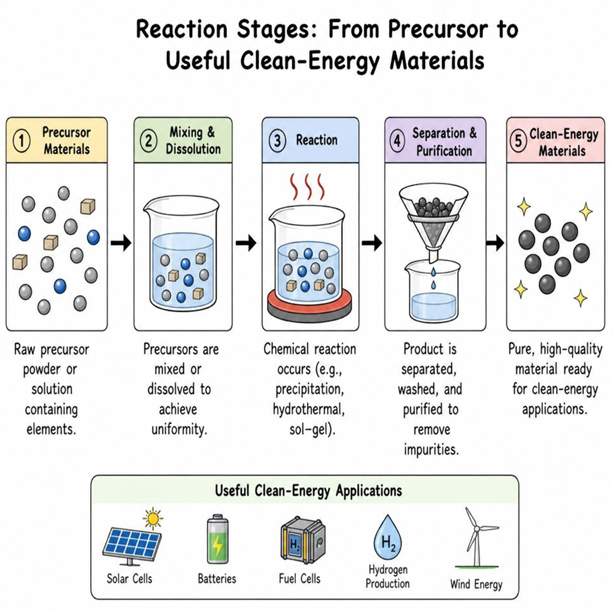
Many materials are made by heating precursor chemicals until they become a desired final compound. Traditionally, the final product gets most of the attention because it is easier to isolate, characterize, and compare. The intermediate stages, by contrast, can be messy, brief, amorphous, or difficult to reproduce, so they are often treated as background chemistry rather than as possible sources of value.
This research turns that habit into an opportunity. By tracking what happens during the heating process, scientists can map the route from molecule to material and ask whether any stop along the way has useful properties. That is where the phrase hidden materials for batteries and solar fuels becomes more than a catchy label: it describes materials that were present all along, but not visible through a research approach focused only on endpoints.
The approach also highlights the importance of precursor design. If temperature, chemistry, timing, and reaction pathway can steer which intermediate phases appear, then researchers may be able to tune the process intentionally. That could help create alternative battery materials or solar-fuel catalysts with properties that are difficult to reach through conventional synthesis.
Why “hidden” materials could matter for batteries
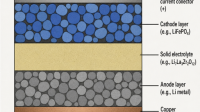
Batteries depend on materials that can store and release ions while remaining stable through repeated charging and discharging. In lithium-ion systems, that usually means carefully engineered electrode materials that allow lithium ions to move in and out without destroying the structure too quickly. The newly reported intermediate material showed lithium-storage behavior, which suggests it may offer clues for designing sustainable battery materials, even if it is not yet a ready-made commercial electrode.
The biggest practical value may be the design lesson. If a temporary intermediate can hold lithium in a useful way, researchers can investigate why. Is it because of open structural spaces? A vanadium oxide framework? A transformation that creates lithium-accessible sites? Answering those questions can guide the search for battery materials that use more abundant ingredients, operate more efficiently, or support longer-lasting storage.
For readers outside the lab, it helps to separate discovery from deployment. A material that performs interestingly in early testing still has to clear many hurdles, including cycling stability, manufacturability, safety, cost, and compatibility with real battery architectures. But early materials discoveries are where those future options begin. Today’s “interesting intermediate” can become tomorrow’s design principle, especially when the research reveals a repeatable way to make and study it.
What battery researchers can take from the discovery
- Reaction pathways are valuable data. The steps between precursor and final product may reveal structures that are not obvious from the finished material.
- Performance can come from structure, not just composition. The same elements can behave differently when arranged in a different phase or framework.
- Alternative battery materials need broader search strategies. Looking only at known stable compounds may miss useful kinetic or intermediate phases.
- Sustainability depends on discovery and control. More sustainable battery materials will require not only better ingredients, but also better ways to make those ingredients perform reliably.
Why solar fuels need better materials
Solar fuels are made by using sunlight to drive chemical reactions that store energy in chemical bonds. One major research goal is water splitting, where sunlight helps produce hydrogen that can later be used as a clean fuel. Materials such as BiVO₄ are important because they can act as photoactive components, absorbing light and participating in the movement of charges needed to drive these reactions.
The challenge is that a solar-fuel material has to do several difficult things at once. It must absorb useful parts of sunlight, separate electrical charges before they recombine, survive in reactive chemical environments, and support efficient surface reactions. A material may look promising in one category but fall short in another, which is why researchers keep exploring new phases, coatings, catalysts, and architectures.
The newly discovered β-BiVO₄ phase is interesting because polymorphs—different crystal forms of the same compound—can have different electronic and structural properties. The Nature Communications paper describes β-BiVO₄ as a higher-energy kinetic polymorph compared with the more familiar monoclinic form, which is exactly the kind of difference that can open new questions for solar-energy design.
How could this change clean-energy research?
This discovery could encourage researchers to treat synthesis as a landscape rather than a straight line. Instead of asking only, “How do we make the final material?” labs may increasingly ask, “What appears along the way, and can we stabilize it, tune it, or learn from it?” That shift could expand the pool of hidden materials for batteries and solar fuels without requiring scientists to abandon known chemical families.
It also fits a broader trend in clean-energy materials research: better tools are making it easier to observe complex changes in real time or near-real time. When scientists can follow phase changes, local structure, and electrochemical behavior more closely, they can identify useful patterns that older methods might miss. This does not replace traditional screening or computational prediction, but it adds another route to discovery.
For industry, the long-term appeal is clear. Better battery materials could support cleaner storage for electric vehicles, devices, and renewable power systems. Better solar-fuel materials could help convert sunlight into storable fuels, addressing one of the hardest problems in renewable energy: how to store energy when the sun is not shining. The immediate result is still basic research, but the direction is practical.
The promise and limits of early-stage materials discoveries
Exciting materials news can easily sound like a finished product is around the corner. In reality, the path from discovery to device is usually long. Researchers must confirm the material’s structure, understand how it behaves under working conditions, improve performance, scale synthesis, and test durability over realistic use cycles.
That caution does not make the finding less important. Early-stage discoveries are valuable because they widen the map. If a hidden intermediate reveals a new way to store lithium or a new version of a solar-fuel material, scientists can use that information even if the exact material never becomes commercial. Sometimes the breakthrough is the material itself; other times, it is the method that shows where to look next.
A balanced view looks like this:
|
Potential benefit |
What still needs work |
|---|---|
|
New phases may offer useful electronic or ion-storage behavior. |
Researchers must prove stability, reproducibility, and device-level performance. |
|
Intermediate materials could inspire alternative battery materials. |
Lab-scale lithium storage does not automatically translate into commercial batteries. |
|
Kinetic control may unlock structures missed by standard synthesis. |
Manufacturing would need precise, scalable process control. |
|
Known compounds like BiVO₄ can be revisited in new forms. |
Solar-fuel systems still require efficiency, durability, and integration improvements. |
A useful reminder about sustainable innovation
Clean-energy progress is often described as a race to find the next miracle material, but this research suggests another route: learn more from the chemistry already in front of us. Sustainable battery materials and solar-fuel systems may come not only from rare discoveries, but from better observation, smarter synthesis, and a willingness to investigate phases that once looked temporary or inconvenient.
That mindset is important because energy technologies must satisfy scientific, economic, and environmental demands at the same time. A promising material is more useful if it can be made consistently, studied transparently, and adapted to real devices. Discovering hidden structures is only the first step, but it gives researchers more options—and clean energy needs more options.
The main takeaway is simple: the “middle” of a chemical reaction may be more valuable than it looks. By uncovering hidden materials for batteries and solar fuels, scientists have shown that overlooked intermediate phases can reveal new properties, new design rules, and new paths toward cleaner energy storage and conversion. The next breakthroughs in battery materials may not be hiding in a completely unknown element or exotic compound; they may be waiting inside the transformations researchers are already running every day.