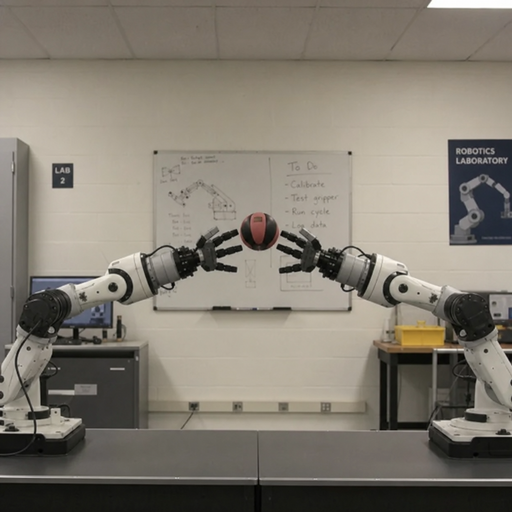
A new generation of two-armed robot research is moving beyond slow pick-and-place demos and into fast, physical interaction. AthenaZero, a bimanual robot developed by the RAI Institute, has demonstrated throwing, catching, and batting balls with movements designed to look and behave more like human motion than conventional industrial automation. The result is not just a fun baseball-style demo; it is a useful glimpse into where robotic manipulation may be heading next.
Why is a robot playing catch such a big deal?
A robot playing catch matters because it forces hardware, sensing, planning, and control to work together in fractions of a second. A ball in flight cannot wait for a slow correction, and a catching motion cannot rely only on rigid positioning. The robot has to predict where the object will be, move safely toward it, absorb contact, and then prepare for the next action.
That is why this kind of demonstration attracts attention in robotics. Throwing and catching may look simple to humans, but they combine timing, force control, visual prediction, and whole-arm coordination. For robotic systems, those skills are much harder than moving a part from one fixed tray to another.
AthenaZero was introduced in a Science Robotics paper published on September 16, 2026. The researchers describe it as a low-inertia bimanual manipulator built for dynamic manipulation, with two arms and underactuated hands rather than a single stiff industrial arm.
Human-like movement starts with lighter-feeling arms
Many robotic arms are excellent at precision, strength, and repeatability, but they often achieve that through stiff linkages and high gear ratios. That design is useful in factories, yet it can make contact-rich tasks harder because the robot’s effective mass and reflected inertia are high. In plain English, the arm may feel heavier and less forgiving when it touches the world.
AthenaZero takes a different path. The RAI Institute says the platform uses low-inertia design principles so the robot can be fast, precise, and better suited to switching between delicate and forceful contact. Its structure includes a one-degree-of-freedom torso, two seven-degree-of-freedom arms, and two six-degree-of-freedom underactuated hands, giving it a human-like upper-body layout without simply copying a person.
This matters because human-like movement is not only about appearance. A graceful throw depends on acceleration, follow-through, compliance, and the ability to manage changing forces. When robotic manipulation involves moving objects quickly, the hardware has to support the control strategy instead of fighting it.
What AthenaZero can actually do
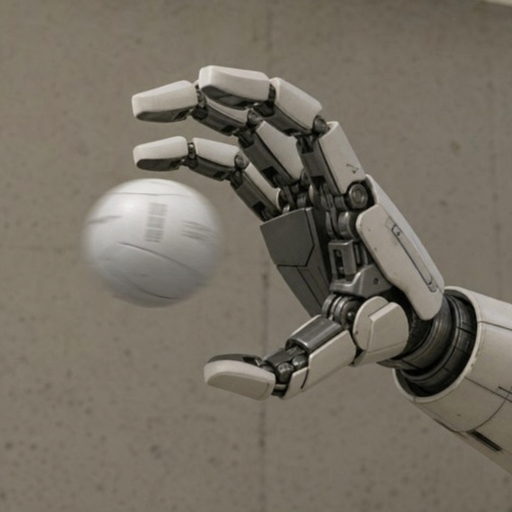
The most eye-catching part of the research is the baseball-inspired task set. According to the published abstract, AthenaZero demonstrated throwing, catching, and batting, including game-of-catch and batting-practice variations involving robot-to-robot and human-to-robot interaction. It was capable of throwing at speeds above 30 meters per second, while catching and batting at speeds above 14 meters per second over a 7.3-meter distance.
Those numbers are useful because they show the work is not limited to slow lab motions. The system is dealing with short time windows, moving targets, and contact events. A ball that arrives quickly gives the robot little room for indecision; a late or overly stiff response can turn a catch into a miss.
The tasks also show why two arms are valuable. A two-armed robot can coordinate movements around a shared workspace, use one arm to prepare while the other acts, and potentially handle tasks that require bilateral timing. Even when one arm performs the visible throw or catch, the torso and second arm affect balance, range, and future motion planning.
Key capabilities demonstrated include:
- Throwing: generating fast, controlled motion and releasing the ball at the right moment.
- Catching: predicting the ball’s path and managing contact rather than simply blocking it.
- Batting: timing a swing so the robot meets a moving object with useful force.
- Partner interaction: operating in robot-to-robot and human-to-robot play patterns.
- Dynamic recovery: preparing for the next action after a high-speed contact event.
The difference between dynamic manipulation and ordinary automation
Dynamic manipulation is the branch of robotic manipulation that deals with motion, impact, momentum, and timing. It includes actions such as throwing, catching, striking, juggling, tossing, snatching, and fast handoffs. These actions are difficult because the robot cannot treat the world as static.
Traditional automation often assumes that the part, tool, and robot path are tightly controlled. The object sits in a known location, the robot follows a programmed route, and the environment stays mostly unchanged. Dynamic tasks break that comfort zone.
A ball in the air is a moving target. Its path can be estimated, but the robot still needs to react to small errors. The arm must move quickly without becoming unsafe or unstable. The hand must receive contact in a way that does not bounce the object away. That combination makes ball play a compact but demanding test for future robotic systems.
For engineers, this is valuable because it compresses several real-world challenges into one visible demonstration. If a robot can handle fast physical interaction in a controlled lab setting, similar principles may eventually support faster packing, tool use, inspection, human-assistive work, and other contact-rich tasks.
Two arms make robots more adaptable
A single robotic arm can perform many useful jobs, but two robotic arms open a wider design space. People rarely manipulate the world with one hand only. We stabilize with one hand while acting with the other, pass objects between hands, adjust posture, and use our body to create better leverage.
Bimanual robots aim to capture some of that flexibility. In industrial settings, dual-arm machines can work on small-parts assembly, material handling, machine tending, and tasks that benefit from holding and manipulating at the same time. For example, Yaskawa’s MOTOMAN-SDA series is described as a dual-arm, 15-axis robot family, and the SDA10D is positioned for complex assembly and small-part material handling.
That is a different use case from AthenaZero’s baseball-style research, but the comparison is useful. A yaskawa two armed robot is typically associated with production automation and industrial workflows, while AthenaZero highlights the research frontier of speed, compliance, and human-comparable timing. Both point to the same broader trend: two arms let robots handle tasks that are awkward for a single manipulator.
Why the “human-like” label should be used carefully
Calling a robot human-like can be misleading if it suggests general human ability. AthenaZero is impressive, but it is still a research platform performing specific tasks under designed conditions. It does not mean general-purpose household robots are ready to catch anything tossed across a room or work safely in every unpredictable environment.
The better interpretation is narrower and more useful. The robot’s movements are human-like in the sense that its low-inertia design, bimanual form, and fast contact behaviors are closer to the timing and physical responsiveness humans use in dynamic tasks. The Science Robotics abstract emphasizes human-comparable timescales where milliseconds matter, which is a more precise way to frame the achievement.
This distinction keeps expectations grounded. Human-like movement is not the same as human-level understanding. The movement may be fluid, but the robot still depends on engineered perception, planning, hardware limits, and controlled safety conditions.
What this could mean for future robotic systems
The long-term promise is not that factories need baseball robots. The promise is that better dynamic manipulation could make robots more useful in messy, changing, physical environments. Any task involving motion and contact can benefit from arms that are lighter-feeling, more responsive, and better at adapting to impact.
Possible areas of influence include:
- Faster handling of irregular objects Robots that can react to moving items may become better at sorting, packing, or catching objects that shift on conveyors.
- Safer human-robot collaboration Lower-inertia, more compliant designs may help robots manage contact more gracefully, although safety still depends on the full system design and operating environment.
- More capable service robots Tasks such as handing over tools, catching dropped items, or assisting with sports and rehabilitation require timing beyond static grasping.
- Improved research benchmarks Throwing, catching, and batting create clear tests for speed, prediction, force control, and recovery.
- Better hardware-control co-design The work reinforces that software alone is not enough. The shape, mass distribution, gearing, and actuation choices of robotic arms all affect what the robot can do.
Search confusion: robots, treads, and Pokémon
Because “two armed robot” is a broad phrase, people often search for very different things under similar wording. Someone looking for a two armed tank tread robot may be thinking about a mobile platform with manipulator arms, while another person searching for a yellow robot two armed pokemon may be trying to identify a fictional character or toy-like design rather than a real machine.
That confusion is understandable. Popular culture gives robots personality and color, while research labs focus on motion, control, and physical performance. AthenaZero sits firmly in the research category: it is not a cartoon mascot, a toy, or a tank-tread rover, but a bimanual system designed to study fast contact-rich manipulation.
The shared theme is embodiment. Whether the robot has wheels, treads, two arms, or a humanoid upper body, its physical form shapes what it can do. For ball throwing and catching, the important features are not color or style; they are low inertia, coordinated arms, responsive control, and accurate timing.
The takeaway
AthenaZero’s ball-throwing and catching demonstrations show how far two-armed robot research has moved from rigid, slow, preprogrammed motion. By combining bimanual hardware with low-inertia design and dynamic control, the system makes fast physical interaction look more natural and more achievable.
The real story is not that a robot can play catch for entertainment. It is that robotic systems are being designed to handle the moving, contact-rich world with more speed and subtlety. That progress could shape the next generation of robotic arms, industrial automation, assistive machines, and research platforms built for real-world manipulation.