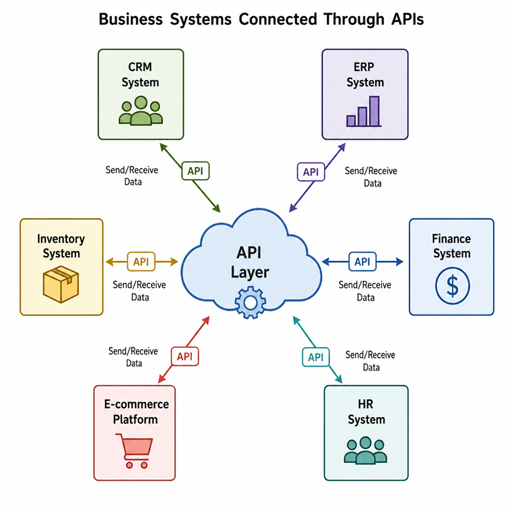
The API economy describes the growing business value created when organizations expose data, functionality, and digital services through application programming interfaces. Instead of building every capability from scratch, companies can connect systems, launch partnerships, automate workflows, and create new revenue streams through well-designed APIs. This guide explains how the API economy works, why it matters, and how businesses can approach api development, api integration, api management, and api monetization with a practical strategy.
What is the API economy?
The API economy is the network of products, platforms, developers, partners, and customers that exchange value through APIs. An API acts as a controlled doorway into a software system, allowing another application to request information or trigger an action without needing direct access to the system’s internal code. When companies treat those interfaces as strategic business assets rather than technical afterthoughts, they become part of the API economy.
At a basic level, APIs let software systems talk to each other. A payment form can connect to a payment processor, a travel app can display flight availability, and a logistics platform can send shipment updates to an online store. Behind these everyday experiences are api services that make digital products faster to build and easier to extend.
The impact goes beyond convenience. APIs can change how businesses operate, partner, sell, and innovate. They make it possible to combine specialized services into complete customer experiences, reduce duplicated development work, and open new channels for distribution. In many industries, the companies that manage APIs well can move faster than competitors that keep their systems isolated.
The shift from internal tools to business infrastructure
APIs were once viewed mainly as tools for developers inside an organization. They helped teams connect databases, applications, and back-office systems. That role still matters, but the modern API economy has expanded the purpose of APIs from internal connectivity to external value creation.
A business can now expose selected capabilities to partners, customers, suppliers, or independent developers. For example, a company might make inventory data available to retail partners, offer identity verification as an embedded service, or let customers pull account data into their own dashboards. In each case, the API becomes infrastructure for a broader ecosystem.
This shift changes how leaders should think about api strategy. The question is no longer only, “How do we connect these systems?” It becomes, “Which capabilities should we make available, to whom, under what rules, and for what business outcome?” That broader view is what separates simple api integration from a mature participation in the API economy.
Why does the API economy matter to businesses?
The API economy matters because it turns digital capabilities into reusable, scalable, and shareable assets. Businesses can use APIs to improve customer experiences, build partnerships, launch new products, automate operations, and create revenue models that would be difficult to support with traditional software delivery alone.
One of the most important effects is speed. When teams can reuse existing APIs, they avoid rebuilding common features such as payments, messaging, analytics, search, authentication, or shipping connections. This shortens development cycles and lets teams focus on the parts of a product that are truly differentiated.
APIs also support flexibility. A company can replace one service, add a new channel, or connect with a new partner without redesigning the entire technology stack. This modular approach is especially useful when customer expectations change quickly or when a business needs to test new offerings without committing to a full system rebuild.
The business value often appears in several areas:
- Faster product development: Teams use existing api services instead of creating every feature internally.
- Better customer experiences: APIs allow data and services to appear in the channels customers already use.
- Stronger partnerships: Partners can connect directly to approved capabilities through secure interfaces.
- Operational efficiency: Automated data exchange reduces manual work and repeated entry.
- New revenue opportunities: Api monetization can turn valuable functionality into a paid product or partner offering.
- Greater scalability: Standardized APIs make it easier to support more users, integrations, and digital channels.
For many organizations, the API economy is not a separate technology trend. It is part of how modern business gets done.
The core building blocks of a successful API approach
A strong API program does not start and end with code. It combines product thinking, governance, security, documentation, analytics, and developer experience. Without these foundations, even technically functional APIs can become difficult to use, hard to maintain, or risky to expose.
Clear business purpose
Every API should have a reason to exist. Some APIs support internal efficiency, while others enable customer-facing products, third-party partnerships, or commercial api services. Defining the purpose early helps teams make better decisions about design, access, performance, support, and pricing.
A business-purpose lens also prevents API sprawl. When teams create APIs without shared standards or ownership, organizations may end up with overlapping interfaces, inconsistent data, and unclear maintenance responsibilities. A deliberate api strategy keeps the portfolio focused on real business needs.
Reliable api development practices
Effective api development requires more than exposing an endpoint. Teams need to design APIs around real use cases, predictable data structures, clear error messages, versioning plans, and security requirements. The goal is to make the API understandable and dependable for the people and systems that use it.
Good development practices also include testing, monitoring, and lifecycle planning. APIs should be treated as long-term products that may evolve over time. If a change breaks an important integration, the impact can spread quickly across customers, partners, and internal teams.
Strong developer experience
Developers are often the direct users of an API, even when the ultimate audience is a customer or partner. If documentation is confusing, authentication is difficult, or examples are missing, adoption will suffer. A useful developer experience includes guides, reference documentation, sample requests, clear onboarding steps, and support paths.
This is where technical quality and business outcomes meet. The easier an API is to understand and implement, the faster partners and internal teams can create value from it. A great API can lose momentum if it is hard to discover or difficult to use.
Security and governance
APIs can expose valuable data and critical business functions, so security must be built into the strategy from the beginning. Access controls, authentication, authorization, encryption, rate limits, and monitoring all help protect the organization and its users. Governance ensures that APIs are created, published, changed, and retired in a controlled way.
Good governance does not have to slow teams down. In fact, shared standards can make delivery faster because teams know what patterns to follow. The goal is to create enough structure to reduce risk while still encouraging innovation.
API integration as a driver of digital transformation
Api integration is the process of connecting applications, data sources, platforms, or services through APIs so they can work together. In practical terms, it helps businesses replace disconnected workflows with coordinated digital processes. This is one reason APIs are central to digital transformation efforts.
For example, a sales platform might connect with billing software, customer support tools, marketing automation, and a data warehouse. Without integration, teams may spend time copying information between systems, reconciling errors, or waiting for reports. With API-based connections, information can move more consistently and quickly across the organization.
Api integration also helps businesses adapt to specialized tools. Instead of relying on one system to do everything, organizations can combine best-fit services. This creates a more flexible technology environment, but it also increases the need for thoughtful api management. The more connected a business becomes, the more important it is to understand which systems depend on which APIs.
A practical integration checklist includes:
- Identify the business process first. Define the workflow or customer experience the integration should improve.
- Map the required data. Clarify which data must move, in what format, and how often.
- Define ownership. Assign responsibility for the API, the connected system, and ongoing support.
- Plan for failure. Decide what happens if a service is unavailable, delayed, or returns an error.
- Monitor performance. Track usage, latency, errors, and business impact after launch.
- Document dependencies. Keep a current record of connected systems so changes do not create surprises.
Integration work can look technical on the surface, but its real value is operational. When APIs connect the right systems in the right way, teams can move with less friction.
API management turns connectivity into control
Api management refers to the policies, tools, and processes used to publish, secure, monitor, analyze, and maintain APIs. It gives organizations visibility into who is using APIs, how they are performing, and where risks or opportunities exist. Without management, an expanding API portfolio can become difficult to govern.
A strong api management approach usually covers several functions. API gateways help route requests and enforce access rules. Analytics reveal traffic patterns, adoption, errors, and performance. Developer portals support onboarding and documentation. Policy controls help teams apply consistent security, rate limiting, and usage standards.
The practical benefit is control. If an API is central to customer onboarding, partner transactions, or internal operations, the business needs to know whether it is available and working as expected. Management also supports better decision-making because leaders can see which APIs are used heavily, which need improvement, and which may no longer justify maintenance.
Api management is especially important as organizations move from a handful of internal APIs to larger ecosystems. The more value an API creates, the more important it becomes to protect, measure, and improve it.
How does API monetization work?
Api monetization is the process of generating measurable business value from APIs, either directly through fees or indirectly through growth, retention, efficiency, or ecosystem expansion. Not every API needs to be sold as a standalone product, but every important API should have a clear value model.
Direct monetization is the most obvious approach. A company may charge developers, partners, or customers for access to a specific API. Pricing might be based on usage, subscription tiers, premium features, transaction volume, or enterprise agreements. This model works best when the API provides a capability that users cannot easily build themselves or access elsewhere with the same reliability.
Indirect monetization can be just as powerful. An API may help partners sell more of a company’s core product, make customer onboarding easier, increase platform stickiness, or reduce service costs through automation. In these cases, the API supports revenue or savings even if access itself is not sold separately.
Common api monetization models include:
- Free access for adoption: Useful when the goal is ecosystem growth or developer experimentation.
- Tiered usage plans: Allows light users to start small while heavier users pay more.
- Partner-only access: Supports strategic relationships and controlled distribution.
- Transaction-based pricing: Aligns revenue with the value or volume of activity.
- Premium data or features: Offers basic access broadly while reserving advanced capabilities for paying users.
- Internal cost savings: Measures value through reduced manual work, faster delivery, or fewer duplicated systems.
The right model depends on the audience and the value delivered. A public developer API, a private partner API, and an internal automation API may all require different success metrics.
Designing an API strategy that supports growth
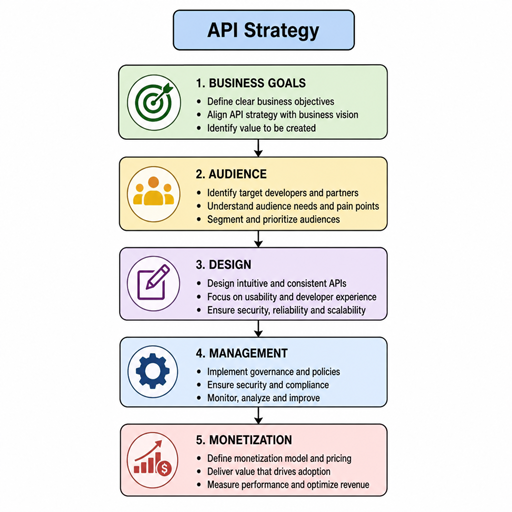
An effective api strategy connects technical decisions to business priorities. It defines which APIs should exist, who they serve, how they are governed, and how success will be measured. Without that strategy, API programs can become reactive, fragmented, or overly dependent on individual teams.
Start by identifying the capabilities that matter most. These may include customer data access, order processing, payments, reporting, account management, inventory, communication, or identity services. Then determine which audiences need those capabilities: internal teams, customers, partners, developers, or external platforms.
Next, decide how open each API should be. Some APIs should remain private, others may be shared with approved partners, and a smaller set may be appropriate for public developer access. This access model shapes documentation, security, support, onboarding, and monetization.
A useful strategy should answer these questions:
- Business goal: What outcome should the API support?
- Audience: Who will use it, and what problem are they solving?
- Value proposition: Why would users choose this API over another option?
- Access model: Is it private, partner-facing, or public?
- Security model: What data and actions require protection?
- Lifecycle plan: How will the API be versioned, updated, and retired?
- Success metrics: How will usage, performance, satisfaction, revenue, or efficiency be measured?
Strategy also requires prioritization. Not every system needs an API, and not every API should become a product. The strongest programs focus on capabilities that are reusable, valuable, and maintainable.
Risks and challenges in the API economy
The API economy creates opportunity, but it also introduces complexity. Businesses that expose services without planning can face security gaps, inconsistent user experiences, performance problems, and high maintenance costs. The same connectivity that creates value can create risk when it is poorly controlled.
Security is often the most visible concern. APIs may provide access to sensitive data or important business actions, so weak authentication, excessive permissions, or poor monitoring can have serious consequences. Teams should limit access to what users actually need and continuously monitor unusual behavior.
Reliability is another major issue. When customers or partners build around an API, downtime or breaking changes can affect their operations. Clear versioning, status communication, testing, and deprecation policies help maintain trust.
Organizations also need to manage complexity. As APIs multiply, teams may struggle to know which ones exist, who owns them, or whether they are still supported. A central catalog, consistent documentation, and shared standards help keep the portfolio usable.
Finally, monetization can be difficult if the value proposition is unclear. Charging for an API simply because it exists is rarely enough. Users need to understand what problem it solves, how it saves time, or how it helps them create revenue.
Best practices for building value with APIs
Creating value in the API economy requires both discipline and empathy for the people who use the API. The technical interface should be stable and secure, but it should also be easy to understand, test, and adopt. Strong API programs treat usability as a competitive advantage.
Consider these best practices:
- Design from real use cases. Start with the workflows developers, partners, or customers need to complete.
- Keep APIs consistent. Naming, authentication, error handling, and response formats should follow shared patterns.
- Invest in documentation. Include examples, setup instructions, common errors, and practical implementation guidance.
- Plan for change. Use versioning and deprecation policies so improvements do not unexpectedly break users.
- Measure what matters. Track technical metrics such as latency and errors, plus business metrics such as adoption or revenue impact.
- Secure by default. Apply least-privilege access, strong authentication, and monitoring from the start.
- Support the user journey. Make it easy for developers to discover, evaluate, test, and launch with the API.
These practices help turn APIs from technical endpoints into dependable business assets. The goal is not just to connect systems, but to create connections that people can trust and build on.
The future impact of the API economy
The API economy will continue to shape how companies build digital products and partnerships. As businesses depend on more platforms, data sources, and specialized services, APIs will remain the connective layer that allows those pieces to work together. The organizations that benefit most will be the ones that combine technical execution with clear business intent.
The future is likely to favor companies that make their capabilities easier to access, easier to govern, and easier to embed into other experiences. That may mean offering api services to partners, improving internal reuse, creating new monetization models, or using api integration to streamline operations. In each case, APIs help the business become more modular and adaptable.
For leaders, the main lesson is straightforward: APIs are not only a developer concern. They influence product strategy, customer experience, partnerships, revenue, and operational resilience. A thoughtful approach to api development, api strategy, api management, and api monetization can help organizations participate in the API economy with more confidence and less risk.
The companies that succeed will not be the ones with the most APIs. They will be the ones with APIs that are useful, secure, well-managed, and clearly connected to business value.