AI models are getting better at tasks that look simple to people but are surprisingly difficult for machines, including spelling words backward. The improvement comes from a more letter-aware approach: instead of treating text as chunks of meaning only, upgraded systems can pay closer attention to individual characters, shapes, sequence, and position. That shift has practical value for optical character recognition, ai letter recognition, ai handwriting analysis, and broader ai text analysis.
Why does spelling backward expose a weakness in AI?
Spelling backward exposes a weakness in AI because it tests whether a model can track each letter in exact order, not just understand the word’s meaning. A human can look at “garden” and reverse it letter by letter, but many language models are trained to predict patterns in tokens, which may represent whole words, word parts, or character groups. If the model does not reliably “see” every letter as a separate unit, it can understand the word while still making mistakes when asked to manipulate its spelling.
This matters because many real-world text tasks are not only about meaning. They are about precision. A bank form, medical label, shipping code, classroom worksheet, or handwritten note may contain short strings where one wrong character changes the result. Better ai letter recognition helps systems move from “I know roughly what this says” toward “I can account for each mark on the page.”
Letter-level vision changes the way models handle text
Traditional language models are strong at context. They can infer that “I left my keys on the kitch__ counter” probably contains “kitchen,” even if part of the word is missing. That ability is useful, but it can hide a problem: guessing from context is not the same as reading every character correctly.
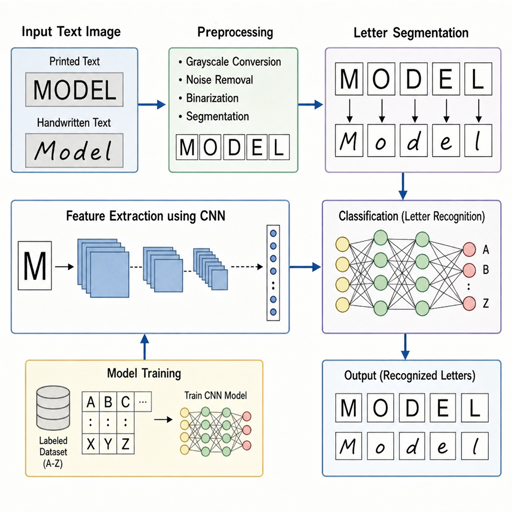
Letter-level recognition adds a different kind of discipline. The system must identify what appears in the input, preserve the order, and connect visual marks to textual meaning. That is especially important when a task requires reversal, sorting, spelling correction, transcription, or comparison between similar strings.
A model upgraded to see every letter can perform better on tasks such as:
- Backward spelling: reversing a word accurately instead of relying on memory or pattern guesses.
- Serial number reading: distinguishing similar characters such as O and 0, I and 1, or S and 5.
- Document capture: extracting names, addresses, dates, and codes from scanned pages.
- Handwritten text review: interpreting variable letter shapes without losing character order.
- Script and language analysis: comparing writing systems where character boundaries may be unfamiliar to the model.
This does not mean AI suddenly reads perfectly. It means the system has a better path for combining what it sees with what it understands.
The connection between OCR, ICR, and modern AI
Optical character recognition has been used for years to turn printed or scanned text into machine-readable data. It is the technology behind many document digitization workflows, from scanning invoices to indexing old archives. OCR works best when the input is clear, printed, and consistent.
Intelligent character recognition, often called ICR, extends that idea into more difficult territory. It is commonly associated with handwritten or less predictable text, where letters may connect, tilt, vary in size, or differ from person to person. This is where ai handwriting analysis can be useful, because the system needs to interpret marks that do not look as standardized as a printed font.
Modern AI can support both OCR and ICR by adding contextual reasoning. If a scanned form contains a field labeled “ZIP code,” the model can use that context to expect a certain type of entry. But the best results come when context does not override character evidence. A strong text recognition ai workflow balances three signals:
- Visual evidence: What marks, strokes, or pixels are actually present?
- Character structure: Which letters, numbers, or symbols do those marks likely represent?
- Language context: What word, phrase, or data type would make sense here?
When those signals work together, AI becomes more reliable for practical reading tasks.
What changes when AI can see every letter?
When AI can see every letter, it becomes better at exact text manipulation, not just general comprehension. That includes reversing words, identifying typos, reading unfamiliar names, checking spelling, comparing strings, and extracting structured information from images or documents. The model still needs reasoning, but the reasoning is grounded in character-level detail.
Consider a simple word like “staple.” A model that processes it as a familiar token may know its meaning, related words, and common usage. But if asked to spell it backward, it must break the word into s-t-a-p-l-e and output e-l-p-a-t-s. If it skips the internal letter map, it may produce something close but wrong.
Now apply that same issue to a handwritten prescription, a classroom reading tool, or a logistics label. The challenge becomes more serious. Character-level accuracy helps AI systems avoid overconfident guesses, especially in cases where the text is short and context is limited.
This is also where ai script analysis becomes relevant. Different scripts and writing systems have different visual patterns, spacing rules, and character shapes. A model that pays attention to fine-grained marks can better support multilingual document processing, historical text work, accessibility tools, and education platforms.
Practical uses beyond a backward spelling trick
Spelling backward is a neat demonstration, but it is not the main point. It is a stress test. If a model can reverse a word accurately, it shows that the system is tracking sequence and character identity more carefully than a model that only works from broad language probability.
That capability supports many everyday applications:
- Document automation: Businesses can capture form entries, invoice fields, shipping labels, and application data with less manual correction.
- Searchable archives: Libraries, schools, and organizations can convert scanned material into searchable text.
- Assistive reading tools: People can use AI to read signs, notes, labels, and handwritten content aloud or in simplified form.
- Education support: Learners can get feedback on spelling, letter order, handwriting clarity, and word construction.
- Quality control: Teams can compare printed packaging, product codes, or legal text against approved references.
- Data cleanup: AI can flag mismatches, missing letters, duplicate characters, or likely transcription errors.
In each case, the value is not only that AI can read. It is that AI can read carefully.
Better recognition also creates better analysis
Recognition and analysis are closely linked. If the system misreads the input, even the smartest analysis can go wrong. Stronger ai text analysis depends on trustworthy text capture at the beginning of the process.
For example, sentiment analysis on customer comments is less useful if the system misreads product names. Contract review is risky if a clause number, date, or exception is captured incorrectly. Medical or academic transcription needs extra caution because small character errors can create confusion.
Improved ai letter recognition helps reduce that gap. It gives downstream systems cleaner input, which can improve classification, summarization, translation, search, and decision support. The point is not to replace human judgment in sensitive areas, but to reduce avoidable friction and make review more efficient.
A reliable workflow might include:
- Capture the image or text source with enough clarity for recognition.
- Run optical character recognition or intelligent character recognition depending on whether the text is printed, handwritten, or mixed.
- Use AI to interpret structure such as fields, headings, paragraphs, tables, or labels.
- Flag uncertain characters instead of silently guessing.
- Send important exceptions to human review when accuracy matters.
That combination is often more useful than a model that confidently returns a polished answer without showing where uncertainty exists.
The limits still matter
Even advanced systems can struggle with poor lighting, damaged paper, unusual handwriting, low-resolution scans, decorative fonts, overlapping marks, or ambiguous characters. A person may also need to verify results when the content is legally, medically, financially, or personally important.
There is also a difference between recognizing letters and understanding intent. AI may read every character in a handwritten note but still misinterpret tone, context, or meaning. Likewise, a system may correctly identify a word written in another script without understanding the cultural or linguistic nuance behind it.
Good AI design should make those limits visible. Instead of presenting every output as certain, a practical system can show confidence levels, highlight unclear regions, preserve the original image, and make correction easy. That is especially important for ai handwriting analysis, where variation is normal and ambiguity can be unavoidable.
What teams should look for in text recognition AI
Choosing or designing a text recognition ai system should start with the actual task, not the buzzword. A tool that works well for clean printed documents may not be right for cursive notes. A model that summarizes long reports may not be the best option for letter-by-letter verification.
Use this checklist when evaluating a solution:
- Input type: Does it handle printed text, handwriting, mixed documents, images, screenshots, or forms?
- Character accuracy: Can it preserve exact spelling, punctuation, spacing, and sequence where needed?
- Uncertainty handling: Does it flag low-confidence characters or force a single answer?
- Language and script support: Does it fit the scripts, alphabets, and writing styles you actually use?
- Workflow integration: Can people review, correct, export, or audit the extracted text?
- Privacy and governance: Is sensitive content handled in a way that matches your organization’s requirements?
- Human oversight: Are there clear points where a person can approve important outputs?
The best system is not always the most complex one. It is the one that reads the right material accurately enough for the job and makes mistakes easy to catch.
A small test with a bigger message
Backward spelling may seem like a party trick, but it reveals a meaningful shift in AI development. Models that can see and reason over individual letters are better equipped for exact text work, from optical character recognition to ai script analysis and intelligent character recognition. They can still use context, but they are less dependent on guessing from context alone.
The bigger lesson is simple: better AI reading starts with better attention to detail. When models can track every letter, they become more useful for documents, handwriting, education, accessibility, search, and structured data work. The future of ai text analysis will not only depend on models that understand language broadly; it will depend on models that can slow down, look closely, and get the small things right.