A record-setting distant fast radio burst has given astronomers a rare signal from the early universe and a new clue about what may create these brief, powerful flashes. The burst, known as FRB 20240304B, was detected by the MeerKAT radio telescope and later traced with the James Webb Space Telescope to a faint, star-forming dwarf galaxy that existed when the universe was only about 3 billion years old.
What did astronomers discover?
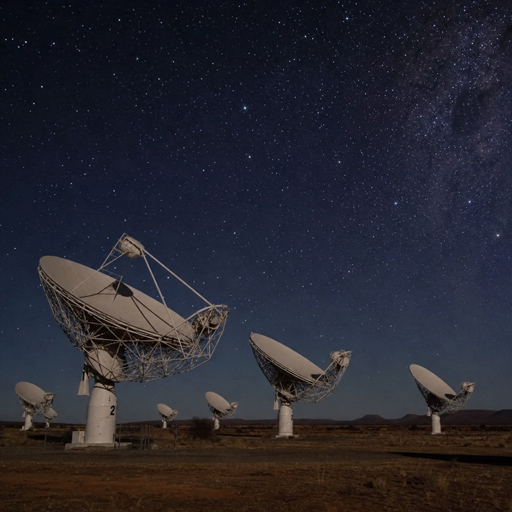
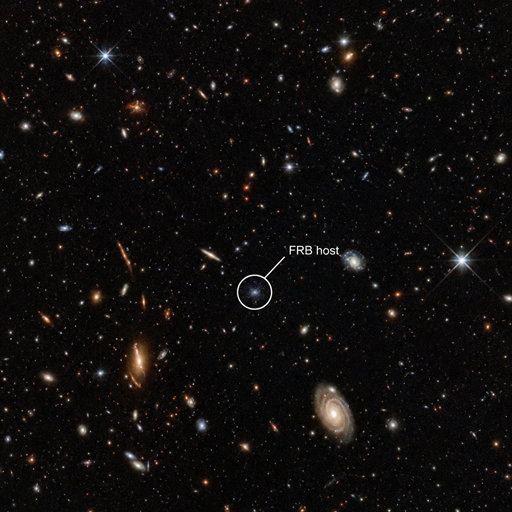
Astronomers identified the host galaxy of the most distant fast radio burst seen to date: FRB 20240304B. The MeerTRAP team detected the burst on March 4, 2024, using South Africa’s MeerKAT telescope, and Webb observations later confirmed the source galaxy at a redshift of 2.148, placing the event just 3 billion years after the Big Bang.
That distance matters because fast radio bursts are already hard to study nearby, let alone across most of cosmic history. They last only milliseconds, often appear once, and then vanish. In this case, radio astronomy provided the first sign that the signal came from an extreme distance, but infrared observations were needed to prove where it came from.
Fast radio bursts are short signals with big scientific value
Fast radio bursts, or FRBs, are intense flashes of radio emission from space. They are among the most intriguing astrophysical phenomena because they are brief, energetic, and still not fully explained. Some repeat, but many mysterious radio bursts are detected only once, which makes follow-up work difficult and valuable.
The discovery of FRB 20240304B shows why cosmic radio bursts are more than astronomical curiosities. A signal that crosses billions of light-years carries information about its source, its host galaxy, and the material it passed through on the way to Earth. In other words, an FRB can act like a momentary beacon, lighting up otherwise hidden parts of the universe.
For researchers, that makes each distant fast radio burst detection a two-part opportunity. First, it may reveal the type of object capable of producing the burst. Second, it can help map diffuse matter between galaxies, including the faint structures often described as the cosmic web.
How was the distant fast radio burst detection confirmed?
The confirmation required a chain of observations: MeerKAT detected and localized the burst, ground-based telescopes tried to find the host galaxy, and Webb finally revealed the faint source. Even though astronomers knew the burst’s position precisely, the world’s largest ground-based telescopes could not see a galaxy there, so the team turned to Webb’s infrared instruments.
Webb’s NIRCam instrument detected a galaxy in the right location, and NIRSpec measured the galaxy’s redshift. That redshift measurement is what turned a promising candidate into a record-setting result. Without identifying the host galaxy, astronomers could not confidently place the FRB in cosmic time.
The “nothing to see” result from the ground was also scientifically useful. Keck Observatory observations showed that the host was too faint for conventional ground-based detection, helping justify the need for space-based follow-up. That sequence highlights how modern radio astronomy increasingly depends on coordination between radio arrays, optical observatories, and infrared space telescopes.
A small young galaxy changes the story
One of the most surprising parts of the discovery is not just how far away the burst was, but where it originated. The host galaxy appears to be a small dwarf galaxy that was actively forming stars, rather than the larger star-forming galaxies often associated with previously studied FRB hosts. NASA reported that the galaxy was about 1,000 times less massive than expected for an FRB host.
That detail matters because different origin theories predict different environments. If some fast radio bursts come from merging neutron stars, they might be expected in older stellar environments because such mergers can take billions of years to unfold. But if the bursts come from young magnetars — highly magnetic neutron stars left behind after massive stars explode — they can appear much sooner after star formation.
The host of FRB 20240304B appears to favor the faster route. Its youth, low mass, and active star formation suggest that this burst may have been produced by a young compact object rather than by an old stellar merger. Researchers are careful not to call the case closed, but the evidence strengthens the magnetar explanation for at least some FRBs.
Key clues from FRB 20240304B
- Extreme redshift: Webb measured the host galaxy at redshift 2.148, placing the signal in an era just 3 billion years after the Big Bang.
- Unusually faint host: The source galaxy was not visible in deep ground-based imaging, which made Webb essential for the distant fast radio burst detection.
- Small galaxy environment: The host was far less massive than many FRB host galaxies astronomers expected to find.
- Active star formation: The galaxy was forming stars, supporting the idea that young stellar remnants may be able to generate FRBs quickly.
- Cosmic web potential: The burst’s long journey gives researchers a probe of material between galaxies.
What can one burst tell us about the universe?
One burst cannot solve the entire FRB mystery, but it can test ideas that were previously hard to reach. Because FRB 20240304B traveled from such an early epoch, it samples a much longer path through intergalactic space than nearer bursts, giving scientists a way to study matter that is too faint to see directly.
As radio waves move through space, intervening material can affect their arrival in measurable ways. Astronomers can use those imprints to investigate the distribution of ionized gas between galaxies. This is why researchers often describe FRBs as cosmic flashlights: they briefly illuminate the invisible medium between the source and Earth.
The farther away the burst, the more cosmic structure the signal can probe. That makes very distant FRBs especially useful for studying how matter was arranged when the universe was younger. FRB 20240304B is therefore valuable both as a clue to burst origins and as a tool for exploring large-scale cosmic structure.
The discovery also shows what remains unknown
The most honest answer is that astronomers still do not know exactly what generates all fast radio bursts. Magnetars are strong candidates, and this discovery makes the young-magnetar explanation more persuasive for this event. Still, FRBs may not all share one origin, and a single record-breaking detection cannot represent the entire population.
That uncertainty is part of what makes the field so active. Researchers need more well-localized bursts, more host galaxy measurements, and more examples from the early universe. Each new detection helps separate patterns from coincidences: whether bursts prefer certain galaxies, whether repeating and non-repeating FRBs have different engines, and how burst properties change with cosmic time.
Future radio facilities and follow-up observations could turn rare discoveries into a larger sample. NASA noted that MeerKAT may be able to detect and localize several FRBs per year at redshifts greater than 1, while Webb will remain important for studying faint host galaxies beyond the reach of many ground-based telescopes.
A new record, and a better question
The discovery of FRB 20240304B does more than set a distance record. It points astronomers toward a more precise question: under what conditions can the universe produce these millisecond radio flashes? The answer now seems more closely tied to young, active stellar environments than some earlier models would have predicted.
For anyone following radio astronomy, the takeaway is clear. The most distant fast radio burst ever detected is not simply a louder or farther version of previous signals; it is a rare message from a young universe, carrying clues about compact stars, faint galaxies, and the hidden matter between them.