Public infrastructure is entering a new maintenance era, where autonomous robots, sensors, and AI-supported workflows help teams inspect, clean, repair, and monitor essential assets with less disruption. Roads, bridges, tunnels, rail systems, airports, water networks, and public buildings all depend on consistent upkeep, yet many agencies face aging assets, labor shortages, budget pressure, and rising expectations for reliability. Autonomous robotic maintenance offers a practical way to make maintenance automation safer, more predictable, and more data-driven without removing the need for skilled human oversight.
The goal is not to replace public works teams. It is to give them better tools: machines that can enter risky spaces, repeat detailed inspections, collect high-quality data, and support smarter decisions before small issues become expensive failures.
What is autonomous robotic maintenance?
Autonomous robotic maintenance is the use of robots that can perform maintenance-related tasks with limited direct human control, often guided by sensors, mapping systems, robotics technology, and AI maintenance software. In public infrastructure, that can mean a robot inspecting a bridge joint, a drone scanning a power line corridor, a crawler moving through a stormwater pipe, or a robotic platform cleaning a transit station floor overnight. The “autonomous” part matters because these systems can navigate, detect conditions, and complete defined workflows without a person manually controlling every movement.
In practice, autonomy exists on a spectrum. Some robots follow pre-planned routes and alert operators when they detect an issue. Others adjust their path in real time, avoid obstacles, return to charging stations, or prioritize inspection points based on asset condition. The most advanced systems combine robotic maintenance with smart maintenance platforms that turn field data into work orders, condition reports, and predictive insights.
This makes the technology especially useful for infrastructure that is difficult, dangerous, repetitive, or expensive to inspect manually. A tunnel wall, sewer line, bridge underside, rail track, or high-voltage area may require lane closures, confined-space permits, specialized crews, or elevated safety planning. Autonomous robots can reduce some of that burden by going where people should spend less time and by collecting consistent data at regular intervals.
Why public infrastructure needs smarter maintenance now
Public infrastructure is often maintained under pressure. Assets are expected to remain available while communities grow, weather patterns become more demanding, and public budgets stay tight. Maintenance teams may know which systems need attention, but still struggle to inspect every asset often enough, document conditions consistently, and schedule repairs before deterioration accelerates.
Traditional maintenance is frequently reactive. A road surface is repaired after complaints. A pump is addressed after performance drops. A bridge component receives attention after a visual inspection flags concern. Reactive work will always exist, but relying on it too heavily can lead to service interruptions, emergency spending, safety risks, and public frustration.
Smart maintenance changes the focus from “fix it when it fails” to “understand condition early enough to act wisely.” Autonomous robotic maintenance supports that shift by making inspection and monitoring more frequent, detailed, and scalable. Instead of sending crews only when a visible problem appears, agencies can use automated systems to gather ongoing evidence about wear, corrosion, leaks, cracks, blockages, vibration, heat, or movement.
The result is not just more data. It is better timing. When agencies understand asset condition sooner, they can bundle work, avoid unnecessary closures, prioritize the most urgent repairs, and justify spending with clearer evidence.
The core technologies behind robotic maintenance
Autonomous robotic maintenance depends on several technologies working together. The robot itself is only one part of the system. Sensors, software, communications, data storage, analytics, and human review all shape whether the program creates real value.
Mobile robotic platforms
The physical platform depends on the environment. Wheeled robots are useful in buildings, transit stations, airports, and paved utility areas. Track-based robots can move through rougher terrain, pipes, or confined spaces. Drones are suited for aerial inspections, rooftops, towers, bridges, and corridors that are hard to reach from the ground. Aquatic robots can support inspection of reservoirs, tanks, canals, ports, or underwater structures.
Each platform has strengths and limits. A drone may collect fast visual data but cannot carry heavy repair tools. A pipe crawler can move through enclosed infrastructure but may require access points and cleaning before deployment. A ground robot may work well in predictable spaces but need careful planning in crowded public areas. Choosing the right platform begins with the asset, not the trend.
Sensors and machine perception
Sensors allow autonomous robots to understand surroundings and asset condition. Cameras, thermal imaging, lidar, ultrasonic sensors, gas detectors, vibration sensors, and acoustic tools can all play a role. For infrastructure owners, the value lies in matching the sensor to the maintenance question.
For example, a visual camera may help document surface cracks, graffiti, water staining, or missing components. Thermal imaging may reveal overheating equipment or moisture patterns. Acoustic sensors may help detect leaks or unusual mechanical behavior. Lidar can create detailed spatial models that show deformation, clearance issues, or changes over time.
AI maintenance and analytics
AI maintenance software helps turn raw data into useful signals. It may classify defects, compare current scans with previous inspections, identify anomalies, estimate deterioration patterns, or recommend follow-up action. This is where maintenance automation becomes more than a robot completing a route.
However, AI should be treated as a decision-support tool, not an unchecked authority. Public infrastructure decisions affect safety, mobility, access, and public trust. Human experts still need to validate findings, review uncertain cases, and decide how to prioritize work.
Connectivity and asset management integration
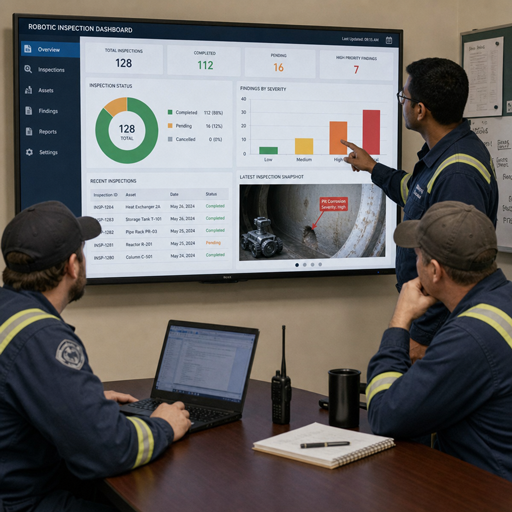
Robotic systems are most valuable when they connect to existing maintenance workflows. If a robot finds a blocked drain, the finding should not sit in a separate dashboard that no one checks. It should connect to asset records, inspection histories, work order systems, maps, and planning processes.
Integration is often the difference between a promising pilot and a useful long-term program. Agencies should plan early for data formats, cybersecurity, user permissions, reporting needs, and how robotic findings will move into daily operations.
Where autonomous robots are already useful in infrastructure maintenance
Robotic maintenance is not limited to futuristic repair machines. Many of the strongest use cases involve inspection, cleaning, monitoring, and targeted support tasks that improve how crews plan and perform work.
Bridges, tunnels, and elevated structures
Bridges and tunnels are natural candidates for autonomous robotic maintenance because they can be difficult to inspect safely and often require traffic management. Drones can capture imagery of bridge decks, towers, cables, and undersides. Crawling robots may inspect surfaces at close range. Tunnel inspection robots can document cracks, water intrusion, lighting issues, ventilation equipment, or surface damage.
The practical benefit is reduced exposure for inspectors and less disruption for the public. Instead of closing lanes for extended manual checks, teams can use robots to collect preliminary data, then send specialists to the exact areas that need hands-on review. This does not remove the need for qualified engineers, but it helps them focus attention where it matters most.
Water, wastewater, and stormwater systems
Pipes, drains, culverts, tanks, and channels are difficult environments for people. They may involve confined spaces, poor visibility, contamination, unstable surfaces, or flow hazards. Robotic crawlers and floating platforms can inspect these systems while reducing the need for human entry.
In wastewater and stormwater networks, robots can identify blockages, cracks, root intrusion, sediment buildup, corrosion, and structural deformation. In water facilities, robotic systems can help inspect tanks or reservoirs with less downtime. When this data is tied to asset management, agencies can prioritize cleaning, lining, replacement, or emergency response more effectively.
Roads, sidewalks, and street assets
Roadway maintenance is a high-volume challenge. Pavement cracks, potholes, faded markings, damaged signs, blocked drains, and curb issues can appear across large networks. Autonomous vehicles, inspection robots, and sensor-equipped fleets can collect data while moving through routine routes.
This approach is especially useful when paired with smart maintenance planning. Rather than responding only to complaints or periodic windshield surveys, agencies can build a more current picture of conditions. That helps prioritize resurfacing, patching, accessibility improvements, and drainage work based on evidence rather than guesswork.
Rail, transit, and stations
Rail and transit systems depend on reliable tracks, platforms, signals, escalators, elevators, ventilation systems, lighting, and cleaning routines. Autonomous robots can inspect track corridors, monitor stations, clean floors, detect spills, or support security and facility teams.
For transit agencies, the value is often operational continuity. Maintenance windows are short, and service delays have a visible public impact. Robots that work during off-hours or in controlled areas can collect information and complete repetitive tasks while human teams focus on repairs, customer-facing issues, and safety-critical decisions.
Energy, lighting, and public facilities
Streetlights, public buildings, solar assets, substations, and distributed energy equipment all require inspection and upkeep. Autonomous robots can identify failed lights, thermal anomalies, vegetation conflicts, damaged panels, or access issues. Inside public buildings, robotic systems may support cleaning, air-quality monitoring, security patrols, and equipment inspection.
These use cases may seem modest compared with major bridge or tunnel robotics, but they can deliver steady value. Many public agencies manage thousands of small assets. Automating routine checks across those assets can improve visibility and reduce the number of problems discovered only after public complaints.
How does maintenance automation improve public service?
Maintenance automation improves public service by helping agencies detect problems earlier, use staff time more effectively, reduce avoidable disruptions, and make decisions from consistent field data. It does not make infrastructure maintenance effortless, but it can make the work more proactive and better organized. When autonomous robots handle repeatable inspection or monitoring tasks, human teams gain time for judgment, repair planning, community communication, and complex fieldwork.
The public may never notice the robot itself. What people notice is fewer surprise closures, faster response to visible issues, cleaner facilities, safer work zones, and better-performing systems. For infrastructure owners, those outcomes come from a combination of automation, skilled labor, and clear operating processes.
Key service improvements include:
- Earlier issue detection Robots can inspect assets more frequently than many manual programs allow. That can reveal small cracks, leaks, corrosion, misalignment, or debris before they become larger failures.
- More consistent documentation A robot following a defined route can capture comparable data each time. This makes it easier to see change over time and reduces variation caused by different inspection styles.
- Reduced disruption Robotic inspections can sometimes happen without large closures, scaffolding, or extensive traffic control. Even when closures are still needed, better data can make them shorter and more targeted.
- Improved worker safety Robots can enter confined, elevated, contaminated, hot, or unstable environments before people do. That allows teams to assess conditions and plan safer interventions.
- Better prioritization AI maintenance tools can help group and rank findings so teams know which issues are routine, which need monitoring, and which require urgent attention.
- Stronger public accountability Digital records, images, maps, and maintenance histories make it easier to explain why certain repairs are scheduled, deferred, or prioritized.
The human role becomes more important, not less
A common concern about autonomous robotic maintenance is that it will replace maintenance workers. In public infrastructure, the more realistic picture is different. Robots can take over some repetitive, hazardous, or data-heavy tasks, but people still define priorities, interpret risk, perform complex repairs, manage public impacts, and make ethical decisions.
Maintenance teams also provide context that machines do not naturally understand. A robot may detect a crack, but an experienced engineer understands whether that crack is related to load, age, materials, drainage, temperature, or prior repairs. A sensor may flag vibration, but a technician may know that a nearby project, temporary operating pattern, or known equipment behavior explains the reading.
As robotics technology becomes more common, agencies will need new skill mixes. Field staff may learn to deploy robots, validate sensor data, troubleshoot equipment, and review AI-assisted findings. Supervisors may need to design workflows that blend automated inspections with manual response. IT and cybersecurity teams may become more involved in maintenance operations.
This shift can make public maintenance careers more technical and safer. It can also help agencies preserve institutional knowledge by capturing field observations in digital systems instead of relying only on memory, paper notes, or isolated files.
Challenges that agencies should plan for early
Autonomous robots can add real value, but they are not a magic fix for every maintenance problem. Public agencies should approach adoption with practical expectations and strong governance.
Data overload
Robots can collect enormous amounts of images, scans, and sensor readings. Without a plan, teams may end up with more data than they can review. The best programs define what data matters, how it will be labeled, who reviews it, and what action follows each type of finding.
A useful question is: “What decision will this data improve?” If the answer is unclear, the program may need a narrower scope.
Integration with legacy systems
Many infrastructure owners already use asset management software, geographic information systems, maintenance logs, and work order platforms. A robotic system that cannot connect to these tools may create duplicated work. Staff may have to manually transfer findings, which slows adoption and increases errors.
Before selecting technology, agencies should map the current maintenance workflow. They should know where data starts, where decisions happen, how work is assigned, and how completion is documented.
Public safety and operating boundaries
Autonomous robots working in public spaces must be predictable, visible, and safe. Sidewalks, stations, parks, and civic buildings include pedestrians, children, pets, mobility devices, vehicles, and unpredictable behavior. Robots need operating rules, geofencing, speed controls, emergency stop functions, signage, and human oversight.
Public communication also matters. People may be curious, cautious, or uncomfortable around autonomous robots. Clear signage and transparent explanations can reduce confusion and build trust.
Cybersecurity and privacy
Robotic maintenance often involves cameras, maps, network connections, and cloud-based software. That creates cybersecurity and privacy responsibilities. Agencies should consider who owns the data, where it is stored, how long it is kept, who can access it, and how sensitive locations or personally identifiable information are protected.
Cybersecurity should be part of procurement and operations, not an afterthought. Public infrastructure is too important to connect new devices without clear safeguards.
Procurement and lifecycle costs
The purchase price of a robot is only one part of the investment. Agencies also need to consider training, software subscriptions, maintenance, spare parts, connectivity, integration, insurance, staff time, and eventual replacement. A low-cost pilot can become expensive if it cannot scale or if the vendor ecosystem is too narrow.
Strong procurement focuses on the full lifecycle. It asks whether the technology can be maintained, upgraded, audited, and supported over time.
What should an agency consider before launching a robotic maintenance program?
An agency should start with a specific maintenance problem, not with a robot. The strongest programs identify an asset class, a pain point, a safety concern, or a recurring inspection need, then evaluate whether autonomous robotic maintenance is the right tool. Starting with a narrow, measurable use case keeps the program practical and makes it easier to earn support from field teams, leadership, and the public.
A useful planning checklist includes:
- Define the maintenance objective. Decide whether the goal is faster inspection, safer access, better records, reduced downtime, cleaner facilities, or earlier defect detection.
- Choose the right asset class. Start with infrastructure where manual inspection is difficult, repetitive, hazardous, or inconsistent.
- Document the current workflow. Understand how inspections are scheduled, how findings are recorded, how work orders are created, and where delays happen.
- Set data standards. Define image quality, location accuracy, naming conventions, severity categories, retention rules, and review responsibilities.
- Include field staff early. Operators, inspectors, engineers, and technicians know the practical realities that determine whether a robot will be useful.
- Test in real conditions. A controlled demo is not enough. Pilots should include weather, lighting, access limits, communications issues, and typical site constraints.
- Plan for human review. AI maintenance findings should be validated, especially when decisions affect safety, public access, or major spending.
- Measure operational value. Track whether the program improves inspection coverage, response time, safety planning, data quality, or maintenance prioritization.
- Build cybersecurity into the project. Review device access, software updates, network connections, data storage, and vendor responsibilities.
- Prepare for scale. If the pilot works, know what staffing, budget, integration, and governance will be needed for wider deployment.
This checklist helps prevent a common mistake: treating robotics as a standalone innovation project. Robotic maintenance works best when it is embedded in the ordinary business of maintaining public assets.
Smart maintenance depends on better decisions
The phrase smart maintenance can sound like a technology slogan, but the concept is practical. Smart maintenance means using timely information to choose the right maintenance action at the right time. Sometimes that action is immediate repair. Sometimes it is monitoring, cleaning, redesign, replacement, or simply documenting that an issue is stable.
Autonomous robots support smart maintenance by improving the quality and frequency of observation. They can inspect the same area repeatedly, compare conditions, and reveal patterns that are hard to see in isolated visits. Combined with AI maintenance tools, this creates a stronger basis for prioritization.
Still, smart maintenance is not only about prediction. It is also about coordination. If a city knows that several nearby assets need work, it may coordinate repairs to reduce repeated disruptions. If a transit agency knows which station systems are most likely to need attention, it can align parts, crews, and service windows. If a water utility sees recurring blockages in one area, it can investigate root causes rather than repeatedly clearing the same pipe.
This is where maintenance automation becomes strategic. The robot gathers information, the software organizes it, and the agency uses it to make better choices.
Building public trust around autonomous robots
Public infrastructure belongs to the community, so technology adoption should be transparent. Residents do not need every technical detail, but they should understand why robots are being used and how the agency will protect safety, privacy, and service quality.
Trust grows when agencies explain the practical purpose. A bridge inspection drone is not a novelty; it is a tool for safer inspections and better condition records. A station cleaning robot is not a replacement for care; it is support for keeping shared spaces cleaner and allowing staff to focus on tasks that require people. A pipe inspection crawler is not hidden surveillance; it is a way to understand underground assets without unnecessary excavation or confined-space entry.
Agencies can support trust by:
- Posting clear notices when robots operate in public spaces
- Training staff to answer basic public questions
- Avoiding unnecessary collection of personal data
- Publishing plain-language explanations of pilot programs
- Sharing outcomes in terms people care about, such as safety, reliability, cleanliness, and reduced disruption
- Creating feedback channels for concerns or accessibility issues
The public is more likely to accept autonomous robots when the benefits are clear and the boundaries are responsible.
The future of robotic maintenance is collaborative
The future of autonomous robotic maintenance will likely be less about single machines and more about connected maintenance ecosystems. Drones, crawlers, ground robots, fixed sensors, mobile crews, asset databases, and AI maintenance platforms will work together to create a more complete view of infrastructure condition.
In that future, a sensor may detect unusual vibration on a structure. A drone may be dispatched to capture visual data. AI may compare the images with previous inspections and flag a potential change. An engineer may review the finding and create a targeted work order. A crew may arrive with the right equipment because the issue has already been located and documented.
That kind of workflow is powerful because it connects observation to action. It reduces guesswork and helps maintenance teams move from broad concern to specific response.
The most successful agencies will not be the ones that buy the most robots. They will be the ones that build the clearest connection between robotics technology, human expertise, asset management, and public value.
A practical takeaway for infrastructure leaders
Autonomous robotic maintenance is becoming an important tool for public infrastructure because it helps agencies inspect more consistently, work more safely, and plan repairs with better information. Its best use is not as a flashy replacement for existing teams, but as a practical extension of skilled maintenance programs.
For leaders considering robotics, the path forward is simple: start with the maintenance challenge, involve the people who understand the asset, test in real conditions, and make sure the data leads to action. When autonomous robots are paired with thoughtful processes and human judgment, they can help public infrastructure become more reliable, resilient, and easier to maintain over time.