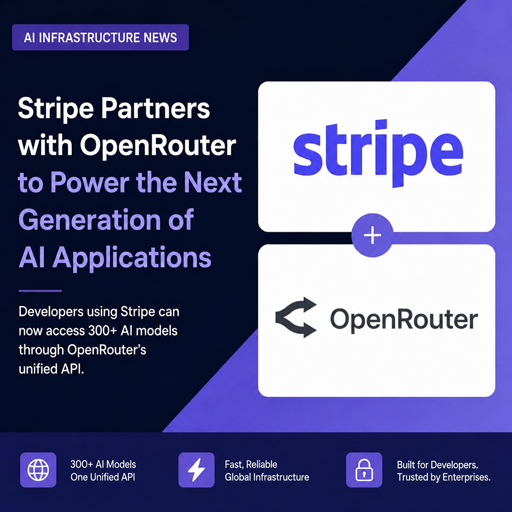
Stripe has agreed to acquire OpenRouter, the AI model gateway and routing platform used by developers and companies to access hundreds of large language models through one interface. The deal was announced on August 19, 2026, with Stripe framing the move as part of its push to build economic infrastructure for AI; the company did not disclose official terms, though multiple reports put the transaction around $7.5 billion or higher.
The announcement adds a major AI-infrastructure deal to recent Stripe company news and extends a buying spree that already included Bridge for stablecoin infrastructure and Metronome for usage-based billing. For readers following Stripe acquisition news, the OpenRouter agreement signals a shift from payments alone toward the systems that meter, route, and monetize AI usage.
What did Stripe announce?
Stripe said it has agreed to acquire OpenRouter, describing the company as a leading AI model gateway and routing platform that helps businesses route and optimize token usage across more than 400 models from more than 80 providers. OpenRouter’s own announcement said it is “joining forces” with Stripe and that its product, name, mission, and roadmap will remain unchanged for users.
The reported price is the headline-grabbing part of the story, but it remains reported rather than confirmed. TechCrunch cited sources telling The New York Times that Stripe paid $7.5 billion, while The Next Web noted that outside reports differed, with Axios putting the figure above $8 billion. Stripe and OpenRouter did not publish a transaction value in their official announcements.
That distinction matters for anyone tracking Stripe acquisition merge news 2025 2026: the strategic rationale is confirmed, while the exact valuation is still based on media reports. In other words, “Stripe acquires OpenRouter for $7.5 billion” is best understood as the widely reported price, not the figure stated by Stripe.
OpenRouter gives Stripe a position in AI token routing
OpenRouter sits between developers and model providers, offering a single interface for selecting and using AI models. The company says its platform provides broad provider choice, observability, cost management, and routing that can improve price, performance, and uptime; it also says it now processes more than 10 trillion tokens per day for more than 10 million developers and companies.
Stripe’s explanation centers on the economics of AI. As companies build more AI features into software, they face a fast-changing market of model releases, pricing shifts, latency differences, and reliability tradeoffs. Stripe said OpenRouter helps businesses evaluate each request and route it based on task complexity, price, speed, and reliability, which is the same kind of optimization logic Stripe already applies to payments, authorization, and fraud.
That makes the acquisition more than a pure developer-tools play. If payments are about maximizing revenue conversion, model routing is about controlling a new and growing expense line: token consumption. Stripe CEO Patrick Collison described tokens as central to companies building with AI, and said Stripe is building “economic infrastructure for AI.”
Key details from the deal
For businesses, developers, and investors following stripe acquisition news, the most useful facts are straightforward:
- Announcement date: Stripe announced the agreement on August 19, 2026.
- Target company: OpenRouter, an AI model marketplace and gateway founded around the rise of multi-model AI development.
- Reported valuation: Media reports place the transaction around $7.5 billion to more than $8 billion, but official deal terms were not disclosed.
- Product scope: OpenRouter says it supports access to 400-plus AI models and serves a community of more than 10 million developers and companies.
- Customer impact: OpenRouter says existing integrations do not change and that routing decisions will remain driven by what is best for the user.
- Strategic fit: Stripe says the combination will help companies maximize revenue and efficacy while minimizing AI costs.
These points also clarify the difference between this story and older search interest around stripe acquisition news August 2025. The OpenRouter announcement is an August 2026 development, while Stripe’s broader acquisition cycle spans multiple years and product categories.
The deal fits Stripe’s broader AI and infrastructure push
Stripe has been expanding beyond payment acceptance into a wider stack for internet businesses, especially where money movement, billing, usage, fraud, and developer workflows overlap. Its February 2025 completion of the Bridge acquisition gave it stablecoin infrastructure, while its January 2026 Metronome announcement strengthened its usage-based billing capabilities.
That context makes the OpenRouter move easier to read. Bridge supports tokenized money movement, Metronome supports complex usage-based pricing, and OpenRouter supports AI model usage and token routing. Together, they point toward Stripe’s ambition to handle not only how companies collect money, but also how they price, meter, optimize, and settle activity in increasingly automated software markets.
The link to Metronome is especially direct. Stripe said in January that the next phase of usage-based billing would support complex product catalogs, sales-led business models, and revenue analytics. OpenRouter adds another layer: not just billing for usage, but helping determine which AI model should handle a given request before that usage becomes a cost.
That is why searches for stripe metronome acquisition news today and the OpenRouter deal are part of the same larger story. Both moves address a world where software companies charge and spend based on consumption rather than simple monthly subscriptions.
Why AI companies and developers are watching closely
For developers, the immediate message from OpenRouter is continuity. The company said it will keep the same mission, name, product, and roadmap, and that existing integrations will not change. It also emphasized that model choice and neutrality remain core commitments.
For AI companies, the acquisition raises bigger questions. OpenRouter is a traffic layer between model providers and users, which means it can influence how demand flows across frontier models, open models, and specialized providers. If Stripe can combine payment data, billing workflows, and model routing, it could become a more central operating layer for AI businesses.
The opportunity is clear: companies want lower AI costs without sacrificing performance or uptime. The sensitivity is also clear: OpenRouter’s value depends on trust that its routing layer remains neutral and does not favor a parent company’s commercial incentives. OpenRouter directly addressed that concern by saying its routing decisions will remain based on what is best for users.
Reported valuation reflects the speed of AI infrastructure M&A
The reported $7.5 billion price stands out because OpenRouter is a young company in a fast-moving category. Fortune reported before the official announcement that Stripe had finalized an agreement for more than $7 billion and noted that OpenRouter had recently raised money at a reported $1.3 billion valuation.
That jump reflects how quickly investors and strategic buyers are repricing AI infrastructure. Model labs have received much of the attention, but the systems around them are becoming equally important: gateways, routers, billing platforms, observability tools, evaluation layers, and security controls. Businesses do not just need access to models; they need a way to decide which model to use, how much it costs, whether it is reliable, and how that usage turns into a bill.
For Stripe, that makes OpenRouter a logical acquisition target. The company already sells infrastructure to developers and internet businesses. Adding an AI routing layer gives it a direct role in the cost side of AI applications, not only the payment side of customer transactions.
What happens next
The companies’ public messaging suggests that OpenRouter will continue operating in a familiar form for customers while Stripe looks for ways to connect routing, billing, and profitability tools over time. OpenRouter told users that nothing about current integrations changes, while Stripe emphasized the combined ability to optimize token spending and business outcomes.
The next signals to watch are product integration details, any updates to OpenRouter’s pricing or governance commitments, and whether Stripe brings OpenRouter more deeply into Stripe Billing, Metronome, or AI-focused developer tools. Until then, the safest reading of the news is simple: Stripe has not just bought an AI tool; it has moved closer to the transaction layer of AI itself.
For anyone following stripe bridge acquisition news, stripe acquisition news August 2025, or the latest Stripe company news, the OpenRouter deal shows a consistent direction. Stripe is building around the economics of the next software cycle, where stablecoins move value, usage-based billing captures value, and AI routers decide how token spend is allocated.