Digital identity verification is moving from a one-time document check to a continuous trust layer that supports onboarding, login, transactions, signatures, and account recovery. The future belongs to systems that can confirm a person is real, eligible, and in control of their credentials without creating unnecessary friction or collecting more data than needed. For businesses, that means choosing identity verification tools that balance security, compliance, privacy, accessibility, and user experience from the first interaction onward.
What is digital identity verification?
Digital identity verification is the process of confirming that a person, business, or representative is who they claim to be in a digital environment. In practice, it may combine document checks, biometric matching, database validation, device intelligence, risk scoring, digital credentials, and authentication signals so an organization can make a confident decision before granting access, approving an application, or accepting a signature.
The phrase what is digital identity verification often comes up during onboarding projects, but the answer is broader than “scan an ID.” Modern Digital identity verification connects proofing, authentication, authorization, fraud detection, and consent. NIST’s current digital identity guidelines separate these ideas into related functions, including identity proofing, authentication, and federation, which helps organizations design identity journeys with the right level of assurance for each use case.
This matters because not every interaction needs the same level of scrutiny. Opening a high-risk financial account is different from creating a low-risk community profile. A mature digital identity verification service helps organizations apply the right controls at the right moment instead of forcing every user through the same rigid process.
Digital identity is becoming a reusable trust layer
For years, digital id verification was treated as a gate at the front door: users submitted information, a business approved or rejected them, and the process ended. That model is giving way to a reusable trust layer where verified attributes can support many moments across the customer lifecycle.
In this future, identity is not just “verified” once. It is maintained through ongoing signals: device changes, suspicious login patterns, credential updates, account recovery requests, transaction context, and user consent. The goal is to reduce repeated identity checks for legitimate users while improving detection when something looks wrong.
A reusable trust layer can support:
- Identity verification for digital onboarding, including account opening, age checks, eligibility reviews, and know-your-customer workflows.
- Step-up verification, where additional checks appear only when risk increases.
- Digital signature identity verification, where the signer’s identity is linked to a document, agreement, or approval action.
- Account recovery, where identity evidence helps prevent fraudsters from taking over legitimate accounts.
- Credential reuse, where trusted digital credentials may reduce the need to resubmit documents repeatedly.
The practical implication is simple: identity strategy can no longer sit in only one department. Product, fraud, compliance, security, legal, customer support, and experience teams all influence how trust is established and maintained.
Why is digital identity verification changing now?
Digital identity verification is changing because fraud tactics, customer expectations, regulation, and authentication technology are all evolving at the same time. Businesses need stronger assurance, but users increasingly expect fast, mobile-friendly journeys that do not ask them to repeat the same steps across every service.
Several shifts are pushing the market forward. Synthetic identity fraud and account takeover have made simple data matching less reliable. Remote work, digital finance, telehealth, online marketplaces, and cross-border services have expanded the number of high-value interactions happening without a physical meeting. At the same time, governments and standards bodies are formalizing digital identity frameworks, including the European Digital Identity Wallet ecosystem and updated NIST guidance in the United States.
User expectations are changing too. People want secure access, but they also want fewer passwords, fewer repeated forms, and more control over what they share. FIDO Alliance research and industry programs around passkeys show growing momentum behind passwordless authentication, with organizations reporting security and usability benefits from passkey deployments.
The core components of modern identity verification
A future-ready identity program is not one tool. It is a set of coordinated capabilities that verify identity, evaluate risk, protect credentials, and preserve user trust.
Identity proofing
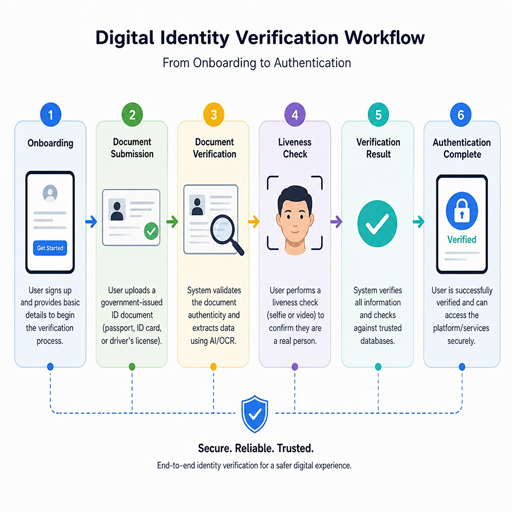
Identity proofing asks whether the person is real and whether the identity evidence belongs to them. This can include government ID capture, document authenticity checks, selfie or liveness review, database validation, business registry checks, or review of authoritative records. The right proofing method depends on risk, jurisdiction, user population, and the consequences of a false approval.
Authentication
Authentication asks whether the returning user is the same person or entity that was previously verified. Passwords are still common, but they are weak when reused, phished, or stolen. Passkeys, security keys, biometrics on trusted devices, and adaptive multi-factor authentication are becoming more important because they can reduce reliance on shared secrets.
Risk intelligence
Risk intelligence looks at context. A login from a known device may be low risk; a password reset from a new device in an unusual location may require additional checks. Device signals, behavioral patterns, velocity rules, IP intelligence, and transaction context can help organizations decide when to approve, block, or step up verification.
Consent and data minimization
Identity systems increasingly need to prove only what is necessary. A user may need to prove they are over a certain age, hold a credential, or live in a region without revealing a full identity document every time. This is where verifiable credentials, digital wallets, and privacy-preserving design become important.
The technologies shaping the next era
The future of Digital identity verification will be shaped by several overlapping technologies. None is a complete answer on its own; the strongest systems combine them thoughtfully.
Digital identity wallets
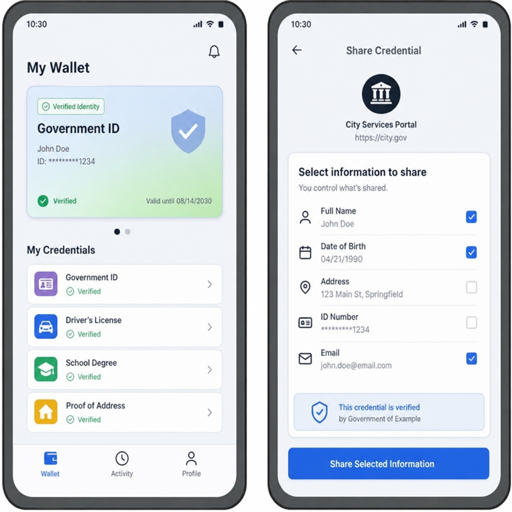
Digital identity wallets are designed to let people store and present identity attributes or documents from a device. The European Commission says EU Digital Identity Wallets are intended to help people identify themselves for public and private services and store digital documents such as mobile driving licenses and education credentials. EU Member States have been working toward making wallets available to citizens, residents, and businesses by the end of 2026.
For businesses, wallets may reduce onboarding friction by allowing users to share trusted attributes directly. Instead of uploading a document image and waiting for it to be checked, a user could share a verified credential. However, adoption depends on interoperability, certification, user trust, and clear relying-party processes.
Passkeys and passwordless authentication
Passkeys are becoming a practical part of identity strategy because they can make authentication easier and more phishing-resistant than passwords. They are not the same as identity proofing: a passkey can help prove control of an account or device, but it does not automatically prove the person’s legal identity. The best use is often a combination: verify the user during onboarding, then bind strong authentication to that verified account.
Biometrics and liveness detection
Biometrics can help match a person to an identity document or unlock a credential on a device. Liveness detection helps determine whether the biometric sample comes from a present person rather than a photo, mask, replay, or injection attack. Because biometric data is sensitive, organizations should use it only when the risk justifies it and should be transparent about storage, retention, and alternatives.
AI-assisted fraud detection
AI can help detect document tampering, unusual behavior, synthetic identities, and coordinated fraud patterns. It can also introduce risk if models are poorly trained, opaque, or biased. The future is not “AI decides everything”; it is human-governed automation with monitoring, explainability, escalation paths, and measurable outcomes.
Verifiable credentials and selective disclosure
Verifiable credentials can let users prove specific claims from trusted issuers. Selective disclosure can reduce over-sharing by allowing a person to prove a fact without revealing the entire underlying document. This matters for privacy, user trust, and compliance because it limits unnecessary data exposure.
Digital signature identity verification links trust to action
Digital signature identity verification connects the person behind an action to the signature event. This is especially important for contracts, loan documents, consent forms, employee agreements, healthcare authorizations, and other records where organizations need confidence that the correct person approved the correct document.
A strong signing flow may include identity proofing before the first signature, authentication at the point of signing, tamper-evident audit trails, timestamping, document integrity controls, and consent records. The right level of assurance depends on the document’s value and regulatory context. A simple internal approval may not require the same identity evidence as a regulated financial agreement.
The future of digital signatures is likely to be more integrated with reusable identity credentials. Instead of asking a signer to repeat a full verification process for every document, organizations may rely on verified accounts, wallet-based credentials, or step-up checks when risk is high.
Choosing identity verification tools for the future
Choosing identity verification tools is not only a vendor comparison exercise. It is a risk design decision. The best fit depends on what you need to verify, who your users are, what regulations apply, and how much friction your process can tolerate.
Use this checklist when evaluating a digital identity verification service:
- Coverage and evidence types Confirm which identity documents, regions, business records, and data sources are supported. If your users are international, coverage gaps can create failed onboarding and support burden.
- Assurance levels and risk controls Look for configurable workflows. Low-risk users should not face unnecessary steps, while high-risk cases should trigger stronger checks.
- User experience Review mobile capture, accessibility, language support, error handling, and recovery paths. A secure process that users cannot complete will still fail the business.
- Privacy and data minimization Ask what data is collected, where it is stored, how long it is retained, and whether unnecessary attributes can be avoided.
- Fraud response Evaluate liveness checks, device signals, velocity rules, manual review tools, and reporting. Fraud teams need usable evidence, not just pass-or-fail decisions.
- Integration and orchestration Consider APIs, web and mobile SDKs, case management, webhook support, audit logs, and compatibility with your authentication and customer identity systems.
- Governance and transparency Ask how models are monitored, how decisions are explained, and how appeals or manual reviews are handled when users are incorrectly rejected.
A practical comparison of verification models
Different identity models solve different problems. Most organizations will use more than one.
|
Model |
Best for |
Main advantage |
Watchout |
|---|---|---|---|
|
One-time document verification |
New account onboarding |
Familiar and widely supported |
Can create repeat friction if used too often |
|
Risk-based verification |
Login, recovery, transactions |
Adapts friction to context |
Requires strong monitoring and rules |
|
Wallet-based credentials |
Reusable proof of attributes |
Can reduce data sharing and repeated checks |
Adoption and interoperability vary |
|
Digital signature identity verification |
Agreements and approvals |
Links identity to a signed action |
Assurance must match document risk |
|
Passkey-based authentication |
Returning users |
Reduces password risk and improves login flow |
Must be paired with proofing for identity assurance |
The key is to avoid treating one model as universal. A future-ready identity architecture uses the minimum effective friction for each moment while keeping a clear audit trail.
Best practices for identity verification for digital onboarding
Identity verification for digital onboarding should feel like part of the product, not a separate obstacle. Users are often deciding whether to trust your service at the exact moment you are asking them to share sensitive information. Clear instructions, fast feedback, and visible reassurance can improve completion without weakening controls.
Start by mapping onboarding risk. What are you protecting: money movement, regulated access, minors, professional credentials, marketplace safety, or contractual consent? Then decide what evidence is needed before account creation, what can be checked later, and what should trigger step-up verification.
Strong onboarding programs usually include:
- Plain-language instructions before document capture or biometric steps.
- Progressive friction, so extra checks appear when risk increases.
- Fallback options for users without supported documents, newer devices, or ideal capture conditions.
- Manual review paths for edge cases instead of automatic abandonment.
- Clear consent and privacy notices that explain why data is requested.
- Post-onboarding monitoring to detect account misuse after approval.
Privacy, accessibility, and inclusion will define trust
The next phase of digital identity will not be judged only by fraud reduction. It will also be judged by whether systems are fair, understandable, and usable by real people in varied circumstances.
Accessibility matters because users may have disabilities, older devices, limited connectivity, language barriers, or documents that do not fit a standard template. Inclusion matters because rigid verification flows can wrongly exclude legitimate users. Privacy matters because identity data is among the most sensitive information an organization can collect.
A responsible program should minimize data, offer alternatives, test across user groups, and regularly review false rejection patterns. It should also separate identity verification from surveillance. The goal is to establish appropriate trust for a specific transaction, not to collect as much information as possible.
The road ahead for digital identity verification
The future of Digital identity verification is more adaptive, credential-based, and user-controlled. Businesses will still need strong fraud prevention, but the best systems will make trusted users move faster while focusing scrutiny where risk is real.
Over the next few years, expect digital wallets, passkeys, verifiable credentials, and AI-assisted risk tools to become more connected. Regulatory frameworks and standards will continue to influence how identity proofing, authentication, federation, and trust services are implemented. ENISA’s work supporting certification for European Digital Identity Wallets reflects how security assurance is becoming part of the identity wallet ecosystem, not an afterthought.
For organizations planning now, the right question is not simply which tool to buy. It is how to build an identity layer that can evolve. Start with risk, design for privacy, make the user journey humane, and choose technology that can support onboarding, authentication, signatures, recovery, and compliance as one connected trust strategy.