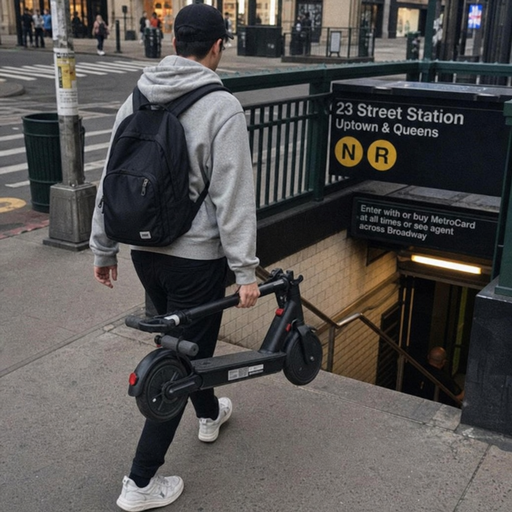
Micro-mobility is the category of lightweight, low-speed travel tools that help people move through cities without relying on a car for every short trip. Backpack-sized folding e-scooters sit at the compact end of that category: they are designed for quick errands, transit connections, campus movement, office commutes, and other last-mile transportation needs where walking is too slow and driving is too much. This guide explains how micro-mobility e-scooters fit into modern streets, what benefits they offer, what trade-offs to consider, and how emerging detection technology can make mixed urban travel safer and easier to manage.
What makes a folding e-scooter part of micro-mobility?
A folding e-scooter becomes part of micro-mobility when it supports short, efficient trips that are too brief to justify a car but too long, hot, hilly, or time-sensitive for a comfortable walk. In practice, that means it works best as a connector: from home to the train, from a parking garage to an office, across a college campus, between meetings, or through a dense neighborhood where parking is limited.
Micro-mobility includes devices such as bicycles, e-bikes, e-scooters, skateboards, and small cargo cycles. The shared theme is not just size. It is the ability to move people through busy places using less street space, less storage space, and less energy than conventional automobiles. Public agencies and transportation researchers increasingly describe shared bikes and scooters as part of the public transportation ecosystem, especially because they can extend the reach of rail and bus networks. NACTO reported that shared bike and scooter systems in the U.S. and Canada reached 157 million trips in 2023, an all-time high for those systems. (itskrs.its.dot.gov)
Backpack-sized folding e-scooters push that idea further by emphasizing personal portability. Instead of looking for a docking station, curbside rental, or parking rack, a rider may be able to fold the scooter, carry it indoors, place it near a desk, or bring it onto certain transit services when rules allow. That can reduce two common friction points in urban e-scooter use: where to leave the vehicle and whether it will be available when needed.
The role of last-mile transportation in daily travel
Last-mile transportation solves the small but stubborn gap between a major travel mode and the actual destination. A train may get someone across the city, but the final mile from the station to the office still matters. A bus may stop near a university, but not next to every classroom or lab. A car may be parked at the edge of a downtown district, while the meeting is several blocks away.
These short links influence whether people choose transit, cycling, walking, driving, or a combination. If the first or final segment feels inconvenient, unsafe, or unpredictable, the whole trip can become less attractive. A compact e-scooter can make that segment faster without turning the entire journey into a car trip.
Common last-mile use cases
A backpack-sized folding scooter is especially useful when the rider needs flexibility more than long range. Typical use cases include:
- Transit connection: Riding from home to a station, folding the scooter, then continuing by train or bus.
- Downtown parking extension: Parking outside a congested core and using a scooter for the remaining distance.
- Campus movement: Traveling between buildings, labs, libraries, dorms, and nearby housing.
- Errand chaining: Combining small trips to a pharmacy, grocery store, café, or appointment without moving a car repeatedly.
- Commuter backup: Keeping a compact scooter available when a shuttle is delayed, a parking lot is full, or a walk would take too long.
The practical value is not only speed. It is control. Riders can build a multimodal trip that adapts to weather, transit schedules, parking availability, and daily workload.
Electric scooter benefits in crowded urban environments
The most visible electric scooter benefits are convenience and speed over short distances, but the deeper advantage is right-sizing. A person traveling two miles to a station or neighborhood destination usually does not need a full-sized vehicle. Urban e-scooters offer a smaller tool for a smaller trip.
That right-sizing can support several sustainable transport options. ITDP has noted that electric micromobility can replace a meaningful share of short car trips in urban settings when paired with supportive policies and infrastructure. It also emphasizes that low-speed e-bikes and e-scooters are most effective when cities treat them more like bicycles than motor vehicles, with clear rules and safe places to ride. (itdp.org)
Space efficiency
Cars require road space while moving and curb space while parked. Folding e-scooters need far less storage area and can sometimes be kept with the rider rather than left outdoors. That matters in apartment buildings, offices, crowded sidewalks, and transit hubs where storage is limited.
Trip flexibility
Micro-mobility solutions work well because they are modular. A rider can combine walking, transit, rideshare, cycling infrastructure, and a compact scooter in one trip. This flexibility is especially helpful in cities where one travel mode rarely solves every problem.
Lower operating burden
Compared with a car, an e-scooter generally has fewer day-to-day ownership burdens: no fuel stops, no large parking footprint, and less mechanical complexity. That does not mean it is maintenance-free. Tires, brakes, batteries, folding joints, lights, and controls still require attention. The point is that for many short trips, the tool is simpler than the alternative.
More predictable short trips
In dense areas, a two-mile car trip can become unpredictable because of traffic, parking, loading zones, and one-way streets. A scooter route using appropriate bike lanes or low-speed streets can sometimes be more consistent. Predictability is one reason commuters consider micro-mobility e-scooters even when the total distance is modest.
Backpack-sized design changes the ownership equation
Not every e-scooter described as compact is truly backpack-sized in a practical sense. Some models fold but remain heavy, awkward, or too long for crowded trains and narrow stairwells. The phrase should be understood as a design goal rather than a universal specification: a scooter that is small enough to carry for short periods and store in places where a standard scooter would be inconvenient.
The real advantage is not simply that the stem folds. It is that the whole product supports mixed movement. A useful portable scooter should be manageable during the non-riding parts of the trip: entering a lobby, climbing steps, passing through a fare gate, waiting in an elevator, or standing in a crowded hallway.
Features that matter more than marketing language
When evaluating a folding scooter, focus on practical details:
- Folded shape: A compact folded footprint is easier to carry than a scooter that technically folds but remains bulky.
- Carry comfort: Handles, stem locks, strap compatibility, and balanced weight make a major difference.
- Weight: A few pounds can matter if stairs, transit transfers, or long indoor walks are part of the routine.
- Wheel size and ride quality: Smaller wheels may improve compactness but can feel harsher on rough pavement.
- Folding mechanism: The latch should feel secure, simple, and resistant to accidental movement.
- Brake setup: Reliable braking is essential in mixed urban environments.
- Lighting and visibility: Built-in lights and reflectors help riders remain visible at dawn, dusk, and night.
- Battery placement: A protected, well-integrated battery can improve portability and reduce snag points.
A compact scooter should not ask the rider to choose between portability and basic safety. If the scooter is so small that it feels unstable, under-braked, or uncomfortable on normal street surfaces, it may not be the right tool for daily use.
How do backpack-sized e-scooters compare with bikes, e-bikes, and shared scooters?
Backpack-sized e-scooters are best for riders who prioritize portability, multimodal travel, and short urban trips. Bikes and e-bikes usually offer better comfort and range, while shared scooters reduce ownership responsibility but depend on local availability, pricing, and parking rules. The best choice depends on whether the rider values storage, speed, range, cost control, or carrying capacity most.
Compared with bicycles
A traditional bicycle is efficient, durable, and comfortable over longer distances. It can also carry bags, accept racks, and handle rougher roads better than many tiny scooters. The trade-off is storage. A bike needs secure parking, and carrying it through an office or transit station is often inconvenient.
A folding e-scooter works better when the route includes indoor storage, stairs, elevators, or crowded platforms. It is less suitable when the rider needs cargo capacity, longer trips, or stronger performance on rough pavement.
Compared with e-bikes
E-bikes are among the strongest sustainable transport options for replacing car trips because they combine speed, range, and physical comfort. They are excellent for longer commutes, hills, and riders who want exercise with assistance. However, many e-bikes are too large or heavy to carry indoors casually.
A backpack-sized scooter is usually more about connection than full-trip replacement. It may not replace a long car commute, but it can make a transit commute viable by removing the awkward first and last mile.
Compared with shared scooters
Shared scooters are convenient when they are nearby, charged, and legally parked. They also remove the need for personal maintenance. But they can be unavailable during peak times, restricted by service areas, or affected by local fleet management.
Owning a folding scooter gives the rider more control. The device is there when needed, adjusted to personal preferences, and not dependent on a nearby rental vehicle. The owner also accepts responsibility for charging, maintenance, security, and compliance with local rules.
Sustainable transport options depend on the whole system
Micro-mobility is most sustainable when it replaces car trips, connects people to public transportation, and operates within safe infrastructure. It is less beneficial when it mainly replaces walking or creates sidewalk clutter, unsafe riding behavior, or short-lived hardware waste. That is why the conversation should include streets, rules, batteries, repairability, and rider habits—not just the scooter itself.
ITDP has highlighted both the promise and the challenges of electric micromobility, including emissions reductions and mode shift potential as well as concerns around safety, equity, manufacturing, materials sourcing, and disposal. (itdp.org) A compact e-scooter can be part of a cleaner mobility pattern, but only when the device is durable, maintained, used responsibly, and integrated with other transportation choices.
How riders can improve the sustainability of e-scooter use
Individual choices matter. Riders can make a folding scooter more sustainable by using it thoughtfully:
- Replace short car trips first. The biggest practical impact comes when the scooter substitutes for driving, not walking.
- Use transit as the backbone. Pair the scooter with buses, trains, and ferries when longer distances are involved.
- Maintain the scooter. Proper tire pressure, brake adjustment, and battery care can extend service life.
- Avoid disposable thinking. Choose products that can be repaired, serviced, and used for more than one season.
- Charge safely and efficiently. Follow manufacturer guidance, avoid damaged chargers, and store batteries responsibly.
- Ride where appropriate. Use bike lanes, low-speed streets, or permitted paths rather than crowded sidewalks when local rules direct that.
The environmental story of a scooter is not fixed at purchase. It is shaped by how often it is used, what trips it replaces, how long it lasts, and how safely it is managed at the end of its life.
Safety is a design, behavior, and infrastructure issue
Safety discussions around urban e-scooters often focus on rider behavior, but that is only one part of the picture. Safe micro-mobility also depends on street design, vehicle design, maintenance, visibility, traffic speed, and clear rules. A responsible rider on an unsafe road still faces risk, while a well-designed lane can reduce conflict for everyone.
Vehicle-level safety basics
For a folding scooter, the most important safety features are not always the most exciting ones. Brakes should feel controlled and predictable. Tires should match the pavement conditions the rider actually encounters. Lights should be visible from the front and rear. The folding mechanism should lock securely without wobble.
The smaller the scooter, the more important these details become. Compact wheels can be more sensitive to potholes, metal plates, gravel, and uneven pavement. Riders should test how a scooter handles real surfaces before relying on it for a daily commute.
Rider habits that reduce risk
Good riding habits are simple but powerful:
- Wear a helmet and use additional visibility gear when conditions call for it.
- Keep both hands available for steering and braking.
- Slow down around pedestrians, driveways, parked cars, and intersections.
- Avoid carrying loose bags that can affect balance.
- Signal intentions when possible, but do not compromise control to do so.
- Learn local rules for sidewalks, bike lanes, trails, and transit access.
- Inspect the latch, brakes, tires, and lights before routine trips.
Many scooter crashes are not about top speed. They happen in transitions: entering a street, crossing an intersection, avoiding a door zone, or riding over a surface the small wheels do not handle well. Anticipation matters.
City-level safety needs
Cities can support micro-mobility by building protected bike lanes, calming traffic, improving pavement quality, creating scooter parking zones, and designing intersections for slower, lighter vehicles. Clear rules help too. Riders, pedestrians, drivers, and transit operators all benefit when everyone understands where e-scooters belong.
AI and multimodal detection are becoming part of micro-mobility management
AI systems can help cities, researchers, and mobility operators understand how bicycles, e-scooters, pedestrians, and cars interact in complex streets. In this context, the phrase “ai powered multimodal classifiers micro mobility detection bicycles e scooters” points to a growing technical field: using camera, sensor, GPS, inertial, or combined data to distinguish travel modes and detect vulnerable road users.
This does not mean every scooter needs to be “AI-powered.” The more useful idea is that streets and mobility systems may increasingly rely on classification tools to measure demand, identify conflict points, enforce geofenced rules, improve safety studies, and plan infrastructure. Researchers have explored kick-scooter detection using sensor-based transportation mode classification, and other work has focused on detecting e-scooter riders in dense urban environments. (sciencedirect.com)
Why detection matters
Cities cannot manage what they cannot see. If traffic counts only capture cars, planners may underestimate how many people are walking, cycling, scooting, or using assistive devices. Better detection can support more accurate decisions about lane placement, signal timing, parking areas, curb management, and safety interventions.
Detection also matters for automated and connected vehicles. As streets become more sensor-rich, systems need to distinguish between a pedestrian, a cyclist, an e-scooter rider, and a parked micromobility vehicle. Recent research has introduced datasets and benchmark models aimed at detecting vulnerable road users and micromobility vehicles, including cyclists, e-scooterists, bicycles, and e-scooters. (doi.org)
Limits and concerns
AI classification is not magic. It can be affected by lighting, weather, occlusion, camera angle, unusual vehicle shapes, local riding behavior, and biased training data. Privacy must also be handled carefully, especially when video or location data is involved.
The best use of these tools is not surveillance for its own sake. It is better street design, better safety analysis, and better integration of micro-mobility solutions into transportation networks.
Choosing a compact e-scooter for real-world use
The right folding scooter is the one that fits the rider’s route, body, storage needs, and risk tolerance. A spec sheet can help, but daily usability depends on the small moments: carrying it up stairs, braking on wet pavement, folding it in a crowded hallway, or lifting it into a car trunk.
Before buying, map the actual trips the scooter must serve. Include the non-riding segments. If the route includes a third-floor walk-up, a heavy scooter may become a burden. If the route includes broken pavement, a tiny-wheeled model may feel unstable. If the destination has strict indoor rules, storage and carrying options matter as much as speed.
Practical buying checklist
Use this checklist to evaluate a compact folding e-scooter without getting distracted by vague claims:
- Route fit: Is the scooter comfortable on the streets, paths, and surfaces you will actually use?
- Portability: Can you lift, carry, and maneuver it when folded without strain?
- Storage fit: Will it fit under a desk, in a closet, near a work area, or in a permitted transit space?
- Battery needs: Does the realistic range match your daily route with a buffer for detours and aging?
- Braking confidence: Can you stop smoothly and predictably at urban speeds?
- Visibility: Are lights and reflectors adequate for your riding hours?
- Weather expectations: Are you prepared for wet surfaces, reduced traction, and manufacturer limits?
- Serviceability: Can tires, brakes, grips, lights, and batteries be maintained or replaced?
- Local legality: Are e-scooters allowed where you plan to ride, park, and carry them?
- Security: If you cannot bring it inside, can it be locked safely and appropriately?
A good micro-mobility purchase is not only about the fastest or smallest product. It is about reducing friction across the whole trip.
Best practices for integrating e-scooters into a multimodal routine
A folding e-scooter becomes most useful when it is treated as one part of a travel system. That means planning around transit schedules, safe routes, weather, charging, and storage. The goal is not to use the scooter for every trip; it is to use the right mode for each segment.
Build a reliable route set
Create two or three dependable routes rather than improvising every day. One route may prioritize protected bike lanes. Another may avoid hills. A third may serve as a low-traffic option for rainy days or heavy pedestrian periods. Over time, riders learn where pavement is rough, where drivers turn quickly, and where scooter dismounting makes sense.
Pair charging with habits
Charging works best when it becomes routine. For example, a rider may charge at home after the commute, top up during the workday if allowed, or reserve the scooter for the first and last mile while relying on transit for distance. Safe charging practices should follow the manufacturer’s guidance, especially around approved chargers, ventilation, damaged batteries, and storage conditions.
Respect shared spaces
The success of urban e-scooters depends partly on public trust. Riders should slow near pedestrians, park without blocking sidewalks, avoid building entrances, and follow local rules. Even personally owned folding scooters can affect how the public views micro-mobility if ridden or stored carelessly.
The future of compact micro-mobility is connected and practical
The future of micro-mobility will likely be shaped less by novelty and more by integration. The most useful products and systems will connect smoothly with transit, fit safely into streets, last long enough to justify their materials, and remain simple enough for ordinary people to use every day.
Backpack-sized folding e-scooters are a practical expression of that future. They take the core promise of micro-mobility—small vehicles for short trips—and make it more personal, portable, and multimodal. For some riders, they will not replace a bike, car, or transit pass. They will make those other options work better.
For cities, the opportunity is to design streets where small electric vehicles, bicycles, pedestrians, transit, and cars can coexist with less conflict. For riders, the opportunity is to choose a device that genuinely solves a transportation problem rather than simply adding another gadget. When compact e-scooters are durable, safe, well-regulated, and used to replace unnecessary car trips, they become more than a convenience. They become one of the most accessible micro-mobility solutions for everyday urban movement.