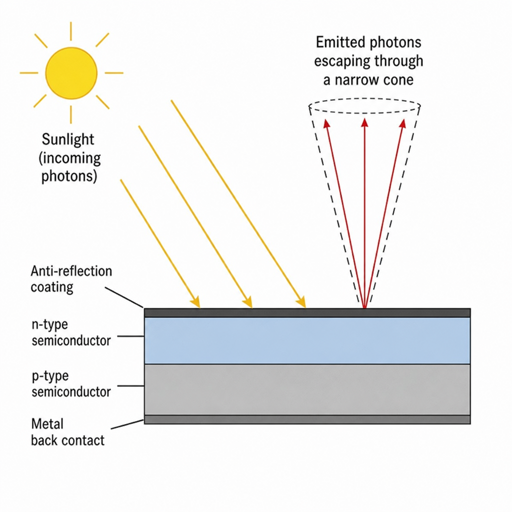
Solar cells do not only absorb light; high-quality cells can also re-emit some light internally as electrons and holes recombine. New optical designs aim to make that emitted light escape in fewer directions, which can reduce electrical losses and improve solar cell efficiency. For homeowners, engineers, and product researchers, the practical lesson is simple: better light management can raise voltage, improve solar energy output, and help future panels produce more from the same area.
Why would a solar cell emit light at all?
A solar cell emits light because the photovoltaic process is partly reversible: sunlight creates charge carriers, and when some of those carriers recombine, they can release energy as a photon. The U.S. Department of Energy explains that direct recombination reverses the process that generated electricity, while other recombination paths release energy as heat instead of useful current. That is why solar cell efficiency depends not only on how much light enters the cell, but also on how the cell handles reflected light, heat, voltage, and recombination losses.
In everyday terms, think of the cell as a carefully managed light trap. Incoming sunlight should enter easily and stay long enough to be absorbed. Light that is created inside the cell should either be recycled productively or escape in a controlled way that does not increase electrical losses more than necessary.
The direction of emitted light matters
When a solar cell emits photons in many directions, the process carries an entropy cost. Research on angle-limited solar cells shows that reducing the angular distribution of emitted light can reduce dark current and increase efficiency because emitted photons are less likely to escape immediately. In other words, restricting the escape cone can improve photon recycling and raise the voltage available from the cell.
This does not mean a panel becomes efficient simply by “glowing less.” The goal is more precise: allow sunlight in from useful directions while limiting the directions in which internally generated photons can leave. The best designs manage both sides of the equation—strong absorption on the way in, controlled emission on the way out.
The photon-recycling effect
Photon recycling happens when a photon emitted inside the cell is reabsorbed and creates another electron-hole pair. In a clean, high-quality semiconductor, this can give the cell another chance to convert energy into electrical output rather than losing it. Angle restriction helps because it keeps more internally emitted photons within the device for longer, especially near the absorption edge where light trapping is valuable.
The voltage benefit
Efficiency is tied to both current and voltage. If a design reduces recombination-related losses and dark current, the cell can maintain a higher operating voltage. That voltage improvement may look small on a per-cell basis, but across many cells in a module, small gains can contribute to better solar module efficiency.
How does this improve real solar panel efficiency?
Restricting light emission can improve solar panel efficiency when the optical design increases useful absorption, supports photon recycling, and does not introduce new losses such as excess reflection, heat, or parasitic absorption. Recent work on silicon cells has explored angular response designs that accept sunlight over practical solar paths while reflecting overly oblique light, and the research notes that even simple direction-aware schemes can raise theoretical limiting efficiency above conventional assumptions.
The key phrase is “when designed well.” A rooftop module faces changing sun angles, cloud cover, reflections from the environment, dust, temperature swings, and installation constraints. A lab concept must survive that messy reality before it becomes a mainstream feature in commercial modules.
A useful way to evaluate the idea is to ask what problem the optical layer solves:
- Does it admit enough useful sunlight? A restrictive optic that blocks morning, evening, or diffuse light could reduce annual energy production even if it improves a narrow lab metric.
- Does it reduce escape losses? The design should narrow the emission path without trapping heat or causing unwanted absorption.
- Does it work with real module materials? Glass, encapsulant, coatings, back sheets, and cell interconnects all affect final solar energy output.
- Does it improve energy yield, not just peak efficiency? A panel’s nameplate efficiency is measured under standard conditions, while field output depends on temperature, orientation, shading, and weather.
Efficiency numbers need careful reading
Solar shoppers often compare one percentage with another, but the context matters. Solar cell efficiency measures the conversion performance of a cell itself. Solar module efficiency includes the assembled panel, where gaps, glass, wiring, encapsulation, and layout can reduce the percentage compared with the bare cell. Solar panel efficiency is often used as a consumer-facing term for module efficiency.
That distinction is important when researching products such as Maxeon Gen 3. A Maxeon Gen 3 cell datasheet lists electrical characteristics for typical cells and shows cell-bin efficiencies including 24.4% and 24.0%, depending on bin. A 2024 Maxeon 3 module datasheet, by contrast, lists finished panel power ratings of 405–420 W and module efficiency up to 22.2%, which is lower than the bare-cell figure because a module is a complete assembled product.
For readers comparing search results like “maxeon gen iii silicon solar cell efficiency 2024,” “maxeon gen iii solar cell efficiency 2024 datasheet,” or the longer “maxeon gen iii solar cell efficiency 2024 datasheet cell efficiency,” the practical advice is to verify whether the number refers to a cell, a module, or a specific product configuration. A high cell number can be real and still not match the finished module label.
A quick checklist for comparing efficiency claims
Use this checklist before treating any efficiency percentage as an apples-to-apples comparison:
- Identify the unit being measured. Is the claim for a single cell, a mini-module, a full module, or a complete installed system?
- Check the test condition. Standard test conditions are not the same as hot-roof operating conditions.
- Look for power rating and area together. Efficiency is about power per area, not just watts.
- Separate peak efficiency from energy yield. A slightly lower-efficiency panel may produce more annual energy if it handles temperature, shade, or orientation better.
- Read the datasheet date and model number. Product names can stay similar while wattage classes, cell counts, and availability change.
What this means for future panel design
The idea of emitting light in fewer directions fits a larger trend in solar technology: squeezing more performance from optics, surfaces, and interfaces rather than relying only on new absorber materials. Anti-reflection coatings, textured silicon, passivated contacts, back-contact layouts, tandem cells, and direction-selective optics all address the same broad challenge—keep useful photons working inside the device while reducing the pathways that waste energy.
For manufacturers, better angular control could eventually help raise solar module efficiency without dramatically increasing panel size. For system designers, higher efficiency can mean more capacity on space-limited roofs, vehicles, portable equipment, or building-integrated surfaces. For homeowners and businesses, the value is not the physics term itself; it is the possibility of more kilowatt-hours from the same available area.
Still, direction-selective light management is not a universal shortcut. If a cell has many non-radiative defects, emitted-photon control will not fix the underlying material loss. If an optical layer blocks too much diffuse light, annual solar energy output may suffer. And if manufacturing complexity adds too much cost, the improvement may remain limited to specialized markets.
Practical takeaways for buyers and researchers
If you are evaluating solar products today, do not expect consumer datasheets to advertise “fewer emission directions” as a standard feature. The more relevant buying signals remain verified module efficiency, power rating, temperature coefficient, degradation assumptions, warranty terms, installer quality, and site design. The underlying science matters because it explains where the next gains in solar panel efficiency may come from.
For researchers and technical buyers, the opportunity is more specific. Directional emission control is most compelling when paired with high-quality cells, excellent passivation, low parasitic absorption, and optics that match the real solar trajectory. It is a system-level design problem, not just a coating or mirror problem.
The simplest conclusion is also the most useful: solar cells gain efficiency when they manage light more intelligently. Absorbing more incoming sunlight is only half the story; controlling how internally emitted light escapes can also protect voltage and reduce loss. As this research moves from theory and lab devices into manufacturable designs, it could become one more reason future solar modules deliver more energy from the same patch of sunlit space.