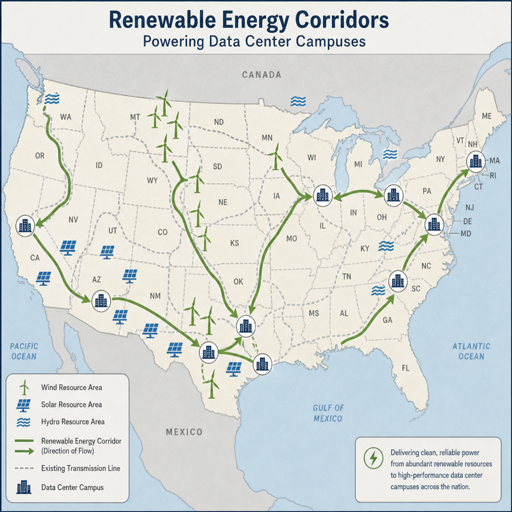
Cloud providers are increasingly treating clean energy access as a site-selection priority, not a side project. As AI, analytics, streaming, and enterprise cloud workloads grow, the next generation of green data centers will depend on where reliable power, renewable generation, storage, and transmission can come together. For buyers, this shift matters because green cloud services are becoming tied to regional energy strategy, not just corporate sustainability messaging.
Why are cloud providers targeting clean energy corridors?
Cloud providers are targeting clean energy corridors because data centers need large, steady power supplies, and clean electricity is easier to scale in places with strong generation resources, grid capacity, and supportive infrastructure. A corridor is not just a line on a map; it is a practical zone where solar, wind, hydropower, nuclear, geothermal, storage, substations, fiber routes, and transmission planning can support high-density computing.
The pressure is straightforward. Data centers are essential infrastructure for modern software, AI, e-commerce, finance, healthcare, media, and public services. At the same time, their electricity needs are growing fast enough that energy availability can influence where new campuses are built. The U.S. Department of Energy has pointed to clean generation, storage, existing nuclear and hydropower, retired energy sites, grid upgrades, efficiency, and demand flexibility as part of the response to data center electricity demand.
That is why the phrase cloud providers clean energy data centers is becoming more than an SEO trend. It describes a real planning challenge: cloud companies want computing capacity close to customers and fiber networks, but they also need power that can satisfy reliability, cost, and carbon goals. The winning regions will likely be those that can connect all three.
The corridor model changes how data centers are planned
Traditional data center site selection often focused on land, tax environment, network access, water availability, disaster risk, and proximity to users. Those factors still matter. What is changing is that power strategy now sits near the top of the list, especially for large campuses designed for AI and other energy-intensive workloads.
A clean energy corridor gives developers a better chance of aligning multiple needs at once. Nearby renewable projects can help reduce market exposure. Transmission access can reduce bottlenecks. Storage and flexible load programs can make intermittent power more useful. Existing energy infrastructure, including retired fossil-fuel sites with grid interconnections, may also shorten the path from concept to operation if communities and regulators support redevelopment.
This does not mean every data center in a corridor is automatically sustainable. A facility can sit near clean power and still rely on a grid mix that includes fossil generation. The point is that corridors create the conditions for sustainable cloud providers to move from annual renewable matching toward more time- and location-aware energy strategies.
What makes a data center corridor “clean”?
A clean data center corridor is defined by the practical availability of low-carbon power and the infrastructure needed to deliver it reliably. It is not enough to build near a solar farm or sign a renewable contract somewhere else; the stronger model connects clean generation, grid capacity, operational flexibility, and transparent reporting.
Several ingredients matter:
- High-quality clean generation: Wind, solar, hydropower, nuclear, geothermal, and other low-carbon resources can all play a role depending on the region.
- Transmission and interconnection capacity: Clean power has limited value if it cannot reach the load. DOE has emphasized that additional transmission infrastructure is needed to support load growth, reliability, resilience, and new generation resources.
- Storage and firm clean power: Batteries, long-duration storage, hydropower, nuclear, and geothermal can help fill gaps when variable renewables are not producing.
- Demand flexibility: Some workloads can be shifted by time or region, helping operators reduce pressure during grid peaks.
- Efficient building design: Cooling systems, server utilization, heat management, and water strategy all affect the environmental profile of green data centers.
- Community fit: Corridors only work long term if development accounts for local ratepayers, land use, water, jobs, and grid impacts.
The last point is easy to overlook. A carbon-neutral cloud claim may sound global, but the effects of a data center are local. Communities want to know whether new campuses will strain the grid, raise costs, consume scarce water, or deliver durable economic benefits. Clean energy corridors can help answer those concerns, but only when planning is transparent.
Sustainable cloud providers are moving beyond annual matching
For years, many companies bought enough renewable energy over a year to match their annual electricity use. That approach helped finance clean energy projects and remains important. But it does not always mean a data center is running on clean electricity every hour.
The next phase is more granular. Google, for example, has described a goal of operating on 24/7 carbon-free energy, which means matching electricity consumption with carbon-free energy on an hourly basis in each region where it operates. This is a higher bar than annual matching because it asks whether clean power is available when and where demand occurs.
Other large cloud and technology companies are also expanding their clean energy procurement toolkits. Recent market reporting has shown hyperscalers continuing to dominate corporate renewable energy contracting while also looking beyond traditional renewable power purchase agreements as AI increases electricity demand. Amazon says its sustainability work for AWS includes energy efficiency, carbon-free energy, embodied carbon reduction, responsible water use, circular economy practices, and customer sustainability tools.
For customers comparing sustainable cloud providers, this shift matters. A provider that only says “renewable energy matched” may not be telling the same story as one that reports regional, hourly carbon-free energy progress, water metrics, and workload efficiency options. The details increasingly separate broad green marketing from stronger operational practice.
The business case for green cloud services is getting stronger
The move toward green cloud services is not only about reputation. Clean energy access can affect risk, resilience, customer demand, and long-term operating strategy. As more organizations track Scope 3 emissions and vendor sustainability, cloud infrastructure becomes part of procurement and compliance conversations.
A company running applications in the cloud may not control the data center directly, but it can influence demand by choosing regions, architectures, and providers thoughtfully. That is especially relevant for AI workloads, data-heavy analytics, backup strategies, and always-on digital products. If two cloud regions offer similar performance, the cleaner and more efficient region may become the better business choice.
Cloud providers also have their own reasons to invest in cleaner corridors:
- Power availability can unlock growth. A provider cannot deploy new capacity without reliable electricity.
- Clean energy contracts can hedge long-term volatility. Renewable and firm clean power agreements may reduce exposure to fossil fuel price swings.
- Customers increasingly ask for sustainability data. Enterprise buyers want clearer reporting for emissions, energy, and water.
- Grid partnership can improve reliability. Demand response, storage, and advanced controls can support both the data center and the wider grid.
- Public trust affects permitting. Projects that show local benefits and responsible energy planning may face fewer objections.
The result is a more strategic view of cloud infrastructure. Carbon-neutral cloud ambitions are no longer tucked into annual ESG reports. They are shaping where campuses are built, how power is procured, and which regions become digital infrastructure hubs.
Carbon-neutral cloud claims need careful reading
Carbon-neutral cloud language can be useful, but it can also hide important differences. Some claims are based on renewable energy certificates or offsets. Others include direct power purchase agreements, hourly clean energy matching, efficiency programs, or investments in emerging technologies. These approaches are not interchangeable.
When evaluating a provider, buyers should ask what the claim covers. Does it apply to the provider’s total operations, a specific cloud service, or a selected region? Is the electricity matched annually or hourly? Are offsets used, and if so, for what portion of the footprint? Does reporting include location-based and market-based emissions? Are water use, embodied carbon, and hardware lifecycle considered?
A practical checklist for cloud buyers:
- Look for region-level energy and emissions information, not only global averages.
- Ask whether renewable matching is annual, monthly, or hourly.
- Review whether the provider invests in additional clean energy projects.
- Consider workload placement in lower-carbon regions when latency and compliance allow.
- Use autoscaling, rightsizing, and storage lifecycle policies to reduce wasted compute.
- Prefer architectures that do more useful work per unit of energy consumed.
- Track sustainability alongside cost, performance, security, and availability.
The cleanest unit of compute is often the one you do not waste. Even when using green cloud services, efficient software design matters. Bloated workloads, idle instances, duplicated data, and inefficient AI experimentation can undermine the benefits of cleaner infrastructure.
Green data centers still face hard constraints
The clean energy corridor trend is promising, but it is not a simple fix. Grid interconnection queues can be slow. Transmission projects can take years. Clean firm power is not available equally in every region. Water availability may constrain cooling choices. Local communities may worry that data center growth will compete with households and businesses for affordable electricity.
There is also a timing challenge. Cloud and AI demand can grow faster than new energy infrastructure. If data centers come online before clean generation and transmission are ready, emissions may rise in the near term even if companies have long-term clean energy targets. That is why responsible development has to combine procurement, efficiency, grid support, and community engagement.
The strongest green data centers will likely use a portfolio approach rather than a single solution. Solar and wind can provide low-cost clean energy. Batteries can shift power across hours. Nuclear, hydropower, geothermal, or other firm resources can support round-the-clock needs where available. Advanced cooling can reduce energy and water stress. Software scheduling can shift flexible workloads to cleaner times and regions.
What this means for cloud customers
Cloud customers do not need to become energy experts, but they should become better question-askers. The sustainability profile of a workload depends on the provider, the region, the architecture, and the operating discipline behind it. A company can choose a sustainable cloud provider and still waste resources if it overprovisions everything.
Start with the workloads that are easiest to optimize. Development environments, batch processing, backups, analytics jobs, and non-urgent AI training may offer more flexibility than latency-sensitive customer applications. For each workload, ask whether it can run in a cleaner region, operate during lower-carbon hours, use smaller instances, or store less duplicated data.
Then connect cloud sustainability with FinOps. Cost optimization and carbon reduction often overlap because both reward lower waste. Rightsizing compute, deleting unused volumes, compressing data, improving code efficiency, and setting lifecycle rules can reduce spend while supporting sustainability goals.
Clean energy corridors will define the next cloud map
The geography of the cloud is being redrawn around energy. Regions with abundant clean power, modern transmission, community support, and strong digital infrastructure are positioned to attract the next wave of cloud investment. Regions without those ingredients may struggle, even if they offer land or tax incentives.
For cloud providers, clean energy corridors are a path to scale without abandoning climate commitments. For customers, they are a reminder to look beyond generic carbon-neutral cloud language and ask how, where, and when digital services are powered. The future of cloud will not be judged only by speed and storage. It will also be judged by how responsibly the industry turns electricity into intelligence, connection, and economic value.