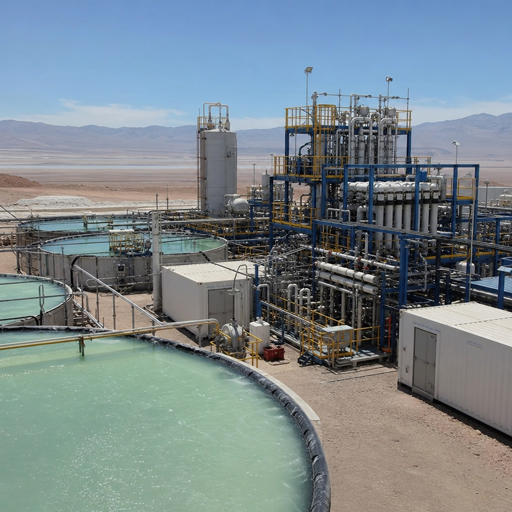
Direct lithium extraction is moving from promising pilot concept to a more serious commercial scaling pathway for lithium brines. Instead of relying mainly on large evaporation ponds, direct lithium extraction DLE technology selectively removes lithium from brine, then returns most of the remaining brine to the reservoir or routes it to further treatment. This guide explains how DLE fits into the lithium production process, why scale-up is difficult, and what operators, investors, and supply-chain teams should watch as projects move from demonstration to commercial operations.
What is direct lithium extraction, and why does commercial scaling matter?
Direct lithium extraction is a group of lithium extraction methods designed to separate lithium ions from brines using materials or systems that preferentially capture lithium. Commercial scaling matters because a DLE process that works in a laboratory or pilot skid still has to prove it can handle real brine chemistry, continuous operation, reagent management, product quality, reinjection, permitting, and cost control at industrial volumes.
Traditional brine production commonly concentrates lithium by moving brine through evaporation ponds before additional processing. That approach can be effective in suitable climates, but it typically needs large land areas and long residence times. DLE aims to shorten the path from brine to lithium intermediate by targeting lithium directly, which is why it has become central to many direct lithium extraction news updates and project announcements. The IEA has identified commercialization of DLE as one of the innovation routes that could help increase lithium supply, while the U.S. Department of Energy has supported projects involving geothermal and Smackover brines.
The commercial scaling challenge is bigger than the extraction unit
The phrase “direct lithium extraction technology” can make DLE sound like a single piece of equipment. In practice, commercial scaling requires an integrated plant. The extraction step must connect smoothly with brine production wells, pre-treatment, lithium capture, elution or stripping, concentration, impurity removal, conversion to lithium carbonate or lithium hydroxide, water management, waste handling, and brine reinjection.
That integration is where many projects face their real test. A sorbent may capture lithium well in clean test solutions, but real brines can contain magnesium, sodium, potassium, calcium, boron, silica, hydrocarbons, suspended solids, and scaling compounds. Temperature and pressure conditions also vary by resource. A scaled DLE plant must keep working through that variability without losing selectivity, damaging materials, consuming too many reagents, or creating bottlenecks downstream.
Commercial scale also changes the risk profile. At pilot scale, teams can manually adjust operating conditions and tolerate downtime while learning. At commercial scale, uptime, maintenance intervals, consumable life, quality assurance, and logistics become financial drivers. A plant that achieves high lithium recovery but needs frequent media replacement or complicated chemical regeneration may struggle unless the full operating model is robust.
How direct lithium extraction fits into the lithium production process
DLE is not the whole lithium production process. It is the selective extraction stage inside a broader brine-to-product system. The output from DLE is usually a lithium-rich stream, such as lithium chloride solution, that still needs purification and conversion before it can become battery-quality lithium carbonate or lithium hydroxide.
A simplified DLE production pathway often looks like this:
- Resource definition and wellfield design Operators characterize the brine reservoir, lithium concentration, flow rates, impurities, pressure behavior, and reinjection strategy. Poor reservoir planning can limit even a strong extraction technology.
- Brine lifting and pre-treatment Brine is brought to surface and conditioned. Pre-treatment may remove solids, oil, silica, iron, or scaling species that could foul membranes, coat sorbents, or interfere with ion exchange.
- Lithium capture The DLE unit contacts brine with a selective material or separation system. Depending on the method, lithium may bind to an adsorbent, exchange onto a resin, pass through a membrane, transfer into a solvent, or move through an electrochemical system.
- Lithium release and concentration Captured lithium is released into a smaller stream. This step determines how concentrated, clean, and chemically compatible the lithium intermediate will be for downstream conversion.
- Purification and conversion The lithium-rich solution is polished to remove contaminants, then converted into a saleable lithium chemical. Projects may target lithium carbonate, lithium hydroxide, or an intermediate depending on market and processing strategy.
- Brine reinjection or disposal The depleted brine is typically reinjected where geology and regulation allow. Reinjection must protect reservoir pressure, avoid contamination, and satisfy permitting requirements.
The U.S. DOE’s environmental assessment for the South West Arkansas Project describes a commercial concept that extracts brine from the Smackover Formation, removes lithium, converts it to battery-quality lithium carbonate, and reinjects effluent brine for pressure maintenance. That illustrates how DLE must be engineered as a full field-and-plant system, not a stand-alone separator.
Main direct lithium extraction methods
DLE is best understood as a technology family. Different brines suit different approaches, and many commercial flowsheets combine more than one separation method.
Adsorption and ion-sieve systems
Adsorption systems use solid materials that selectively capture lithium from brine. Ion-sieve materials are designed with structures that favor lithium ions over competing ions. These systems can be attractive because they can be arranged in modular columns and cycled repeatedly, but they must prove long media life, stable capacity, and manageable regeneration chemistry in real brines.
The key scaling question is not only whether the material captures lithium. It is whether it continues doing so after thousands of cycles while exposed to heat, impurities, acidity or alkalinity, and cleaning regimes. Media degradation, fouling, and incomplete elution can quietly raise operating costs.
Ion exchange
Ion exchange systems use resins or solids that swap lithium or associated ions with ions on the media. This pathway can provide strong selectivity when the brine chemistry is suitable. However, acid or chemical consumption, resin durability, and impurity loading must be evaluated carefully.
At commercial scale, ion exchange performance depends on column design, contact time, pressure drop, regeneration efficiency, and the consistency of the lithium-rich eluate. If the eluate is too dilute or contaminated, the downstream plant may carry the burden.
Membrane and electrochemical processes
Membrane-based DLE separates ions by size, charge, selectivity, or electric-field-driven movement. Electrochemical systems may use electrodes or membranes to move lithium selectively into a recovery stream. Recent technical reviews describe membrane and electrochemical separations as active areas of DLE development, especially because they may be paired with concentration or conversion steps.
These approaches can be elegant, but they must manage fouling, scaling, energy use, membrane durability, and brine pre-treatment. They may be especially sensitive to brines with high total dissolved solids or complex impurity profiles.
Solvent extraction and hybrid flowsheets
Solvent extraction uses chemical systems that transfer lithium into another phase. It can be selective, but commercial deployment must account for solvent losses, corrosion, environmental controls, and reagent recovery. Hybrid systems may combine adsorption, membranes, ion exchange, evaporation, crystallization, or electrochemical conversion to optimize the whole flowsheet rather than maximize one unit operation.
That hybrid mindset is important. The winning commercial DLE plant may not be the one with the highest single-pass lithium recovery. It may be the plant with the best balance of recovery, selectivity, uptime, water handling, reagent use, capital intensity, permitting practicality, and product quality.
Why is scaling DLE commercially so difficult?
Scaling DLE is difficult because lithium is only one component in a chemically complex fluid, and every decision in the extraction stage affects the rest of the plant. A commercial project must prove reservoir reliability, process reliability, environmental compliance, and product consistency at the same time.
The most important challenges include:
- Brine variability: Lithium concentration and impurities can vary by well, depth, temperature, and production history.
- Selectivity under real conditions: Competing ions can reduce lithium capture or increase downstream purification needs.
- Fouling and scaling: Silica, carbonates, sulfates, organics, and suspended solids can impair equipment.
- Media or membrane lifetime: Replacement frequency can change project economics.
- Water and reagent balance: DLE may reduce reliance on evaporation ponds, but it still needs careful chemical and water management.
- Reinjection performance: Depleted brine must return to the reservoir without causing pressure, scaling, compatibility, or regulatory problems.
- Product qualification: Battery supply chains require consistent specifications, and customers often want proof from repeated production campaigns.
- Financing risk: Lenders and offtakers usually need more than a successful pilot; they look for long-duration operating evidence and credible scale-up plans.
This is why demonstration plants matter. They expose materials, pumps, columns, membranes, controls, and downstream purification systems to realistic operating conditions. Standard Lithium reported in April 2026 that its Arkansas demonstration work had completed more than 15,000 cycles for the core DLE technology intended for the South West Arkansas Project, while the company’s project materials identify first commercial production as targeted for 2029. Those kinds of long-duration operating milestones are central to de-risking, even though they do not remove every commercial risk.
What direct lithium extraction companies are trying to prove
Direct lithium extraction companies are not all trying to prove the same thing. Some own resources and need to prove a full brine-to-product project. Others supply technology and need to prove their systems can be licensed, financed, built, operated, and maintained across different brines.
In North America, the Smackover Formation and California’s Salton Sea region have become major focal points. ExxonMobil has acquired brine rights in the Smackover Formation and says it intends to apply subsurface, reservoir, and chemical-processing capabilities to lithium extraction. Standard Lithium and Equinor’s Smackover Lithium joint venture is developing DLE projects in Southwest Arkansas and East Texas, including the South West Arkansas Project. In California, DOE announced a conditional commitment for EnergySource Minerals’ ATLiS project to produce lithium hydroxide from geothermal brine using DLE.
The competitive landscape also includes technology developers working on adsorbents, membranes, ion exchange, electrochemical systems, and integrated process packages. For buyers, partners, and investors, the important question is not simply “Which company has DLE?” The better question is “Which company has demonstrated the right DLE system on the right brine, at the right duration, with a credible route to product and permits?”
Commercial readiness indicators to watch
DLE project announcements can sound similar, so it helps to separate technical progress from true commercial readiness. The following signals are more meaningful than broad claims about sustainability or high recovery:
- Real-brine testing: Results should come from the target brine, not only synthetic solutions.
- Long-duration cycling: Repeated cycles show whether media, membranes, and operating conditions remain stable.
- Integrated downstream conversion: A lithium-rich stream is useful only if it can be converted into a qualified product.
- Contaminant rejection: Removal of magnesium, calcium, boron, sodium, potassium, and other impurities affects final cost and quality.
- Reinjection evidence: Reservoir compatibility and pressure management are essential for brine projects.
- Permitting progress: Environmental review, water handling, land access, and well permits can define the timeline.
- Offtake and financing: Customer agreements and project funding indicate market confidence, though they do not guarantee execution.
- Engineering maturity: Front-end engineering, vendor selection, modularization, and construction contracts show whether the project is moving from concept to buildable plant.
A practical due-diligence checklist should ask for cycle data, impurity data, reagent balances, expected media life, energy assumptions, waste streams, product samples, scale-up factor, reservoir model, and contingency plans. If those details are vague, the project may still be early-stage even if the branding sounds commercial.
Environmental and operational implications
DLE is often described as a cleaner alternative to conventional lithium brine extraction because it can reduce the need for massive evaporation ponds and can enable reinjection of processed brine. That potential is real, but the environmental profile depends on the project design. Energy source, water sourcing, chemicals, waste streams, land disturbance, well integrity, and reinjection performance all matter.
Geothermal brines are especially interesting because lithium recovery may be paired with renewable heat or power production. The DOE has supported innovation around lithium from geothermal brines, including the Salton Sea area, where projects are trying to combine critical mineral production with geothermal infrastructure.
For communities and regulators, the key issue is not whether a process is labeled DLE. It is whether the operator can show safe brine handling, transparent monitoring, responsible water management, realistic traffic and construction planning, and clear end-of-life obligations. Commercial scaling must earn social license as well as technical validation.
The outlook for DLE commercial scaling
Direct lithium extraction is no longer just a laboratory idea, but it is also not a universal shortcut. The sector is entering a period where pilot claims must become operating data, and demonstration success must translate into financed, permitted, continuously operating plants.
The strongest projects will likely share several traits: a well-characterized brine resource, a DLE technology matched to that brine, integrated purification and conversion, disciplined engineering, credible reinjection plans, and customers willing to qualify the output. Direct lithium extraction companies that can prove those elements at scale will help define the next generation of lithium extraction methods.
For now, the smartest way to read direct lithium extraction news is with cautious optimism. DLE could expand lithium supply and reshape the lithium production process, especially in brine regions where conventional evaporation is slow, land-intensive, or impractical. But commercial success will come from full-system execution, not from the extraction acronym alone.