Deep-Sea and Ocean Floor Solar Energy Harvesting explores a simple but challenging idea: using sunlight to power marine devices below the surface, on or near the seabed, and across remote ocean environments. It is not a replacement for land-based solar farms or offshore wind, but it could become a valuable tool for ocean energy harvesting where cables, vessels, and frequent battery swaps are expensive or impractical.
At its best, underwater solar panels can help power sensors, autonomous vehicles, beacons, monitoring stations, and other low-to-moderate energy systems. The opportunity sits at the intersection of ocean solar power, marine solar technology, and broader renewable ocean energy.
How can solar power work underwater?
Solar power can work underwater because some sunlight still penetrates the upper ocean, especially in clear water, but the light that remains is very different from sunlight on land. Water quickly absorbs infrared wavelengths, while blue and green light travel farther, which means underwater solar panels need materials and designs tuned for that filtered spectrum rather than standard land-based conditions. Traditional silicon cells can function underwater, but research suggests other photovoltaic materials may be better matched to the underwater light environment.
That distinction matters. A normal solar module is designed for a broad solar spectrum in air. Underwater, the available energy drops with depth, shifts in color, and changes with turbidity, waves, angle of light, suspended sediment, algae, and seasonal conditions. The question is not simply “Can a solar panel be waterproofed?” It is “Can a photovoltaic system produce useful energy in a specific underwater mission, at a specific depth, in a specific water body?”
This is why Deep-Sea and Ocean Floor Solar Energy Harvesting should be understood as a targeted power strategy rather than a universal solution. In clear, shallow, sunlit environments, it may help extend the life of instruments and underwater networks. In very deep ocean environments, where sunlight is absent, it becomes less about placing panels on the abyssal plain and more about using solar near the surface, at shallow seabeds, or as part of hybrid systems that serve deeper equipment.
The ocean floor is not one energy environment
The phrase “ocean floor” can sound like a single destination, but in energy terms it covers very different conditions. A shallow reef, a continental shelf, a coastal aquaculture site, and a deep-sea observatory face different sunlight levels, water movement, pressures, maintenance realities, and ecological sensitivities. Solar harvesting near the seabed is most plausible where sunlight still reaches the installation or where a solar collector can be positioned higher in the water column while power is delivered below.
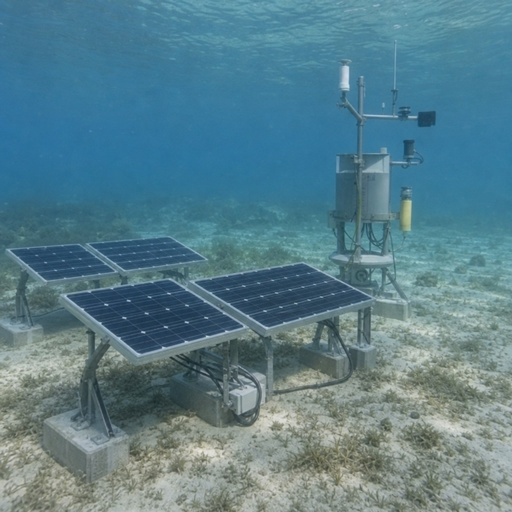
This creates a practical split. Shallow ocean floor solar concepts may involve seabed-mounted frames, low-profile modules, docking stations, or panels attached to subsea infrastructure. Deep-sea concepts are more likely to use solar as one part of a larger system: surface or near-surface collection, energy storage, underwater cables, docking stations, or complementary sources such as wave, tidal, ocean current, or thermal energy.
For ocean energy harvesting, that difference is crucial. The ocean is rich in renewable energy, but not all resources are available everywhere. Solar depends on light. Tidal power depends on predictable water movement. Wave energy depends on sea state. Ocean current systems depend on geography. A strong marine power plan starts by matching the energy source to the mission instead of forcing one technology into every environment.
What makes deep-sea solar harvesting difficult?
Deep-sea solar harvesting is difficult because sunlight fades rapidly with depth, and in the true deep sea there is no usable sunlight for photovoltaic generation. Even in shallower water, light attenuation, spectral filtering, turbidity, surface reflection, sedimentation, biofouling, pressure, corrosion, and maintenance access all make underwater solar more complex than installing a panel in open air. Reviews of submerged photovoltaic systems consistently point to optical losses and marine operating conditions as major constraints.
The most important limitation is available light. A highly efficient cell cannot harvest photons that never reach it. Clear tropical seawater may support useful generation at greater depths than a cloudy harbor, a silty estuary, or an algae-rich lake. Even a small change in water clarity can shift a project from viable to impractical.
The second limitation is keeping the system clean and stable. Marine surfaces attract biofilms, algae, barnacles, sediment, and salt-related damage. On land, a dusty solar panel can often be cleaned with predictable equipment and schedules. Underwater, inspection and cleaning may require divers, remotely operated vehicles, specialized coatings, or designs that reduce fouling in the first place.
The third limitation is mission fit. Deep-sea instruments may need steady power through darkness, storms, seasonal changes, or long periods without service. Solar can contribute, but many marine systems will still need batteries, intelligent power management, and possibly hybrid renewable ocean energy sources.
Underwater solar is a mission-scale technology first
The most realistic near-term role for underwater solar panels is not powering coastal cities from the seafloor. It is powering distributed marine equipment that currently depends on batteries, cables, ship visits, or surface platforms. Nature Photonics describes persistent power as a barrier to a large-scale “Internet of Underwater Things,” and underwater solar has been studied as one possible way to support more autonomous ocean sensing.
That makes the technology especially interesting for low-power and intermittent-load applications. Many marine instruments do not need megawatts. They need enough energy to run sensors, process data, flash a beacon, charge a small battery, wake a communications module, or support a docking station. In those cases, a modest local energy source can reduce service trips and extend mission duration.
There is also a strategic value to keeping power close to the load. Long underwater cables can be costly, vulnerable, and difficult to permit or repair. Batteries are useful, but finite. Surface buoys can carry solar panels, but they are exposed to storms, vessel traffic, fouling, salt spray, birds, and visibility concerns. A submerged or low-profile solar system may reduce some surface exposure, though it introduces its own underwater maintenance demands.
Marine solar technology pathways
Deep-sea and ocean floor solar concepts are developing along several practical pathways. Some are closer to commercial reality than others, but each addresses a different part of the marine power challenge.
- Floating ocean solar power: Panels sit at or above the surface on floating structures. This approach captures stronger sunlight than submerged systems, but it must survive waves, salt, wind, corrosion, mooring loads, and marine growth.
- Shallow submerged photovoltaics: Panels are placed just below the surface or at shallow depth. Submergence can help with cooling and lower visual profile, but water also reduces and filters incoming light.
- Seabed-assisted solar systems: Panels, storage, or power electronics may be integrated with shallow seabed infrastructure. These concepts are most relevant where the ocean floor remains within the photic zone.
- Vehicle-integrated solar: Autonomous surface vehicles, underwater vehicles operating near the surface, or docking stations can use solar to extend operating time.
- Hybrid renewable ocean energy systems: Solar works alongside wave, tidal, current, wind, or stored energy, helping balance power availability across changing conditions.
The best design depends on the load. A seabed sensor that wakes once per hour has different needs from an autonomous underwater vehicle docking hub. A coral reef monitoring camera has different constraints from a subsea data node. Marine solar technology works best when the panel, battery, controller, enclosure, and maintenance plan are designed around the full mission profile.
Materials are changing the conversation
Material choice is central to underwater solar performance. Because water filters the solar spectrum, photovoltaic materials that respond well to blue-green light can be more attractive underwater than materials optimized for land. Research has discussed several candidates for underwater solar applications, including gallium indium phosphide variants, cadmium telluride, organic semiconductors, amorphous silicon, and perovskite semiconductors.
Perovskites are drawing particular attention because their composition can be tuned for different light environments. In September 2026, reporting on a Joule paper described perovskite-based underwater solar cells tested at about 10 meters in the South China Sea, where the system reportedly charged lithium-ion batteries during a two-hour test. That kind of field validation does not mean underwater solar is ready for every ocean project, but it does show how quickly the research frontier is moving.
Flexible solar cells are another promising direction. Curved or lightweight modules may integrate more easily with underwater vehicles, buoys, housings, and irregular marine structures. A flexible module that conforms to a vehicle body, beacon, or sensor housing can provide local charging without requiring a large rigid frame. However, flexibility alone does not solve sealing, connector reliability, fouling, or optical loss.
A good underwater solar design must consider:
- Spectral response in blue-green light
- Waterproofing and encapsulation
- Resistance to saltwater corrosion
- Pressure tolerance at operating depth
- Biofouling and cleaning strategy
- Mechanical stability in currents and waves
- Safe integration with batteries and electronics
- Retrieval or service options if the system fails
The technology is therefore both photovoltaic and marine engineering. A high-performing cell in a laboratory is only one part of a working ocean system.
Where underwater solar panels make the most sense
Underwater solar panels make the most sense in sunlit, relatively clear waters where the energy demand is modest, maintenance access is planned, and the value of local power is high. The strongest use cases are not necessarily the largest ones; they are the ones where replacing batteries, running cables, or dispatching vessels is disproportionately expensive.
Potential applications include:
- Oceanographic sensors: Long-duration monitoring for temperature, salinity, currents, acidity, dissolved oxygen, or biological activity.
- Environmental cameras: Reef, kelp forest, aquaculture, or habitat monitoring where periodic imaging is more important than continuous high-power operation.
- Navigation and safety beacons: Low-power lights or acoustic devices in remote marine areas.
- Autonomous underwater vehicle support: Docking or trickle-charging stations that extend mission time and reduce recovery trips.
- Aquaculture systems: Local power for sensors, feeders, cameras, and communications in farms where surface infrastructure is limited.
- Marine research stations: Small distributed loads near reefs, coastal shelves, polar field sites, or protected areas.
- Subsea communications nodes: Low-power relays that collect, store, or transmit data when conditions allow.
These applications share a pattern: the power requirement is meaningful but not enormous, the equipment benefits from staying deployed, and the system can tolerate variable solar input with batteries or energy-aware operation. That is a better fit than trying to send bulk electricity from deep underwater solar farms to the grid.
Ocean solar power works best as part of a system
Ocean solar power becomes more useful when it is designed with storage and controls from the beginning. Underwater light varies by time of day, season, weather, depth, water clarity, wave state, and biological growth on the panel. A marine device that depends on solar needs to know when to sleep, when to collect data, when to transmit, and when to conserve energy.
A typical architecture may include a photovoltaic module, charge controller, battery pack, power management electronics, sensors, communications hardware, and a protective enclosure. In more advanced systems, the controller may adjust duty cycles based on battery state. For example, a reef camera might record frequently during bright conditions and reduce capture frequency after several cloudy days.
Hybridization can make the system more resilient. Tidal currents may be predictable where solar is variable. Wave energy may be stronger during cloudy storms. Batteries can smooth short gaps, while hydrogen or other long-duration storage may fit larger marine energy systems. NREL has noted that marine energy resources can complement solar and wind, particularly where predictability, low surface visibility, or local ocean resources matter.
For deep-sea and ocean floor applications, the smartest question is often not “solar or another technology?” It is “What combination delivers the required uptime with the least maintenance, risk, and environmental disturbance?”
A practical evaluation checklist
Before planning a deployment, engineers, researchers, and marine operators should evaluate the site and mission in detail. A useful checklist includes:
- Define the load. Estimate average power, peak power, duty cycle, startup surges, and emergency reserve needs.
- Map the light environment. Measure or model sunlight at the intended depth across seasons, weather patterns, and water clarity conditions.
- Assess water quality. Consider turbidity, sediment, algae, dissolved organic matter, and pollution that may reduce light transmission.
- Choose the right photovoltaic material. Match spectral response to the underwater light profile rather than assuming a land-based module is optimal.
- Design for fouling. Include coatings, wipers, orientation choices, cleaning intervals, or retrieval plans.
- Plan for pressure and corrosion. Select enclosures, connectors, frames, and fasteners for the actual depth and salinity.
- Include storage. Size batteries or other storage for cloudy periods, nighttime operation, and maintenance delays.
- Protect marine life. Avoid sensitive habitats, reduce entanglement risks, and design installations that can be removed responsibly.
- Model maintenance. A system that is efficient but hard to service may be less useful than a lower-output system with predictable upkeep.
- Test in stages. Start with tank tests, then shallow field pilots, then longer deployments before scaling.
This checklist helps prevent a common mistake: focusing only on cell efficiency. In marine environments, reliability, serviceability, and ecological fit can matter just as much as conversion performance.
Environmental and operational considerations
Renewable ocean energy should reduce harm, not simply move impacts underwater. Any ocean floor solar project must consider habitat disturbance, shading, heat effects, electromagnetic fields from cables, chemical leakage risk, anchor damage, navigational safety, and end-of-life recovery. Even small installations can matter if placed in sensitive coral, seagrass, spawning, or benthic habitats.
The operational side is equally important. Marine maintenance is expensive and weather-dependent. A panel that requires frequent manual cleaning may not be practical in remote waters. A battery enclosure that cannot be inspected easily becomes a risk. A cable that looks simple on a drawing may be vulnerable to abrasion, fishing activity, anchors, or storms.
Good design reduces these risks early. Low-toxicity materials, modular retrieval, robust connectors, clear site mapping, antifouling strategies, and conservative power budgets all help. So does honest performance modeling. Underwater solar should be deployed where it is likely to deliver useful power without creating a maintenance burden greater than the problem it solves.
The future of renewable ocean energy is hybrid
The most compelling future for Deep-Sea and Ocean Floor Solar Energy Harvesting is not an ocean covered with submerged panels. It is a network of smarter marine systems that use the right renewable source in the right place. Solar may power shallow sensors. Wave devices may support exposed coasts. Tidal turbines may serve predictable channels. Batteries may handle daily cycling. Other storage may support longer gaps.
This hybrid view is more realistic and more exciting. It lets ocean solar power play to its strengths: quiet operation, modularity, compatibility with electronics, and usefulness for distributed low-power loads. It also avoids overselling solar in places where physics is not on its side.
As materials improve, controllers become more efficient, and autonomous marine operations expand, underwater solar panels could become a normal part of the ocean technology toolkit. The biggest gains may come from small systems multiplied across many missions: more sensors staying online, fewer vessel trips, longer autonomous surveys, and better data from places that are currently hard to monitor.
Key takeaways
- Deep-sea solar is limited by the absence of sunlight at true deep-ocean depths.
- Ocean floor solar is most realistic in shallow, clear, sunlit environments or as part of a system that delivers power below.
- Underwater solar panels need materials suited to blue-green underwater light, not just standard land-based photovoltaic assumptions.
- Biofouling, turbidity, corrosion, pressure, and maintenance can determine success as much as cell efficiency.
- The best near-term uses are mission-scale: sensors, beacons, cameras, docking stations, aquaculture support, and autonomous systems.
- Marine solar technology becomes more valuable when paired with batteries, smart controls, and other renewable ocean energy sources.
A realistic path forward
Deep-Sea and Ocean Floor Solar Energy Harvesting is an emerging field with real promise and clear limits. It will not make sunlight available in the dark deep sea, and it will not remove the need for careful marine engineering. But in the right locations, underwater solar panels can help make ocean infrastructure more autonomous, resilient, and sustainable.
The practical opportunity is to stop thinking of ocean solar power as a miniature version of land-based solar and start treating it as a specialized marine tool. When matched to clear water, suitable depth, modest loads, durable materials, and thoughtful maintenance planning, it can support the next generation of ocean monitoring, research, and autonomous marine operations.