Advanced biosecurity resilience is the discipline of preparing biological risk programs to prevent, absorb, adapt to, and recover from disruptive events. It goes beyond routine compliance by connecting biosecurity measures, operational continuity, human behavior, technology, and governance into one practical system. For organizations working at the frontier of research, agriculture, public health, manufacturing, or environmental monitoring, the goal is not only to stop incidents, but to stay functional when conditions change.
What does advanced biosecurity resilience mean?
Advanced biosecurity resilience means building biosecurity systems that remain reliable under pressure. It combines strong biosecurity protocols with resilience planning, so teams can respond to uncertainty without improvising from scratch. Instead of treating biosecurity as a static checklist, it treats it as a living capability that must be tested, improved, and adapted as threats, workflows, supply chains, and technologies evolve.
At the frontier, biological risk rarely fits neatly inside one facility, one department, or one type of hazard. A breakdown may involve a pathogen exposure concern, a cyber disruption affecting access controls, a delayed shipment of critical supplies, staff shortages, equipment failure, or a communication gap between partners. Resilience is what helps an organization keep decisions clear when several of those pressures arrive at once.
The advanced part matters because basic controls can fail when they are not integrated. A locked storage area is useful, but it is more valuable when tied to access authorization, inventory reconciliation, incident reporting, staff training, vendor oversight, and recovery procedures. In resilient programs, each control supports the others.
The frontier is defined by complexity
Frontier environments are places where biological risk intersects with speed, scale, uncertainty, or novelty. That may include high-containment research, synthetic biology, precision agriculture, animal health networks, vaccine or biologics production, field surveillance, biobanking, or cross-border health programs. The details differ, but the pattern is similar: more connected systems create more possible points of failure.
This does not mean every organization needs the most complex solution available. It means each organization needs biosecurity measures that match its risk profile and operating reality. A small laboratory, a food production site, a research consortium, and a regional response network will all require different designs. The common requirement is that controls remain usable during normal work and dependable during disruption.
Advanced biosecurity resilience also recognizes that people make or break systems. Even the best technology cannot compensate for unclear responsibilities, confusing escalation pathways, or training that does not reflect real conditions. A resilient program is understandable to the people who must use it on a difficult day.
Core components of resilient biosecurity systems
Resilient biosecurity systems are built from several connected layers. Each layer should reduce risk on its own, but the real value comes from how the layers reinforce one another.
Key components include:
- Risk-aware governance: Clear ownership for decisions, approvals, exceptions, and accountability.
- Documented biosecurity protocols: Practical procedures for access, handling, storage, transfer, waste, decontamination, reporting, and emergency response.
- Reliable detection and reporting: Channels that allow staff to flag concerns early without confusion or unnecessary delay.
- Physical and digital controls: Facility security, access management, inventory systems, data protection, and monitoring where appropriate.
- Training and exercises: Repeated practice that turns written expectations into familiar actions.
- Continuity planning: Backup processes for critical staff, materials, equipment, communications, and records.
- Review and improvement: Lessons learned from drills, audits, near misses, operational changes, and external developments.
These components should not live in separate binders or isolated software tools. A change in one area can affect the others. For example, a new sample tracking platform may improve inventory accuracy, but it may also require updated access rules, staff training, contingency plans for outages, and revised incident workflows.
Biosecurity measures that strengthen day-to-day readiness
The strongest biosecurity measures are the ones that fit naturally into routine work. If a control is too burdensome, unclear, or disconnected from operational needs, people may work around it. Resilience planning therefore begins with the practical question: can the team actually follow this process when workloads are high?
Effective day-to-day measures often include controlled access to sensitive areas, verified authorization for biological materials, clear chain-of-custody practices, inventory reconciliation, secure storage, waste handling procedures, and documented transfer approvals. These measures reduce the chance that a small deviation becomes a serious incident.
Just as important, everyday controls create useful signals. Missing records, repeated access exceptions, unusual material movement, or recurring training gaps can reveal weaknesses before they become failures. A resilient organization treats these signals as opportunities for improvement rather than administrative noise.
How should organizations approach resilience planning?
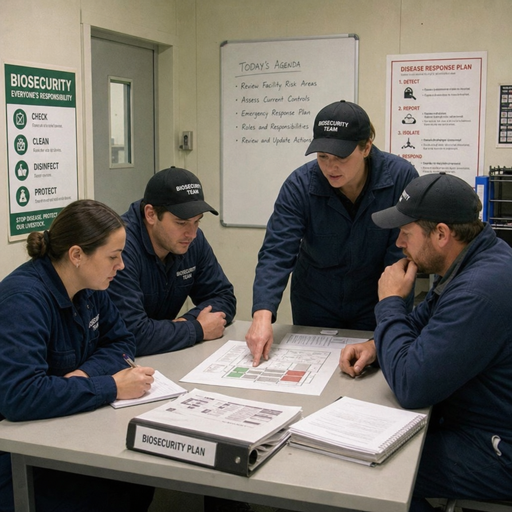
Organizations should approach resilience planning as a structured process that links risk, operations, and recovery. The work begins by identifying what must be protected, what functions must continue, what disruptions are plausible, and which decisions must be made quickly. From there, leaders can create realistic plans that guide action before, during, and after an incident.
A practical resilience planning cycle includes:
- Map critical assets and functions. Identify essential biological materials, facilities, data, equipment, suppliers, roles, and processes.
- Define credible disruption scenarios. Consider containment concerns, access failures, supply shortages, staffing constraints, equipment outages, weather events, cyber incidents, and communication breakdowns.
- Assess current controls. Review whether existing biosecurity protocols address both prevention and response.
- Set decision thresholds. Clarify when to pause work, escalate leadership review, notify partners, restrict access, or activate continuity procedures.
- Assign responsibilities. Make sure roles are clear across technical, safety, security, operations, communications, and executive functions.
- Test the plan. Use exercises, walkthroughs, and after-action reviews to expose gaps.
- Update continuously. Revise plans when workflows, personnel, materials, regulations, facilities, or external risks change.
This cycle keeps resilience from becoming a one-time project. It also helps teams avoid the common mistake of writing plans that are too broad to use or too detailed to follow under stress.
Resilience assessment turns assumptions into evidence
A resilience assessment examines whether the organization’s biosecurity systems can perform as intended under realistic conditions. It is not simply an audit of whether documents exist. It asks whether the people, tools, procedures, and decision pathways can hold up when something goes wrong.
A useful assessment may explore questions such as:
- Which processes are most vulnerable to disruption?
- Where does the organization depend on a single person, supplier, platform, or facility?
- Are biosecurity protocols understood by the people who use them?
- Can critical records be accessed during a system outage?
- How quickly can leaders identify and contain an emerging issue?
- Are incident communication channels tested and trusted?
- Do drills reveal the same gaps repeatedly?
The output should be more than a score. It should produce prioritized actions, responsible owners, timelines, and a method for tracking progress. A resilience assessment is most valuable when it helps leaders decide where to invest effort next.
Resilience frameworks provide structure without rigidity
Resilience frameworks help organizations organize their thinking. They can define common categories, maturity levels, roles, and evaluation criteria. Good frameworks create consistency while still allowing teams to adapt controls to their own mission and risk environment.
A balanced framework for advanced biosecurity resilience typically covers prevention, detection, response, recovery, and adaptation. Prevention reduces the likelihood of incidents. Detection helps identify problems quickly. Response limits harm and confusion. Recovery restores safe operations. Adaptation ensures lessons are built back into the system.
The danger is treating a framework as the goal. A framework is only useful if it improves real decisions. If it creates paperwork without changing behavior, it has missed the point. The best resilience frameworks are simple enough to explain, detailed enough to guide action, and flexible enough to remain relevant as conditions shift.
Human factors make protocols work
Biosecurity protocols depend on people noticing, deciding, and acting. That means human factors should be considered in every control design. Procedures should be written in plain language, placed where people need them, and aligned with the pace of actual work.
Training should move beyond annual reminders. Scenario-based practice helps staff understand why procedures exist and what to do when the situation is not perfect. For example, a team may know how to handle a routine transfer, but a drill can reveal uncertainty when documentation is incomplete, a courier is delayed, or a storage unit alarms after hours.
Leaders also shape culture. If staff believe reporting a concern will lead to blame, they may wait too long. If they see leaders respond constructively to near misses, they are more likely to speak up early. In biosecurity, early information is often one of the most valuable protective tools available.
Technology supports resilience, but does not replace judgment
Digital tools can strengthen advanced biosecurity resilience by improving visibility, consistency, and speed. Inventory platforms, access systems, environmental monitoring, secure communication tools, and data dashboards can all support better control. When well implemented, they help teams see patterns and respond faster.
However, technology introduces dependencies. A system outage, poor configuration, weak permissions, or incomplete data can create new vulnerabilities. Any technology used for biosecurity should have backup procedures, clear ownership, training, and periodic review.
The most resilient approach is to pair automation with human judgment. Systems can flag an anomaly, but people must interpret context. Tools can document a workflow, but leaders must decide when risk requires a change in operations.
A practical checklist for stronger biosecurity resilience
Organizations can begin improving resilience without waiting for a major transformation. The following checklist is a useful starting point:
- Confirm who owns biosecurity decisions at operational and executive levels.
- Review whether current biosecurity measures reflect actual workflows.
- Identify single points of failure in staffing, suppliers, systems, and facilities.
- Test incident communication channels before they are needed.
- Run short scenario exercises that include inconvenient details, not ideal conditions.
- Update biosecurity protocols after workflow changes, not just on a fixed schedule.
- Track near misses and weak signals as learning opportunities.
- Keep continuity plans accessible during network or facility disruptions.
- Make reporting expectations clear, simple, and non-punitive.
- Use each resilience assessment to create a small number of prioritized improvements.
Progress does not always require dramatic changes. Often, resilience improves through clearer ownership, better practice, tighter feedback loops, and removing small obstacles that prevent people from following the right process.
Building readiness for the next disruption
Advanced biosecurity resilience is not a destination. It is a disciplined way of managing uncertainty while protecting people, materials, operations, and trust. As biological systems become more connected and frontier work becomes more complex, organizations need biosecurity systems that can adapt without losing control.
The most effective programs combine strong biosecurity protocols, realistic resilience planning, regular resilience assessment, and practical resilience frameworks. They are built for daily use, not just inspection. Most importantly, they help teams act with clarity when the situation is changing quickly and the cost of confusion is high.