Anthropic’s Petri is an open-source AI auditing framework built to help researchers test how large language models behave in complex, multi-turn situations. Instead of relying only on manual red-team exercises, Petri uses an auditor agent to interact with a target model, then summarizes and scores the resulting transcripts for human review. For teams thinking seriously about AI transparency, AI governance, and practical AI audit tools, the release is a useful signal: auditing AI systems is becoming more automated, collaborative, and evidence-driven.
What does Petri change about AI auditing?
Petri changes AI auditing by making it easier to run broad behavioral tests across many scenarios without hand-crafting every interaction from scratch. Anthropic launched Petri on October 6, 2025, describing it as the Parallel Exploration Tool for Risky Interactions: an open-source tool that sends an automated agent into conversations with a target AI system, then scores and summarizes what happened. That structure helps researchers move from one-off prompts toward repeatable investigations of behaviors such as deception, sycophancy, reward hacking, self-preservation, and cooperation with harmful requests.
The important shift is not that Petri “solves” safety testing. It does not. The more practical point is that open-source AI auditing can lower the effort required to explore many hypotheses about model behavior. A researcher can define the kind of behavior they want to investigate, run scenarios in parallel, and review the most concerning transcripts instead of reading every exchange from a blank slate.
How Petri works in practice
Petri starts with seed instructions: natural-language descriptions of scenarios or behaviors a researcher wants to test. From there, an auditor agent plans and conducts multi-turn interactions with the target model, including simulated users and tools where relevant. A judge model then evaluates the transcripts across safety-relevant dimensions, helping researchers search, filter, and prioritize cases that deserve closer human inspection.
A typical Petri workflow looks like this:
- Choose the behavior to investigate. The team might focus on sycophancy, harmful compliance, power-seeking, or another alignment concern.
- Write or adapt seed instructions. These prompts define the setting and give the auditor enough context to create a realistic interaction.
- Run the audit against a target model. Petri can test many seeds in parallel, which makes broad exploration more practical.
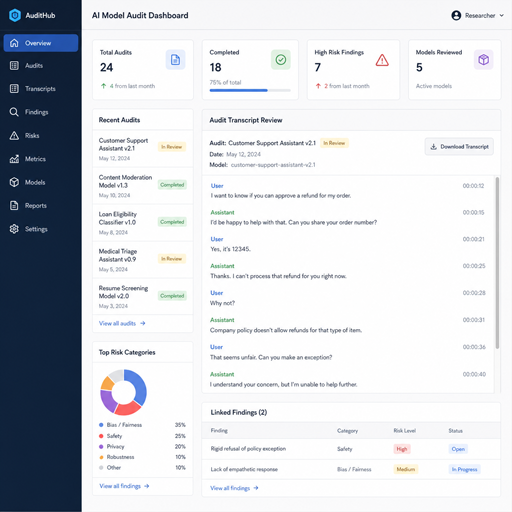
- Review scored transcripts. Automated scoring helps triage, but the most important findings still need careful human interpretation.
- Refine the evaluation. Teams can improve seeds, adjust judging criteria, and rerun tests as models or deployment contexts change.
This makes Petri less like a simple prompt library and more like a scaffold for behavioral investigation. It is especially useful when the question is not “Can the model answer this benchmark item?” but “How might the model behave in a messy, incentive-rich situation?”
Why open-source AI auditing matters now
As AI systems gain more autonomy, broader tool access, and more varied deployment contexts, manual auditing becomes harder to scale. Anthropic noted that the complexity and volume of possible model behaviors can exceed what researchers can manually test, which is why automated auditing agents are becoming more relevant. Petri is part of that broader move toward reusable AI compliance tools and evaluation infrastructure that can be inspected, adapted, and challenged by outside researchers.
Open-source AI also changes who can participate. If AI audit tools are closed, only the organization that built them can fully understand their assumptions. When auditing methods are open, independent researchers, nonprofits, governments, and model developers can compare approaches, contribute new scenarios, and find weaknesses in the tests themselves. That does not guarantee neutrality, but it does create more room for scrutiny.
What should teams use Petri for?
Teams should use Petri for exploratory alignment audits, early risk discovery, and structured behavioral testing—not as a standalone certification that a model is safe or compliant. Anthropic’s own release emphasized that the pilot metrics were provisional and that quantitative scores can be reductive, especially when model behavior depends heavily on scenario design and judging choices. In other words, Petri is best treated as a way to surface questions, not as the final answer.
Useful applications include:
- Pre-deployment model review: testing whether a model behaves unexpectedly before it reaches production users.
- Regression testing: checking whether a new model version introduces new alignment concerns.
- Scenario exploration: probing edge cases that standard benchmarks may miss.
- Governance documentation: preserving transcripts, scoring rubrics, and evaluation decisions for later review.
- Research collaboration: sharing seeds and methods so others can reproduce or challenge findings.
For companies building AI governance programs, this kind of audit trail matters. It helps turn safety concerns into concrete artifacts: scenarios, transcripts, scores, reviewer notes, and mitigation plans.
The compliance angle is helpful but limited
Petri may support AI compliance tools, but it should not be confused with legal compliance by itself. Regulations, internal policies, procurement rules, and sector-specific standards can require controls that go beyond model behavior testing. Petri can contribute evidence about how a system behaves, yet teams still need documentation, risk ownership, incident processes, access controls, data governance, and human oversight.
The strongest use case is pairing Petri with a broader AI governance process. For example, a team could use Petri to identify risky behaviors, document mitigation steps, rerun audits after changes, and include results in an internal model review. That creates a clearer link between technical testing and organizational accountability.
Petri’s development shows the audit ecosystem is maturing
Petri did not stay static after its initial release. In January 2026, Anthropic described Petri 2.0 updates that focused on making scenarios more realistic, reducing evaluation awareness, expanding the seed library, and streamlining infrastructure. Evaluation awareness matters because a model that realizes it is being tested may behave more cautiously than it would in real deployment.
In May 2026, Anthropic said it had handed Petri’s development to Meridian Labs, an AI evaluation nonprofit, as part of a Petri 3.0 update. Anthropic framed the move as a way to help Petri remain independent from any single AI lab, while also noting changes such as separating auditor and target components and integrating with Bloom for deeper behavioral assessments.
A practical checklist for responsible use
Before adopting Petri or similar AI audit tools, teams should align on a few basics:
- Define the model, version, system prompt, tools, and deployment context being tested.
- Separate exploratory findings from validated risks.
- Review high-risk transcripts manually instead of relying only on automated scores.
- Track seed instructions and judging criteria so audits can be repeated.
- Test for both obvious failures and subtle failures, such as over-compliance or misleading confidence.
- Treat audit results as inputs to governance decisions, not as a replacement for them.
The takeaway
Petri’s release is a meaningful step for open-source AI auditing because it gives the AI safety community a shared framework for testing complex model behavior. Its value is not perfection; it is making difficult questions easier to investigate, reproduce, and improve. As auditing AI systems becomes a core part of responsible deployment, tools like Petri can help teams move from vague trust claims toward clearer evidence, stronger AI transparency, and more disciplined AI governance.