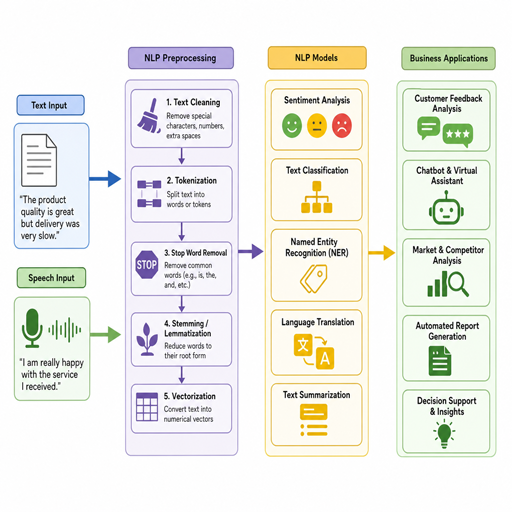
Natural Language Processing (NLP) is the field of artificial intelligence that helps computers work with human language in text and speech. It turns messy, context-rich communication into information machines can classify, search, summarize, translate, generate, or respond to. As language models become more capable, the future of NLP is less about single-purpose tools and more about systems that can understand intent, adapt to context, and support real decisions with transparent, responsible language intelligence.
What is Natural Language Processing NLP?
Natural Language Processing NLP is a branch of AI focused on enabling computers to recognize, interpret, generate, and act on human language. It combines linguistics, computer science, machine learning, and deep learning so software can process words, grammar, meaning, tone, and context rather than only exact commands. IBM describes NLP as a field that helps computers and digital devices recognize, understand, and generate text and speech by combining computational linguistics with statistical, machine learning, and deep learning methods.
The key idea is simple: human language is unstructured, but computers need structure. A support email, product review, phone transcript, legal clause, search query, or social media post may contain valuable signals, yet those signals are hidden inside informal wording, ambiguity, slang, misspellings, domain-specific terms, and emotional tone. NLP techniques help transform that raw language into patterns a machine can analyze.
At its most practical, NLP answers questions such as: What topic is this message about? Is the customer angry, satisfied, or confused? Which names, dates, products, and places are mentioned? What should be summarized? What should the system say next? These questions explain why NLP sits behind tools for text analysis, sentiment analysis, speech recognition, search, translation, chatbots, document review, and writing assistance.
Defining characteristics of NLP include:
- Human language as the input or output: NLP works with text, speech, or both.
- Structure from unstructured data: It converts free-form language into tokens, labels, vectors, entities, topics, or summaries.
- Context-aware interpretation: Modern NLP looks beyond individual words to relationships between words, sentences, speakers, and tasks.
- Prediction and generation: Many systems classify language, while newer language models also generate fluent responses.
- Domain sensitivity: A phrase can mean different things in healthcare, law, retail, finance, education, or everyday conversation.
- Continuous evaluation: NLP systems need testing because language changes, data shifts, and model behavior can vary by audience and use case.
The basic pipeline behind language understanding
NLP may feel magical when a system instantly summarizes a document or answers a question, but most solutions follow a recognizable pipeline. The exact design depends on the task, model, data quality, and risk level, yet the workflow often begins with collecting language data, cleaning it, preparing it for a model, applying an algorithm, and evaluating the result.
A typical NLP workflow includes:
- Data collection: The system receives emails, reviews, transcripts, documents, chats, search logs, survey responses, or other language records.
- Data preprocessing: The text or speech is cleaned, normalized, segmented, tokenized, and prepared for analysis.
- Feature representation: Words, phrases, or audio signals are converted into numerical forms that models can process.
- Modeling: A rule-based system, statistical model, machine learning classifier, transformer, or large language model performs the task.
- Post-processing: The system formats the output, filters low-confidence results, applies business rules, or prepares a response.
- Evaluation and monitoring: Human reviewers, test sets, automated metrics, and feedback loops help determine whether the system is useful and reliable.
Data preprocessing deserves special attention because it shapes everything that follows. In classic text analysis, preprocessing may include lowercasing, removing duplicates, fixing encoding problems, stripping irrelevant markup, splitting text into tokens, handling punctuation, and removing or preserving stop words depending on the task. In speech recognition, preprocessing may also include audio cleanup, segmentation, speaker separation, and conversion of sound into features before text output is produced.
Modern language models reduce the need for some manual feature engineering, but they do not remove the need for careful data preparation. If the input contains private information, biased examples, duplicated records, irrelevant noise, or inconsistent labels, the output can become less trustworthy. The future of NLP will still depend on disciplined data practices, even as models become more flexible.
How does NLP work in practice?
NLP works by turning language into computational representations, then using rules or models to detect patterns and produce an output. Earlier systems often relied heavily on hand-built grammar rules, dictionaries, and statistical patterns; modern systems typically use machine learning and deep learning to learn language patterns from large datasets. Stanford’s NLP curriculum frames the field around tasks ranging from word-level and syntactic processing to question answering and machine translation, which shows how broad the discipline has become.
A basic text classification system might learn that certain words and phrases are associated with billing issues, technical bugs, or cancellation requests. A named entity recognition system might identify people, companies, products, locations, and dates. A sentiment analysis model might estimate whether a review expresses approval, frustration, sarcasm, or uncertainty. A speech recognition system might convert spoken audio into text so another NLP component can summarize, search, or route the transcript.
The most influential modern shift has been the rise of transformer-based language models. The Transformer architecture, introduced in the research paper “Attention Is All You Need,” uses attention mechanisms rather than recurrence or convolution as the core sequence-processing method. Google’s developer materials explain that transformer models use self-attention so words in a context can learn their relevance to other words, which helps language models handle relationships across longer passages.
In practical terms, attention helps a model treat language less like a fixed list of words and more like a network of relationships. In the sentence “The customer returned the charger because it overheated,” the word “it” likely refers to “charger.” In “The customer returned the laptop because it arrived damaged,” “it” likely refers to “laptop.” A useful model must track these relationships across context, not simply count keywords.
Core NLP techniques and what they do
NLP is not one technique. It is a toolkit of methods that can be combined depending on the problem. Some techniques are simple and interpretable; others are complex and powerful but harder to explain. A mature NLP strategy often blends both.
Tokenization and segmentation
Tokenization breaks text into smaller units, such as words, subwords, phrases, or sentences. This step matters because models do not “see” language the way people do; they process units encoded as numbers. Poor segmentation can distort meaning, especially in languages where word boundaries are not marked with spaces or in domains filled with abbreviations, codes, and product names.
For example, a customer review that says “battery-life isn’t great” could be split in several ways. A system must decide whether “battery-life” is one concept, two words, or a phrase worth preserving. In the future, stronger multilingual and domain-aware tokenization will remain important because global language use is diverse, informal, and constantly changing.
Part-of-speech tagging and parsing
Part-of-speech tagging labels words as nouns, verbs, adjectives, adverbs, and other grammatical categories. Parsing goes further by identifying grammatical relationships between words. These techniques help systems understand not only what words appear, but how they function inside a sentence.
For instance, “book a flight” uses “book” as a verb, while “read a book” uses it as a noun. Search systems, virtual assistants, and information extraction tools benefit when they can tell the difference. Even when deep learning models handle much of this implicitly, linguistic structure remains useful for debugging, explanation, and high-precision applications.
Named entity recognition
Named entity recognition identifies specific items such as people, organizations, dates, locations, products, medical terms, or account numbers. This is useful for document search, compliance review, customer support routing, research analysis, and knowledge graph creation.
A business might use entity extraction to identify which products customers mention most often in support tickets. A legal team might use it to find contract parties and renewal dates. A healthcare system might use specialized entity recognition to extract symptoms, medications, or procedures, although high-risk domains require additional safeguards and expert review.
Sentiment analysis and emotion detection
Sentiment analysis estimates the attitude or emotional tone expressed in language. IBM notes that sentiment analysis can help extract subjective qualities, attitudes, emotions, and similar signals from text. Businesses often use it to analyze reviews, surveys, social posts, support conversations, and brand feedback.
The challenge is that sentiment is not always obvious. “Great, another login issue” may look positive if the system focuses only on “great,” but the full sentence is likely negative or sarcastic. Future sentiment analysis will need to become more context-aware, multilingual, and sensitive to industry-specific language rather than relying on shallow positive-or-negative scoring.
Topic modeling and text analysis
Text analysis uses computational methods to find patterns in written language. Topic modeling, clustering, keyword extraction, semantic search, and classification can help organizations make sense of large document sets. Instead of reading thousands of comments manually, a team can identify themes such as pricing complaints, usability issues, delivery problems, or feature requests.
The best text analysis does not replace human judgment. It narrows the field, reveals patterns, and helps people focus attention where it matters. In the future, text analysis will increasingly connect with dashboards, decision workflows, and automated summaries, making language data easier to act on.
Speech recognition and spoken language processing
Speech recognition converts spoken audio into text. IBM describes speech recognition, also known as speech-to-text, as the task of converting voice data into text data. Once speech is transcribed, NLP can summarize the conversation, detect intent, identify next steps, search the transcript, or route the issue to the right team.
Speech adds complexity because audio includes accents, background noise, overlapping speakers, emotion, pauses, and pronunciation differences. NIST has long supported evaluation work in areas such as language recognition and speaker recognition, reflecting the importance of measurement in spoken language technologies. The future of speech-related NLP will involve not only more accurate transcription, but also better handling of context, speaker roles, privacy, and real-time interaction.
Language models are changing the center of NLP
Language models estimate patterns in language so they can predict, classify, complete, or generate text. Older language models were often limited by short context windows and simple statistical assumptions. Modern large language models use deep neural networks, especially transformer architectures, to model relationships across much larger contexts and produce more flexible outputs.
This shift changes how people build NLP systems. Instead of training a separate model from scratch for every task, teams can often adapt a general-purpose model using prompting, retrieval, fine-tuning, or tool integration. That makes NLP more accessible, but it also raises new questions about reliability, data governance, hallucination, cost, latency, and evaluation.
Language models are especially useful when tasks involve open-ended language rather than fixed labels. They can draft summaries, answer questions, rewrite content, generate code-like structures, compare documents, classify nuanced intent, and support conversational interfaces. However, they should not be treated as automatically correct. A fluent answer can still be incomplete, biased, outdated, or unsupported.
Language models are most useful when they are paired with:
- Clear task instructions that define the output format and goal.
- Relevant context from trusted sources, documents, databases, or user inputs.
- Retrieval systems that ground answers in current or approved information.
- Validation rules for dates, numbers, citations, permissions, and required fields.
- Human review for high-impact decisions, sensitive content, or ambiguous cases.
- Monitoring to detect drift, repeated errors, unsafe outputs, or declining performance.
The future is not simply “larger models.” It is better model orchestration. Smaller specialized models, retrieval-augmented systems, multimodal models, and human-in-the-loop workflows will often be more practical than one large model used for everything.
What makes the future of NLP different from the past?
The future of NLP is defined by a move from narrow language automation to broader language intelligence. Traditional NLP tools often performed one job, such as classifying support tickets or extracting keywords. Emerging systems can combine reading, searching, reasoning, summarizing, speaking, and tool use in a single workflow.
This matters because most real work is not a single NLP task. A customer support assistant may need to understand a complaint, identify the customer’s product, search the knowledge base, summarize the issue, suggest a response, and create a ticket. A research assistant may need to read papers, compare findings, flag contradictions, and produce a concise brief. A compliance tool may need to extract clauses, identify risk language, compare versions, and produce an audit trail.
Several trends are shaping this next stage:
- Context-rich systems: NLP tools will increasingly use organizational knowledge, user history, and task-specific context rather than processing each sentence in isolation.
- Multimodal language understanding: Text, speech, images, tables, and documents will be processed together, making language systems more useful in real workflows.
- Domain adaptation: Models will be tuned or guided for specialized vocabularies in law, medicine, finance, science, manufacturing, and education.
- Responsible AI practices: Bias testing, privacy controls, explainability, provenance, and human oversight will become more central.
- Better evaluation: Organizations will need task-specific tests that measure usefulness, accuracy, safety, and consistency rather than relying only on generic benchmarks.
- Smaller, efficient models: Not every use case needs the largest model available; cost, speed, deployment environment, and privacy often favor efficient systems.
NIST’s generative AI evaluation work highlights the need to test capabilities across modalities and measure both opportunities and risks as generative systems become more widespread. That evaluation mindset is central to the future of NLP because language tools are increasingly embedded in public-facing, business-critical, and decision-support systems.
Practical examples of NLP in everyday systems
NLP appears in more places than many users realize. It is not limited to chatbots or experimental AI tools. It supports routine digital experiences where language needs to be searched, sorted, summarized, translated, or acted upon.
Common NLP use cases include:
- Customer support routing: Classifying incoming messages by topic, urgency, product, or customer intent.
- Review and survey analysis: Using sentiment analysis and topic extraction to understand customer feedback at scale.
- Search improvement: Interpreting meaning and intent rather than relying only on exact keyword matches.
- Document summarization: Condensing reports, policies, contracts, transcripts, and research into shorter summaries.
- Speech recognition: Converting meetings, calls, voice notes, and dictation into searchable text.
- Virtual assistants: Understanding user requests and generating helpful responses or actions.
- Translation and localization: Supporting communication across languages while preserving meaning and tone.
- Compliance review: Finding sensitive information, regulated terms, risky clauses, or missing disclosures.
- Knowledge management: Turning unstructured documents into searchable, organized information.
- Content operations: Drafting, rewriting, tagging, and optimizing content while keeping human editorial control.
These examples show why NLP is valuable: it reduces the friction between human communication and digital systems. People naturally communicate in language, while software needs structured input. NLP bridges that gap.
NLP is not the same as general artificial intelligence
NLP is part of artificial intelligence, but it is not identical to AI as a whole. AI includes many areas, such as computer vision, robotics, planning, optimization, recommendation systems, and reinforcement learning. NLP focuses specifically on language, although modern systems often combine NLP with other AI capabilities.
It is also useful to distinguish NLP from related terms. Natural language understanding focuses on interpreting meaning and intent. Natural language generation focuses on producing language. Computational linguistics often emphasizes the formal and scientific study of language using computational methods. Speech processing focuses on audio signals, speech-to-text, text-to-speech, speaker recognition, and related tasks.
Related concepts compared:
|
Concept |
Main focus |
Example |
|---|---|---|
|
NLP |
Processing human language with computers |
Classifying emails or summarizing documents |
|
Natural language understanding |
Interpreting meaning and intent |
Detecting that “I can’t log in” is a support request |
|
Natural language generation |
Producing readable language |
Drafting a response or report summary |
|
Speech recognition |
Converting spoken audio to text |
Transcribing a customer service call |
|
Text analysis |
Finding patterns in written language |
Identifying common complaints in reviews |
|
Language models |
Predicting or generating language patterns |
Completing a sentence or answering a question |
The boundaries can overlap. A voice assistant, for example, may use speech recognition to convert audio into text, natural language understanding to interpret intent, a retrieval system to find information, and natural language generation to respond. The user experiences one interaction, but several technologies work together behind the scenes.
The role of data preprocessing in future NLP systems
Data preprocessing will remain one of the quiet foundations of strong NLP. Even advanced models depend on the quality, relevance, and governance of the data they receive. A system trained or prompted on messy, inconsistent, or biased data can produce outputs that appear polished but fail the actual task.
For text data, preprocessing may involve removing duplicates, correcting formatting, handling casing, preserving important punctuation, anonymizing sensitive information, detecting language, segmenting documents, and creating consistent labels. For audio data, preprocessing may include reducing noise, detecting speakers, splitting recordings, and aligning transcripts with timestamps. For enterprise use, preprocessing also includes access control, retention policies, consent requirements, and documentation.
The future will likely make preprocessing more automated, but not less important. Tools may become better at detecting poor-quality records, identifying personally identifiable information, or suggesting labels. Still, teams will need to decide what data is appropriate, what should be excluded, what must be reviewed, and what success means for the task.
A practical preprocessing checklist:
- Confirm that the data source is relevant to the actual task.
- Remove duplicates, corrupted files, and irrelevant boilerplate.
- Preserve language features that affect meaning, such as negation and domain terms.
- Protect sensitive information before model training, prompting, or sharing.
- Check whether labels are consistent across annotators or departments.
- Separate training, validation, and test examples to avoid misleading results.
- Document assumptions, exclusions, and known limitations.
- Recheck the data regularly because language, products, and user behavior change.
Strong preprocessing makes NLP less brittle. It also makes evaluation more honest because the system is tested on language that reflects real use rather than a cleaned-up fantasy version of it.
Challenges that will shape NLP’s next phase
NLP has advanced quickly, but its future depends on solving practical problems, not only building more fluent models. The hardest challenges often appear when systems leave the lab and enter real workflows.
Ambiguity is one persistent challenge. Human language depends on context, shared knowledge, tone, and implication. A short phrase such as “that’s fine” can express agreement, disappointment, impatience, or sarcasm depending on the speaker and situation.
Bias is another concern. NLP systems learn from data that may reflect social stereotypes, historical inequalities, or uneven representation across languages and dialects. If those patterns are not tested and mitigated, the system may perform worse for some users or produce unfair outputs.
Privacy becomes more important as NLP tools process emails, calls, chats, medical records, contracts, or internal documents. Language data often contains names, contact details, financial information, health details, trade secrets, and other sensitive content. Future NLP systems will need stronger controls around data access, retention, redaction, and auditability.
Explainability matters because many language outputs are probabilistic. A model may classify a message as urgent, but a support manager may need to know why. A system may summarize a document, but a legal reviewer may need to trace each claim to the source text.
Evaluation is especially difficult for generative systems. A classification model can be scored against labels, but a generated answer may be partially correct, stylistically strong, and factually incomplete all at once. Evaluation will need to combine automated metrics, human review, source grounding, adversarial testing, and real-world feedback.
Responsible NLP will become a competitive advantage
As NLP becomes more embedded in products and operations, responsible design will move from a compliance concern to a quality concern. Users will trust language systems that are accurate, transparent, secure, and respectful of context. They will lose trust quickly when systems invent facts, expose private information, misread intent, or produce confident nonsense.
Responsible NLP starts with the use case. A tool that recommends movie summaries has a different risk profile than a tool that supports medical triage or legal review. The level of oversight, testing, documentation, and human approval should match the potential impact of errors.
Responsible NLP practices include:
- Define the task, user, risk level, and acceptable error types before choosing a model.
- Use approved data sources and document where the data came from.
- Test performance across languages, dialects, user groups, and edge cases.
- Keep humans involved when outcomes affect rights, safety, finances, health, or employment.
- Make outputs traceable to sources when factual accuracy matters.
- Give users a way to correct errors, appeal decisions, or provide feedback.
- Monitor the system after deployment because real language changes over time.
These practices do not slow innovation; they make innovation usable. The future of NLP will reward teams that build systems people can rely on, not just systems that sound impressive in a demo.
How organizations can prepare for the future of NLP
Organizations do not need to adopt every new model or tool immediately. A better starting point is to identify where language creates friction: unread support queues, slow document review, scattered knowledge bases, inconsistent tagging, poor search, manual call notes, or underused customer feedback. NLP is most valuable when it solves a real workflow problem.
A practical roadmap begins with a narrow use case and a clear success measure. For example, a team might start by classifying customer tickets into ten categories, summarizing sales calls, extracting contract renewal dates, or clustering survey responses. Once the system proves useful, the team can expand to more complex tasks.
A simple adoption path:
- Find the language bottleneck. Look for repetitive reading, tagging, searching, summarizing, or routing work.
- Define the output. Decide whether you need a label, score, summary, transcript, answer, extraction, or draft.
- Audit the data. Check quality, permissions, privacy needs, and representativeness.
- Choose the approach. Use rules, classic machine learning, language models, retrieval, or a hybrid system based on the task.
- Test with real examples. Include edge cases, short inputs, long documents, noisy speech, and unusual phrasing.
- Add human review. Keep people in the loop where the model is uncertain or the impact is high.
- Monitor and improve. Track errors, user feedback, drift, cost, latency, and business outcomes.
This approach keeps NLP grounded. The goal is not to use AI for its own sake. The goal is to make language-heavy work faster, clearer, more searchable, and more consistent.
The future is human-centered language intelligence
The next stage of Natural Language Processing NLP will be defined by systems that are more contextual, multimodal, personalized, and accountable. Language models will continue to influence how people search, write, learn, analyze, and interact with software. At the same time, the most valuable systems will not be the ones that merely generate fluent text; they will be the ones that connect language to trusted data, useful actions, and human judgment.
Text analysis, data preprocessing, speech recognition, sentiment analysis, and other NLP techniques will remain essential building blocks. They may be hidden behind more conversational interfaces, but they will still determine whether a system understands the task, handles messy inputs, and produces reliable outputs. The future of NLP is therefore both technical and practical: better models, better data, better evaluation, and better alignment with real human needs.
For beginners, the simplest way to understand NLP is this: it is how computers learn to work with the language people already use. Its future is not about replacing communication, but about making communication easier to organize, search, understand, and act on at scale.