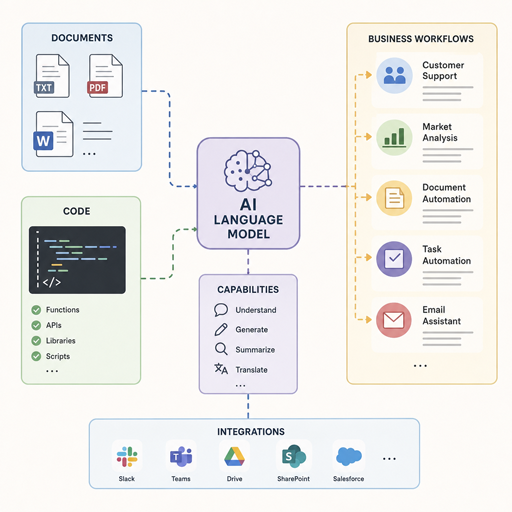
Large Language Models LLM are changing how people search, write, analyze, code, learn, and interact with software. As ai language models become more capable, the real story is not just bigger systems, but smarter, safer, more specialized tools that fit into everyday work. Understanding where these language models are heading can help teams use them with more confidence and less hype.
The future of natural language processing will likely be shaped by models that are more accurate, more context-aware, easier to customize, and better connected to trusted data. For businesses, educators, creators, developers, and curious users, that means new opportunities—but also new responsibilities.
What will define the next generation of Large Language Models LLM?
The next generation of Large Language Models LLM will be defined by usefulness, reliability, and integration rather than size alone. While early attention focused heavily on parameter counts and broad conversational ability, future progress will depend on whether models can reason through complex tasks, cite or retrieve reliable information, adapt to specific domains, and work safely inside real workflows.
This shift matters because most people do not need a model that can answer every possible question in the world. They need a model that can help draft a policy, summarize a meeting, analyze support tickets, explain a legal clause in plain English, or turn messy notes into a useful plan. In other words, the future of ai language models is practical.
From broad intelligence to task-specific value
Many modern language models are impressive because they can handle a wide range of prompts. They can write, translate, summarize, brainstorm, classify text, and generate code-like structures. But broad capability is only the starting point. The next wave will be about matching the right model to the right job.
General-purpose systems will still matter, especially for open-ended research, creative work, and everyday productivity. However, specialized machine learning models will become increasingly important in areas such as customer support, healthcare administration, legal operations, finance, education, software development, and internal knowledge management. These models may not always feel more “creative,” but they can be more consistent in the tasks they were built to perform.
A customer service model, for example, does not need to write poetry. It needs to understand customer intent, retrieve the correct policy, respond in the right tone, and escalate sensitive issues. A coding assistant needs to understand context from a repository, explain trade-offs, and avoid introducing avoidable security risks. This practical specialization is where deep learning models can move from novelty to infrastructure.
Key areas where specialization will matter
- Industry knowledge: Models trained or adapted for specific terminology, regulations, and workflows can provide more relevant responses.
- Company context: Internal documentation, product details, brand guidelines, and customer data can make outputs more useful.
- Task boundaries: A model that knows when to summarize, classify, retrieve, or ask for clarification is often more valuable than one that simply generates more text.
- Quality controls: Domain-specific evaluation can reveal whether a model is truly helpful or merely fluent.
- User experience: The best AI tools may feel less like chatbots and more like quiet assistants built directly into the software people already use.
Better context will make models more useful
One of the biggest limitations of language models is that they may respond confidently even when they lack enough information. Future systems will improve by combining natural language processing with stronger context management, retrieval, memory, and tool use. Instead of relying only on what a model learned during training, AI systems can pull from current, approved, or private sources when generating an answer.
This is especially important for organizations. A business does not want a model to guess what its refund policy says. It wants the model to retrieve the actual policy, interpret it, and provide a response that matches company standards. The same principle applies to internal knowledge bases, technical documentation, sales enablement content, and compliance materials.
Better context also changes how people prompt these systems. Instead of treating the model like an all-knowing oracle, users can treat it like a reasoning layer connected to specific information. That makes the output easier to verify and more aligned with real needs.
How will natural language processing evolve?
Natural language processing will evolve from standalone text analysis into a broader layer for human-computer interaction. Traditional nlp techniques such as classification, entity recognition, sentiment analysis, topic modeling, and machine translation will not disappear; they will increasingly work alongside generative models to support richer, more flexible applications.
For years, NLP systems were often built for narrow tasks. One system might detect sentiment, another might extract names, and another might route a customer ticket. Large Language Models LLM changed expectations by showing that one model could perform many language tasks through instructions. The future will likely combine both approaches: the flexibility of generative ai language models with the precision and efficiency of established nlp techniques.
This blended approach is powerful. A support platform might use classification to detect urgency, retrieval to find relevant documentation, a language model to draft a response, and a rules layer to ensure the message follows policy. Each component does what it does best.
Practical NLP capabilities to watch
- More accurate summarization: Turning long documents, calls, chats, or research into concise outputs that preserve key details.
- Multilingual understanding: Helping teams communicate across languages while respecting cultural nuance and domain-specific vocabulary.
- Intent detection: Understanding what a user is trying to accomplish, not just what words they typed.
- Information extraction: Pulling names, dates, obligations, issues, or action items from unstructured text.
- Conversational interfaces: Letting users interact with data, software, and knowledge systems through natural language.
Multimodal models will expand what “language” means
The phrase “language models” can sound text-only, but the future is increasingly multimodal. Models are becoming better at working across text, images, audio, video, tables, code, and structured data. This does not make language less important. It makes language the interface for understanding many kinds of information.
Imagine asking a system to review a chart, explain the trend, compare it with a spreadsheet, and draft a slide summary. Or consider a technician who uploads a photo of equipment and asks for troubleshooting guidance based on a maintenance manual. In both cases, natural language becomes the bridge between human intent and complex data.
This expansion will also raise expectations. Users will want AI systems that can move fluidly between formats, remember the goal, and explain their reasoning in plain English. The models that succeed will not just generate polished paragraphs. They will help people make sense of messy, mixed information.
Smaller, faster, and more efficient models will gain ground
The future of deep learning models is not only about enormous systems running in massive data centers. Smaller models are becoming more important because they can be cheaper, faster, easier to deploy, and better suited to private or low-latency environments. In many cases, a compact model trained or tuned for a specific task can outperform a larger general model for that particular use case.
Efficiency matters for several reasons. It can reduce operating costs, improve response speed, support offline or edge use cases, and make AI more accessible to organizations with limited resources. It can also help reduce unnecessary complexity. If a team only needs to classify inbound messages or generate structured summaries, the largest available model may not be the best choice.
This creates a more diverse AI ecosystem. Large frontier models may power advanced reasoning and broad exploration, while smaller machine learning models handle routine tasks at scale. The result is less like one giant model replacing everything and more like a network of models working together.
Trust, safety, and governance will shape adoption
As ai language models become more embedded in work and daily life, trust will become a central issue. People need to know when a model is likely to be correct, when it is uncertain, what data it can access, and how its outputs should be reviewed. Without clear governance, even powerful tools can create confusion, risk, or overreliance.
Organizations should think beyond performance demos. They need policies for data privacy, acceptable use, human review, security, bias testing, and output monitoring. They also need to educate employees on what these systems can and cannot do. A model that sounds confident is not automatically correct, fair, compliant, or complete.
A practical checklist for responsible use
Before deploying language models in a real workflow, teams should ask:
- What task is the model expected to perform? Define the use case clearly before choosing a tool.
- What information can the model access? Separate public, internal, confidential, and regulated data.
- How will outputs be checked? Decide when human review is required and who is responsible.
- What could go wrong? Consider inaccurate answers, privacy leaks, biased outputs, and user misunderstanding.
- How will success be measured? Track quality, time saved, user satisfaction, error rates, and business impact.
- When should the model refuse or escalate? Build boundaries around sensitive, uncertain, or high-risk requests.
Responsible adoption does not mean avoiding AI. It means using it with clear expectations and safeguards.
What should businesses do now?
Businesses should start by identifying specific problems where Large Language Models LLM can improve speed, quality, or access to information. The best starting points are often repetitive language-heavy workflows: summarizing documents, drafting routine communications, searching internal knowledge, organizing feedback, or assisting support teams.
A useful approach is to begin small, test carefully, and expand based on evidence. Instead of launching an AI initiative because competitors are doing it, teams should map real workflows and ask where language slows people down. Then they can test whether language models actually improve the process.
Smart first steps
- Audit text-heavy work: Look for repeated writing, reading, classification, or research tasks.
- Choose low-risk pilots: Start with internal productivity or assisted drafting before automating sensitive decisions.
- Use trusted data sources: Connect models to approved documents rather than relying on unsupported generation.
- Train users: Teach employees how to prompt, verify, and refine AI outputs.
- Measure outcomes: Compare results against current workflows, not against unrealistic expectations.
The organizations that benefit most will be the ones that treat AI as a capability to manage, not a magic shortcut.
The human role will become more important, not less
A common fear is that advanced language models will remove people from the process. In some narrow cases, automation will reduce manual effort. But in many areas, the human role will shift toward judgment, direction, review, and creativity.
People will still define goals, understand context, make ethical choices, and decide what good work looks like. AI can provide drafts, options, summaries, and analysis, but humans bring accountability and lived understanding. The strongest results often come when people use models as collaborators: asking better questions, challenging outputs, and adding expertise the model does not have.
This is why AI literacy will become a core skill. Workers will not need to become machine learning engineers to use these tools well. They will need to understand the basics: how prompts affect output, why verification matters, when to use AI, and when not to.
The future is practical, connected, and collaborative
The future of Large Language Models LLM will not be defined by a single breakthrough or one universal model. It will be shaped by many improvements working together: stronger natural language processing, better retrieval, more efficient deep learning models, safer governance, specialized applications, and more thoughtful human use.
For readers watching this space, the key takeaway is simple: focus less on the spectacle and more on the systems. The most valuable ai language models will be the ones that solve real problems, fit naturally into existing work, and help people make better decisions. As language models continue to evolve, their greatest impact may come not from replacing human communication, but from making it clearer, faster, and more useful.