The recent Caltech experiment gives physicists something unusually satisfying: a long-predicted pattern in quantum matter that can now be seen in the lab. By arranging laser-trapped strontium atoms into a controllable quantum simulator, the team directly measured a quantum energy ladder whose spacing had been predicted by conformal field theory for about four decades. The result connects abstract energy ladder theory with real, tunable matter and opens a practical route for probing quantum systems that are too complex for ordinary calculation.
What did Caltech physicists actually measure?
Caltech physicists measured the excitation spectrum of synthetic quantum matter: in plain English, the allowed quantum energy levels a carefully prepared chain of atoms could occupy after being gently driven by lasers. Those levels did not appear randomly. They formed precise ratios, like rungs on a ladder, matching predictions from the Ising and tricritical Ising conformal field theories.
This is not the same as watching an electron jump between ordinary atomic orbitals in a textbook diagram. Here, the “object” being measured was a collective many-body system: a line of atoms interacting so strongly that the whole chain behaved as a single quantum system. That collective behavior is why the experiment matters. It shows that quantum mechanics energy patterns predicted for idealized field theories can emerge from real atoms when the system is tuned to the right critical point.
Why energy ladders matter in quantum mechanics
Energy quantization is one of the core ideas of quantum physics. Instead of taking on any value smoothly, many quantum systems can only occupy certain quantum energy states. The ladder image is useful because it turns an invisible rule into a simple picture: a system may climb from one rung to another, but it cannot stand halfway between allowed rungs.
In simple systems, such as an isolated atom, quantum energy levels can often be calculated and measured with extraordinary precision. In many-body systems, however, the problem becomes far harder. Each particle influences the others, and the number of possible states can grow rapidly. That is why directly measuring a many-body quantum energy ladder is so valuable: it gives physicists an experimental map of structure that theory alone may not easily provide.
The Caltech study focused on quantum critical points, where a system sits at a tipping point between two phases. Unlike water boiling, this transition is not driven by heat. It is driven by quantum effects near absolute zero, where superposition, entanglement, and collective behavior dominate the physics.
The 40-year prediction behind the experiment
The theory behind this result comes from conformal field theory, often shortened to CFT. CFTs are mathematical frameworks used across high-energy physics, statistical mechanics, and condensed matter physics. They are especially powerful near critical points, where very different systems can display the same universal behavior.
That word “universal” is doing a lot of work. At a critical point, many microscopic details fade into the background. A magnet, a chain of atoms, or another material system may follow the same mathematical pattern if they belong to the same universality class. Caltech’s Jason Alicea describes this as the “messy” details washing out, leaving only the essential features.
For roughly 40 years, theorists used CFT to predict how the low-energy rungs in certain finite systems should be spaced. Nature’s report notes that these spectra reveal key data about the underlying CFT, including the operator content associated with the theory. Until this work, much of that rich spectral structure had not been directly observed experimentally.
How did the quantum simulator reveal the ladder?
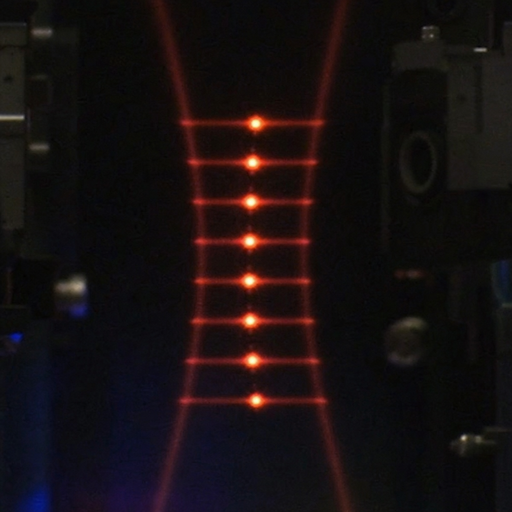
The team used a neutral-atom quantum simulator, not a general-purpose quantum computer. A quantum simulator is designed to reproduce a particular kind of quantum behavior with high control. In this case, the researchers used optical tweezers—tightly focused laser beams—to hold strontium atoms in a one-dimensional line. Other lasers excited the atoms into Rydberg states, where neighboring atoms interact strongly.
Those interactions made the atom chain behave collectively. By tuning the lasers, the team placed the system at critical points described by the Ising and tricritical Ising CFTs. Then they used a method called many-body modulation spectroscopy, which works a little like testing which note makes a wine glass resonate. When the driving frequency matched an allowed excitation, the atom chain responded strongly; when it did not, the response was weak.
The measurement process can be summarized like this:
- Build the atom chain. Strontium atoms were arranged in a line using optical tweezers.
- Create strong interactions. Lasers pushed the atoms into Rydberg states so neighboring atoms affected one another.
- Tune to a critical point. The laser settings brought the collective system to a quantum tipping point.
- Sweep through frequencies. The team gently modulated the lasers at different frequencies.
- Read the resonances. Peaks in the response revealed the quantum energy levels of the many-body system.
Caltech reported that the experiments used chains of up to 35 atoms. After rescaling for system size, the measured rungs collapsed onto the universal curve predicted by the Ising conformal field theory; at the tricritical point, the lowest levels followed a different set of predicted ratios.
Why is this more than a beautiful confirmation?
The result is beautiful because it confirms a clean mathematical prediction in a messy physical world. But it is also useful because it demonstrates a technique for extracting hidden structure from quantum matter. The same approach could help researchers identify universality classes in systems where the answer is not known ahead of time.
That matters because many important quantum systems resist exact classical computation. As the number of particles grows, tracking every possible interaction can become impractical. A well-controlled simulator can let nature perform the quantum calculation directly, while researchers measure the outcome.
The study also shows the growing overlap between quantum computing technology and fundamental physics. Tools originally developed to control qubits and neutral atoms are now mature enough to test deep theoretical ideas. Xiangkai Sun, a co-lead author, emphasized that years of progress in controlling these platforms have made them useful for fundamental physics research, not only for computing applications.
A quick guide to the key ideas
Understanding the discovery is easier when the main terms are separated:
- Energy quantization: The rule that many quantum systems can occupy only specific energy values, rather than a continuous range.
- Quantum energy levels: The allowed energies of a system, often represented as rungs on a ladder.
- Quantum energy states: The physical states associated with those allowed energies.
- Quantum critical point: A zero-temperature tipping point between phases, driven by quantum effects instead of heat.
- Conformal field theory: A framework that predicts universal behavior in certain critical systems.
- Quantum simulator: A controllable physical system built to imitate another quantum system.
- Many-body modulation spectroscopy: The experimental technique used to shake the atom chain and detect its resonant energy levels.
Together, these ideas explain why the experiment is such a strong test of quantum mechanics energy predictions. The team did not merely infer that the theory was plausible. They engineered a system, drove it, watched how it responded, and found the predicted ladder in the data.
What comes next for quantum energy ladder research?
The immediate next step is to use larger and more complex quantum simulators. Caltech’s report says the researchers plan to move beyond atoms arranged in a line and explore grids of atoms. That shift is important because two-dimensional conformal field theories are less fully understood, making them a promising target for experiments that can reveal patterns theory has not yet pinned down.
This is where the work becomes especially exciting. In the current experiment, researchers had precise predictions to check. In future systems, they may use the same tools when no exact answer is available. Manuel Endres described the next step as pointing the technique toward regimes where classical computers cannot quantitatively predict the response.
If that succeeds, the measured quantum energy ladder will be remembered not only as a long-awaited confirmation, but also as a proof of method. It shows that programmable quantum matter can act as both a testbed for established theory and a discovery engine for unknown physics.
The takeaway
Caltech’s measurement turns a 40-year theoretical prediction into an experimental result. By using laser-trapped strontium atoms, Rydberg interactions, and many-body spectroscopy, the team directly observed quantum energy levels arranged in the ratios predicted by conformal field theory. For physicists, the achievement strengthens confidence in a powerful energy ladder theory; for the broader future of quantum science, it shows how controlled quantum simulators can uncover the hidden structure of matter one rung at a time.