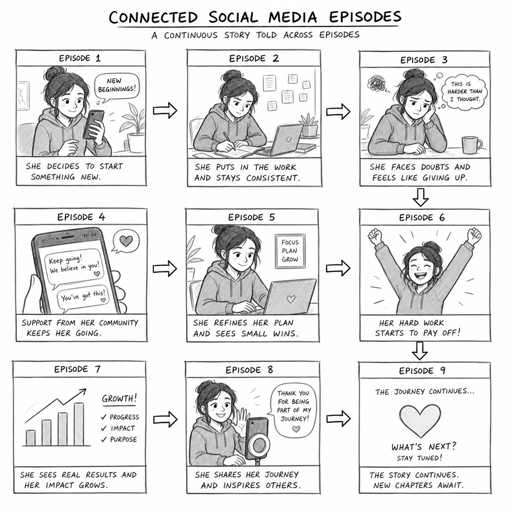
A single social post can earn a reaction, but episodic series content gives audiences a reason to return. By turning a topic, story, lesson, or campaign into connected series episodes, brands can build familiarity, deepen trust, and make content planning more intentional. Instead of starting from zero every time, a content series creates a repeatable structure that supports stronger storytelling and more consistent engagement.
Why does episodic content work better than one-off posting?
Episodic content works because it gives people context, continuity, and anticipation. A standalone post has to capture attention, deliver value, and be remembered all at once; a series can do that over time, with each installment building on the last. This makes serialized content especially useful for brands, creators, and teams that want to explain complex ideas, nurture an audience, or stay visible without relying on random inspiration.
The modern social feed moves quickly. One post may perform well and disappear within hours or days, while another may never reach the people it was meant for. Episodic series content helps solve that problem by creating recognizable patterns. When your audience knows what to expect, they are more likely to notice the next installment, follow the thread, and associate your brand with a specific point of view.
There is also a strategic benefit behind the scenes. A content series reduces the pressure to invent a completely new concept for every post. You still need fresh insights, but the format, theme, and purpose are already defined. That makes planning easier, improves consistency, and helps every post feel like part of a larger narrative rather than a disconnected update.
The shift from isolated posts to connected ideas
One-off social posts are not useless. They can announce news, react to trends, share quick tips, or test audience interest. The problem comes when a brand relies only on isolated posts and expects them to carry the entire weight of awareness, education, and conversion. Without connection, even good content can feel scattered.
Serialized content changes the role of each post. Instead of asking every piece to do everything, each installment can serve a specific purpose. One post can introduce the problem, another can show a common mistake, another can explain a better approach, and another can invite the audience to take action. The result is a more natural path from curiosity to understanding.
This is where episodic storytelling becomes powerful. People are wired to follow progression. A beginning, middle, and next step keeps attention alive because the audience senses movement. Even in short-form channels, an episodic narrative can make educational or promotional content feel less like a broadcast and more like an unfolding conversation.
What makes a strong content series?
A strong content series has a clear promise, a repeatable format, and enough depth to sustain multiple installments. It should not be a random group of posts with similar branding. The audience should understand why the series exists, what they will gain from following it, and how each episode connects to the larger idea.
The best series often start with a focused question or tension. For example, a marketing team might create a series around mistakes that weaken campaign performance. A consultant might create short series episodes that explain how to evaluate vendors. A product-led brand might use episodic series content to show different ways customers solve everyday problems.
Useful series usually include these elements:
- A defined theme: The series should revolve around one topic, problem, audience need, or point of view.
- A recognizable structure: Each installment should feel familiar, whether it uses a recurring hook, format, visual style, or narrative rhythm.
- A logical sequence: The order should matter, even if each episode can stand alone.
- A practical takeaway: Every episode should reward attention with an insight, example, prompt, or next step.
- A sustainable scope: The idea should be broad enough for multiple posts but focused enough to remain coherent.
A content series does not have to be complicated. In fact, simplicity often makes it stronger. If the audience can describe the series in one sentence, they are more likely to remember it and come back for the next part.
Episodic storytelling builds audience memory
Social media rewards attention, but brands grow through memory. A person may not be ready to buy, subscribe, inquire, or share the first time they see your content. Repeated exposure to a clear idea helps them understand what you stand for and why your perspective matters.
Episodic storytelling supports that memory by repeating key signals without repeating the exact same message. The audience sees a consistent theme from different angles. Over time, your content becomes easier to recognize, and recognition lowers the mental effort required to engage.
This is especially helpful for complex or high-consideration topics. A single post about a nuanced subject can feel too dense or too shallow. A series lets you break the idea into smaller parts while preserving the bigger picture. Instead of overwhelming the audience, you guide them step by step.
The format also creates momentum. When an episode ends with a clear next idea, the audience has a reason to continue. That anticipation is difficult to create with isolated posts because there is no implied continuation.
How should you plan serialized content?
Plan serialized content by starting with the audience’s journey, not the posting schedule. Decide what the audience needs to understand, believe, or do by the end of the series, then work backward into individual episodes. This keeps the series focused on progress instead of simply filling content slots.
Begin with a central promise. Ask what the series will help the audience accomplish or see differently. A vague promise such as “marketing tips” is harder to follow than a specific one such as “five ways to turn customer questions into stronger content.” The more precise the promise, the easier it becomes to shape each installment.
A simple planning process can look like this:
- Choose the core topic. Pick an idea that matters to your audience and supports your broader content goals.
- Define the end point. Decide what the audience should know, feel, or be ready to do after the final episode.
- Break the journey into stages. Turn the topic into a sequence of smaller ideas, objections, lessons, or examples.
- Assign a job to each episode. Make sure every installment has a purpose, such as clarifying a myth, showing a use case, or introducing a next step.
- Create a consistent format. Use recurring titles, visual cues, intros, or closing prompts so the series feels connected.
- Build in flexibility. Leave room to respond to comments, questions, or performance signals as the series unfolds.
Planning this way also makes repurposing easier. A longer article can become a short social series. A webinar can become several educational posts. A customer question can become a recurring segment. The key is to avoid treating each platform as a blank page.
Formats that work well for series episodes
Different types of series episodes serve different goals. Some are designed to educate, some to entertain, and some to move the audience closer to a decision. The right format depends on your topic, channel, and audience behavior.
Here are practical formats to consider:
- Myth versus reality: Useful for correcting misconceptions and building authority around a misunderstood topic.
- Step-by-step lessons: Ideal for teaching a process over several posts without overwhelming the audience.
- Before-and-after breakdowns: Helpful when you want to show transformation, improvement, or better decision-making.
- Common mistake series: Effective for drawing attention to pain points while offering constructive guidance.
- Behind-the-scenes episodes: Good for making a brand, team, or process feel more human and transparent.
- Question-led installments: Strong for addressing audience objections or search-driven topics in a direct way.
- Mini case breakdowns: Useful when you can discuss scenarios or patterns without inventing unsupported claims.
Not every episode needs the same length or depth, but the experience should feel connected. If the first post is highly practical and the second is purely promotional, the series may lose trust. A good rule is to make each installment valuable on its own while still pointing back to the larger arc.
One-off posts still have a role
Choosing episodic series content does not mean abandoning single posts. One-off content is useful for timely updates, quick observations, cultural moments, event reminders, or simple announcements. These posts can add variety and immediacy to a content calendar.
The better approach is to give each format a clear job. Use one-off posts for speed and responsiveness. Use serialized content for depth, education, positioning, and sustained engagement. When the two work together, your social presence feels both current and intentional.
A one-off post can also become the seed of a future series. If a quick tip gets strong engagement or sparks thoughtful comments, that may signal a topic worth expanding. In that sense, standalone content can act as a testing ground for larger episodic storytelling ideas.
Common mistakes to avoid
The biggest mistake is calling something a series when it has no real connection. A shared hashtag or similar design is not enough if the ideas do not build toward anything. Audiences can feel when a format is only cosmetic.
Another common issue is stretching a weak idea too far. Not every topic deserves ten installments. If the concept only supports three strong posts, make it a three-part series and stop while it still feels useful. Quality and clarity matter more than length.
Watch out for these problems:
- Starting without an arc: The series feels repetitive because there is no planned progression.
- Overloading each episode: Every post tries to explain too much, leaving no reason for the next installment.
- Ignoring audience response: Comments and questions are missed instead of shaping future episodes.
- Changing formats too often: The audience cannot recognize the series because each post looks and feels unrelated.
- Ending without direction: The final installment does not summarize the value or suggest a meaningful next step.
A series should create confidence, not confusion. If the audience understands where they are in the journey and why the next episode matters, the structure is doing its job.
Turning a content series into a repeatable habit
The most effective content systems are not built on occasional bursts of creativity. They are built on repeatable habits. Episodic content helps because it gives teams a framework they can return to again and again.
Start small. A three-part or five-part series is often enough to test the concept, learn from engagement, and refine the format. Once you know what resonates, you can create a second season, revisit the topic from a new angle, or turn audience questions into future episodes.
It also helps to document what works. Keep notes on hooks, formats, comments, saves, shares, and topics that generate conversation. Over time, these patterns can guide stronger editorial decisions and reduce guesswork.
The takeaway
One-off posts may capture a moment, but episodic series content builds a relationship with the audience over time. By using serialized content, brands and creators can turn scattered ideas into a more memorable, useful, and strategic experience.
A strong content series gives every post a purpose and every episode a place in the larger story. When the theme is clear, the structure is repeatable, and the value compounds, episodic storytelling becomes more than a content tactic. It becomes a smarter way to earn attention and keep it.